


This shift has driven growth. Parent company Amer Sports — which also owns Wilson and Arc’teryx, among others — reached revenues of $6.57 billion in 2025, a 26% year-on-year increase. Salomon was a standout, accounting for more than $2 billion in sales during fiscal 2025’s fourth quarter. For Q1 2026, Amer Sports grew 26% year-on-year to $1.95 billion, with growth in outdoor performance driven by Salomon’s soft goods (footwear, apparel, bags). For Q2, revenues reached $1.63 billion, up 30%, with Salomon’s soft goods carrying outdoor performance growth once again.
Salomon is pleased with the results and the effect of its fashion-ification, but is also keen to rebalance the image, growing across categories while bolstering the core in niche technical gear. For context, Salomon’s lifestyle range of footwear, known as Sportstyle, is growing fast — the bestselling XT-6 design became a meme-able byword for contemporary yuppies across the US and Europe — despite the brand’s small (low-single-digit) market shares in both global sneakers and the global running shoes. As for the niche markets of winter sports, outdoor footwear and trail running, Salomon has a double-digit share in each. So, what’s the plan?
One Salomon
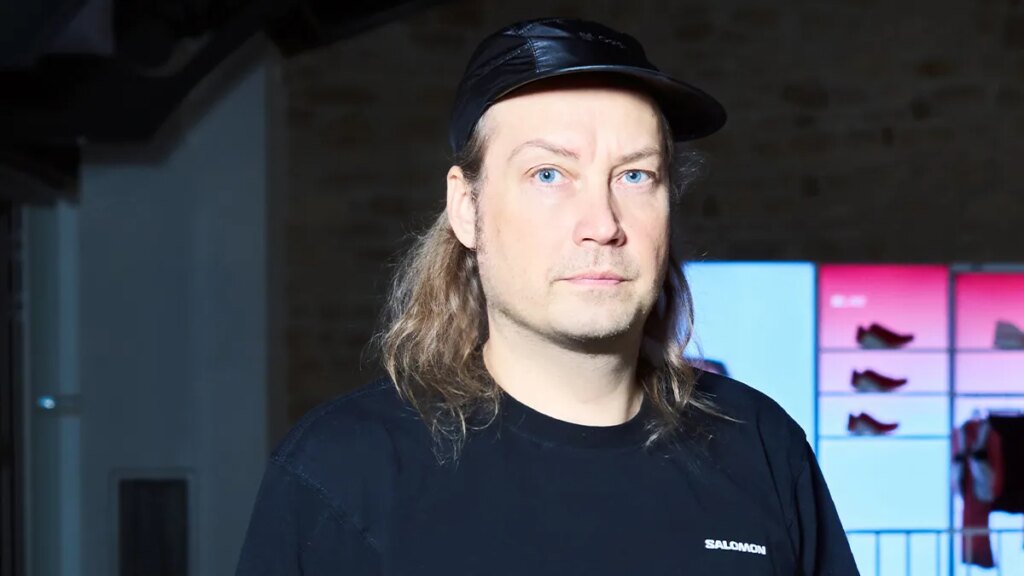
Continuing growth won’t be as simple as doubling down on the lifestyle strategy. Instead, Salonen and Meyzenq have focused on unifying the distinct wings of the business, a shift that’s been underway for a few years now. Before Salonen’s appointment, he worked as a consultant on the brand’s Advanced line — a more fashion-led offering inspired by the brand’s classic products. Even then, he questioned the siloing of fashion, lifestyle, and the original outdoors categories. “I think we can segment things differently [rather] than just having a sub-brand of a sub-brand of a sub-brand,” he says. “I think there’s great value in the idea of just being Salomon.”
Salonen goes as far to suggest that, perhaps, more fashion-led designs produced in-house should be scrapped entirely, reserving this wing for collaborations. In some ways, it goes back to the recognition that what enticed fashion brands to engage with Salomon in the first place was its technical excellence, not its fashion nous. His argument is that by innovating in the technical space, new icon designs come to the fore, and with time, they can eventually retire from the performance space and enter the lifestyle segment. “I think that’s what people expect from us — not just ticking the boxes that are already there, but inventing some other boxes to tick,” he explains.
To Salonen’s point, Salomon has made its name by specializing in technical geekery, producing everything from hydration vests and ski poles through to merino ski socks and — in years gone by — squirrel suits for ski-diving. “I think that’s the great thing about us. We are not shying away from being weird,” he says. With this comes risk, but in the long run, it will be essential to ensuring Salomon remains a best-in-class performance brand, not just a heritage label. His thinking? Salomon should play with consumers and trial products, rather than expecting immediate adoption.
Source link