
‘My Undesirable Friends: Part II — Exile’ Review: An Essential Doc
If part one of director Julia Loktev’s sprawling and essential 12-hour chronicle of journalism under fire concluded, like any good piece of serial storytelling, with a veritable cliffhanger, part two covers the long and painful aftermath following Russia’s full-scale invasion of Ukraine in February 2022.
By that point, we’ve come to know the handful of independent reporters — most of them women accused of being “foreign agents” by Putin’s government — whom Loktev documented during the tense months leading up to the war, showing how they held fast to their beliefs while their country began to crumble around them.
My Undesirable Friends: Part II — Exile
The Bottom Line
Life — and journalism — during wartime.
Venue: Venice Film Festival (Out of Competition)
Cast: Anna Nemzer, Valeria Ratnikova, Ksenia Mironova, Elena Kostyucheko, Yana Kuchina, Irina Dolinina, Alesya Marokhovskaya, Peter Ruzavin, Nataliya Gumenyuk, Sonya Groysman
Director, cinematographer: Julia Loktev
5 hours 56 minutes
In the second half of this epic study of persecution and resistance, we watch these courageous, resourceful young journos deal with forced exile, scattering across several countries and continents as the Russian state continues to pursue them for bogus offenses like spreading “fake news.” Given what they already dealt with back home, it’s no surprise they exhibit a fair amount of sangfroid and journalistic integrity as they wheel their carry-on luggage from one airport or Airbnb to another, trying to find a place to live and especially to work, which they continue to do while the conflict rages on.
Such persistence doesn’t, however, shield them from a deep sense of loss, loneliness, anxiety and especially guilt as the citizens of an oppressive, war-crime-committing superpower, even if they’re also being oppressed themselves. One of them sums up that sentiment early on by quoting a friend, who quips: “It’s like 1941 and you’re simultaneously the German and the Jew.” That Kafkaesque sense of never being fully safe, of never being at peace with oneself, hovers over much of My Undesirable Friends: Part II — Exile, though it also never stops these women from getting the truth out.
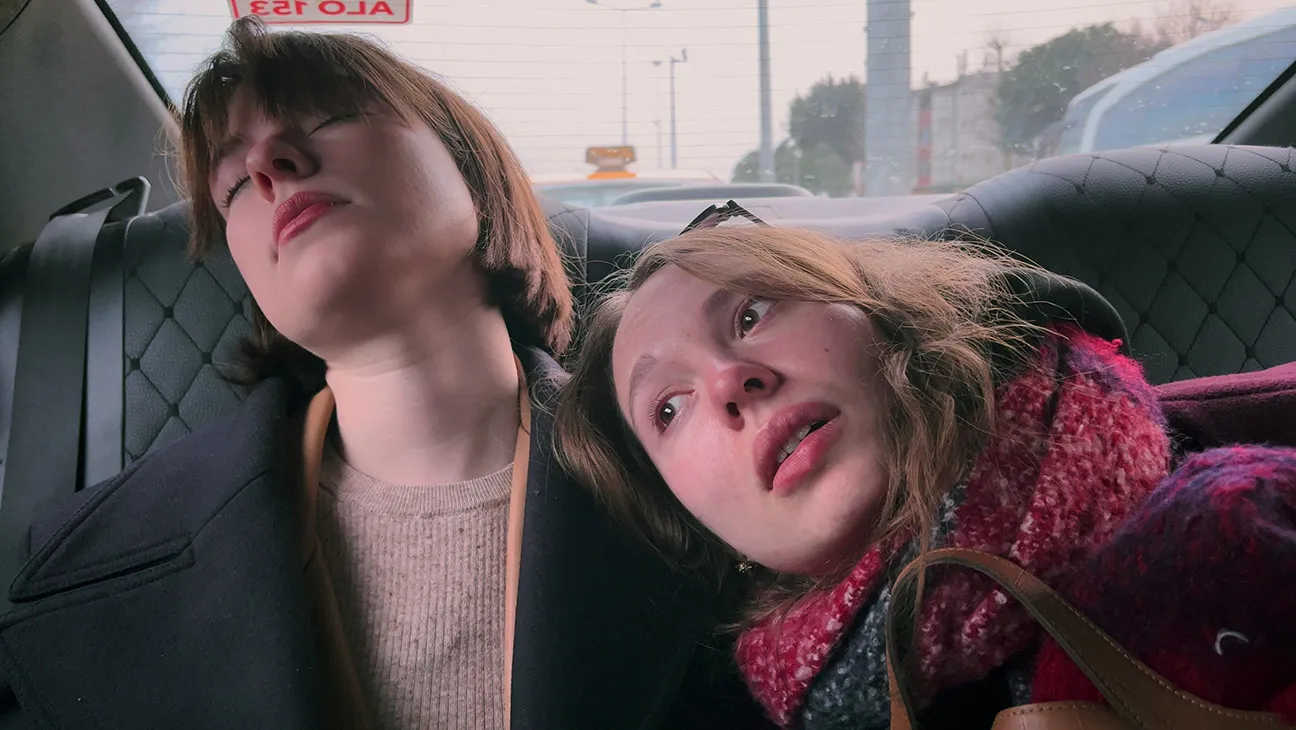
Divided into five chapters that stretch from the invasion until the spring of 2026, the doc stays glued to its reporters through thick and thin — clearly a logistical feat given how they constantly change locations after visas are granted or denied, newsrooms opened or shuttered, and the world as they once knew it is transformed into a continual state of precarity. “It’s like my life is totally in someone else’s hands,” comments Valeria Ratnikova, aka Lera, who’s only 23 when we first see her in a taxi in Istanbul alongside Ksenia Mironova, aka Ksysusha. (The loving Russian diminutives all the characters give each other underscore their sense of solidarity.)
Lera’s trajectory, which takes her from Russia to Turkey to Latvia and finally to the Netherlands, serves as something of a throughline in an ensemble piece that has nearly a dozen protagonists. As the youngest anchorwoman at the independent news station TV Rain, which shuts down in Moscow as soon as the war breaks out, Lera finds herself on the run along with her hardworking colleagues, all of whom are forced to pack their bags (or more like one bag) and rush to the airport before Putin tosses them in jail.
Trying to find their footing abroad while reporting on what’s happening in Ukraine, including the many atrocities committed in the early months of the conflict, the TV Rain team faces untold challenges to get the news out. Not only do they continue to be persecuted from afar — Lera will be convicted in absentia to seven and a half years in prison for working for an “undesirable organization” — but the channel nearly folds when a newscaster uses the term “our army” when referring to the war crimes committed by the Russian military, causing a scandal in their host country of Latvia and, eventually, the suspension of their broadcasting license.
The catch-22 situation the reporters all find themselves in — either stay in Russia and face prison, or flee abroad and face both personal exile and anti-Russian prejudice — is something they accept as par for the course, well aware that those dying in Ukraine do not have the luxury of that option. “Like it or not, the war is being waged in our name too,” one of them comments, taking responsibility as both a Russian citizen and an independent journalist who refuses to bow down to the Kremlin’s demands.
The reporter Peter Ruzavin takes his convictions a step further, joining his girlfriend, Ukrainian author and journalist Nataliya Gumenyuk (founder of the Public Interest Journalism Lab), in Kyiv. At first, he files articles and conducts a podcast about the frontlines, capturing the war from the inside. But at some point, he decides to sign up for the army himself (“It makes sense to fight for it,” he explains), working as a drone operator and eventually getting wounded, for which he receives a medal of honor.
Loktev, who shot the entire 12-hour doc herself, turns each reporter into the character of a real-life series unfolding before our eyes as the years go by and the war inevitably drags on. Framing her subjects in medium close-ups, she creates an intimacy that goes beyond the international crises and political upheavals to focus on the human costs of an unending conflict. The journos may all be hardworking and heroic; they’re also normal people trying to conduct their lives amid the chaos.
These obstacles are clearly faced by TV Rain reporter Anna Nemzer — a close friend of the director and the principal subject of part one — who’s forced to travel from city to city with her husband and young daughter in tow, until they finally settle down in New York. You can see the sheer exhaustion and frustration Anna faces as she tries to both do her job and be a good mother, all the while fleeing from one place to the next. If the experience allows her to focus on the essential (“Who do I love?” “Who am I?” “What is important to me?” she asks aloud), it winds up taking a toll on both Anna and her family.
Anna’s story is among several that Loktev and co-editor Michael Taylor weave together in chronological fashion, showing how each character evolves while facing one obstacle after another. These include the death of loved ones from afar, the risk of assassination by Putin’s minions in whatever country they’re living in, the impossibility of knowing where their next home or job will be, and the anger they face from both Russians (including many of their parents) and Ukrainians who see them as the enemy.
By the time My Undesirable Friends: Part II winds down, just a few months prior to the film’s premiere in Venice, the war seems to have no end in sight, leaving all the lives we’ve been watching permanently disrupted. And yet the reporters continue to press on, with one late segment featuring Ksysusha on location in Washington, D.C., interviewing Trump supporters on the day of his second inauguration. “I’m now in America and the same things are happening here,” she remarks, highlighting how none of us is truly safe from totalitarian oppression, wherever we wind up living. Or, as Lera concludes after being convicted and rendered a fugitive from justice in her homeland, when “the truth is a lie, and a lie is the truth,” some of us need to be brave enough to speak about it.
Source link

