


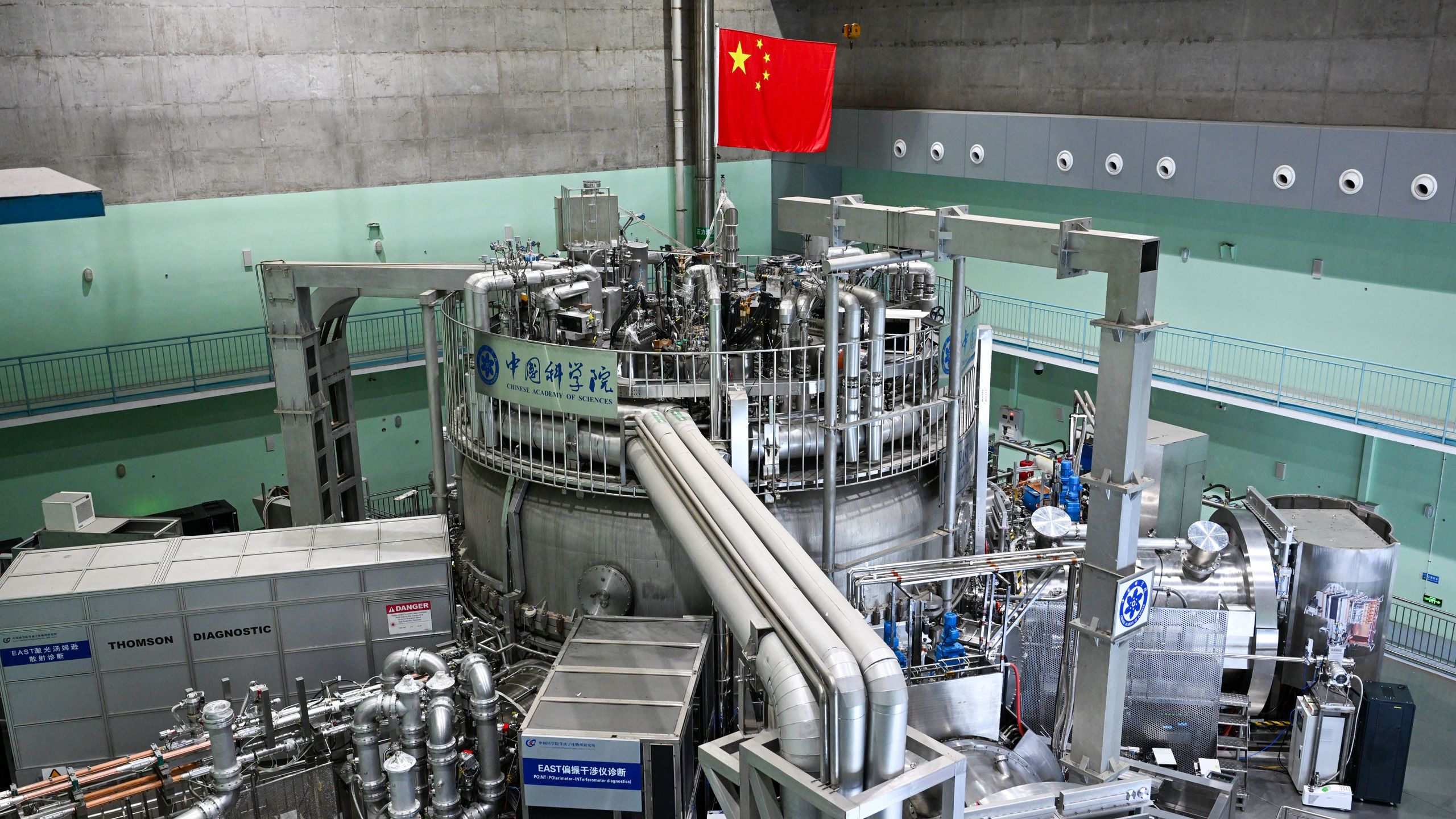
China’s fusion reactor, dubbed the “artificial sun,” has significantly surpassed the fusion limit by firing plasma beyond its normal operating range, advancing humanity’s slow progress toward near-limitless clean energy.
According to a statement released by the Chinese Academy of Sciences, the Advanced Superconducting Tokamak Experimental Device (EAST) has stabilized plasma, the high-energy fourth state of matter, at an extremely high density, which was seen as a major obstacle to nuclear fusion development.
you may like
Nuclear fusion offers nearly limitless clean energy possibilities. In other words, energy that does not contain much of the nuclear waste and climate-warming greenhouse gas emissions released by burning fossil fuels. The new discovery, published January 1 in the journal Science Advances, could bring our species a step closer to understanding this energy source, which some researchers say could be harnessed within decades.
But fusion technology has been in development for more than 70 years and is still very much an experimental science, as nuclear reactors typically consume more energy than they can produce. Meanwhile, climate scientists are now calling for deep cuts in greenhouse gas emissions, as the effects of climate change are already being felt around the world. So while nuclear fusion is unlikely to be a practical solution to the current climate crisis, it could potentially power the world in the future.
Fusion reactors are designed to fuse two lighter atoms into one heavier atom using heat and pressure. In doing so, it produces energy in the same way as the sun. But the sun has much higher pressures than Earth’s nuclear reactors, so scientists compensate by trapping hot plasma at temperatures much higher than the sun.
China’s EAST is a magnetic confinement reactor (tokamak) designed to burn plasma continuously for long periods of time. The reactor heats the plasma and uses a strong magnetic field to confine it inside a donut-shaped chamber. While tokamaks have not yet reached fusion ignition, the point at which the fusion process becomes self-sustaining, EAST reactors are increasing the amount of time they can maintain a stable, highly confined loop of plasma.
One hurdle for fusion researchers is a density limit called the Greenwald limit, beyond which plasmas typically become unstable. This limitation is problematic because higher plasma densities allow more atoms to collide with each other, lowering the energy cost of ignition, but also inhibiting fusion reactions due to instability.
To overcome the Greenwald limit, EAST scientists carefully managed the interaction of the reactor walls and plasma by controlling two key parameters during reactor startup: the initial fuel gas pressure and electron cyclotron resonance heating, or the frequency at which the electrons in the plasma absorb microwaves. According to the study, this kept the plasma stable at extreme densities ranging from 1.3 to 1.65 times the Greenwald limit. This is much higher than the normal operating range for tokamaks, which is 0.8x to 1x.
This is not the first time the Greenwald limit has been exceeded. For example, the U.S. Department of Energy’s DIII-D National Fusion Facility Tokamak in San Diego broke its limit in 2022, and in 2024, researchers at the University of Wisconsin-Madison (Wisconsin) announced that they had used experimental equipment to maintain stable tokamak plasma at about 10 times the Greenwald limit.
But with the destruction of EAST, researchers were for the first time able to heat the plasma to a previously theorized state called the “density-free region,” where the plasma remains stable even as its density increases. The study is based on a theory called plasma wall self-organization (PWSO), which proposes that density-free states may be possible if the interactions between the plasma and reactor walls are carefully balanced, according to the statement.
Advances in EAST and the United States will help develop new nuclear reactors. Both China and the United States are participating in the International Thermonuclear Experimental Reactor (ITER) program, a collaboration of dozens of countries to build the world’s largest tokamak in France.
ITER will be another experimental reactor designed to achieve sustained fusion for research purposes, but could pave the way for fusion power plants. The ITER reactor is expected to begin full-scale fusion reactions in 2039.