
Turning submarine cables into environmental monitoring systems
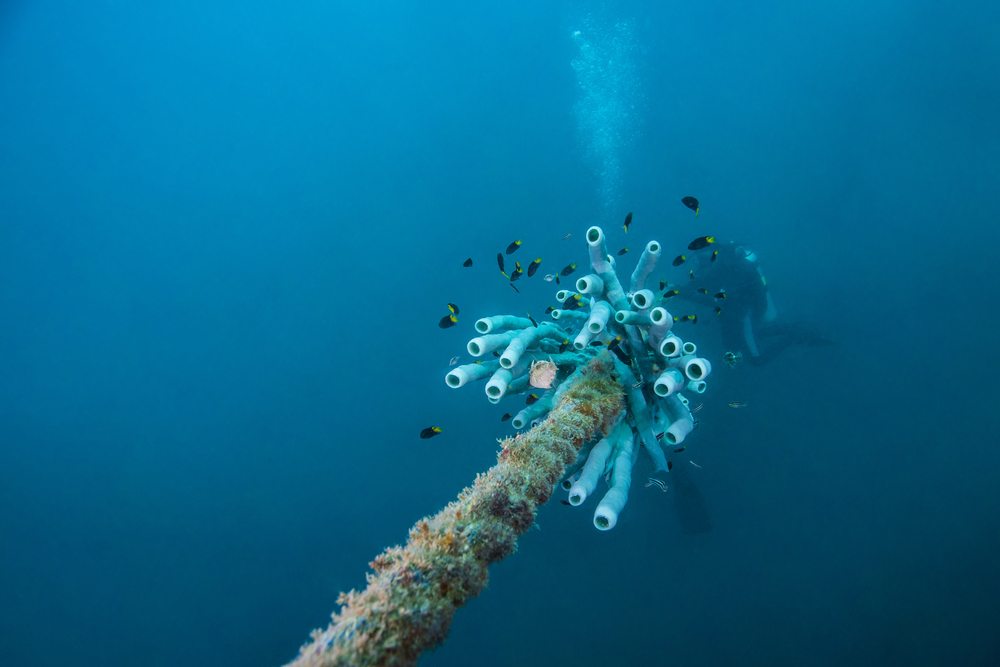
EU-funded researchers are studying how undersea communications cables can act as environmental and seismic sensors, which could be a game-changer for early warning systems.
Beneath the world’s oceans, a quiet revolution is underway. More than 1.48 million kilometers of undersea fiber optic cables carry nearly all of the world’s internet and phone traffic. Now, researchers have shown that these cables can do more than transmit data. They can also hear the voice of the earth.
By capturing small changes in the way light travels, these cables can detect changes in seafloor and water movement, vibrations, and temperature.
An EU-funded research initiative in the emerging field of fiber-optic seafloor sensing is developing technology that could turn the ocean floor into a vast real-time observatory. The findings should allow scientists to better monitor climate change, track tectonic activity, and improve tsunami and earthquake warnings.
Underwater Earth Observation Network
Approximately 70% of the Earth’s surface is covered by water, much of which is inaccessible to conventional seismic instruments.
“Satellite coverage of the ocean surface is excellent,” said Marc-Andre Goucher, a marine geoscientist at the Center for Earth and Ocean Research in Brest, France. “But at depth, where most earthquakes and tsunamis occur, very few have been directly observed.”
Thanks to research into how submarine cables can be repurposed as global sensing networks, this situation is starting to change.
Two complementary technologies dominate this field: distributed acoustic sensing (DAS) and Brillouin optical time-domain reflectometry (BOTDR).
Gatcher led a seven-year EU-funded research initiative called FOCUS, which ended in September 2025.
We investigated how these two techniques can detect deformations as small as 1 to 2 centimeters along active fault lines in the deep ocean.
To test the concept, the team installed a six-kilometre-long prototype cable on the ocean floor along the Northern Alfeo Fault off the coast of Catania, Sicily. The area is prone to seismic activity as it is near Mount Etna, Europe’s largest and most active volcano.
listen to the sounds of the ocean floor
In 1908, a magnitude 7.1 earthquake struck the Strait of Messina between Sicily and mainland Italy, triggering a devastating tsunami that killed more than 80,000 people in one of Europe’s deadliest natural disasters. The researchers’ aim is to more accurately assess the movement of undersea faults and help coastal communities prepare for similar events in the future.
Gatcher’s team collaborated with Italy’s National Institute of Nuclear Physics (INFN), which accepted an agreement to connect the prototype FOCUS cable to an existing undersea cable operating from an undersea observatory off the coast of Catania, Sicily.
The cable was designed in collaboration with IDIL, a French company specializing in fiber optic systems, and is similar to a regular communications cable, but contains special sensor fibers that are more sensitive to mechanical disturbances on the seabed.
It is only 9 millimeters thick and combines two types of optical fibers. One is a loosely buffered fiber similar to a communications cable, and the other is a firmer buffer that is sensitive to strain (mechanical deformation). The researchers used BOTDR to measure subtle changes in fiber length in response to crustal strain.
“Our main goal was to observe what happens before an earthquake and detect early deformations before sudden rupture occurs,” said Dr. Giovanni Barreca from the University of Catania.
Although no notable movements have been observed so far, this is also rich in suggestions. “This means that the fault is now locked and likely tectonic stress is building up,” Gatcher said. “When that stress is released, we’re going to watch.”
Sicilian cables have already proven their worth. In late 2020, it detected a huge undersea current that may have been caused by an undersea landslide. This is a type of “marine avalanche” that can travel hundreds of kilometers and sometimes cause tsunamis.
Although such phenomena are rarely observed, the fiber optic data captured their signature in detail. This creates opportunities to monitor and detect secondary hazards that can threaten coastal communities and critical undersea infrastructure.
From Sicily to the Caribbean
Meanwhile, the FOCUS team also investigated the potential of an underwater communication cable network to improve environmental monitoring.
Researchers used a local underwater cable network off the coast of the Caribbean island of Guadeloupe to monitor changes in seafloor water temperatures.
Initially, the team had to manually collect data from land-based fiber optic relay cabinets every few months. Now, thanks to a permanent setup, we can remotely monitor the cable every three hours.
Their measurements record how light is scattered within the cable. When the cable is disturbed, the tiny scratches in the fiber shift slightly, changing the light pattern. Scientists track these changes to understand what’s happening on the ocean floor.
“If something disturbs the cable, like pulling it, moving it, heating it or cooling it, we can measure that,” Gatcher explained.
While analyzing how optical signals change with temperature, they detected an increase of about 1.5 degrees Celsius over two years in shallow waters. This is consistent with measurements of sea surface temperatures made by satellites. At the same time, large-scale coral bleaching events occurred, reducing coral reefs by about 30%.
In the deep sea off the coast of Guadeloupe, at depths of 300 to 700 meters, the cable temperature increase is small, approximately 0.2 to 1°C.
These findings, which have just been accepted for publication (in Geophysical Research Letters), suggest that thousands of kilometers of communication cables could be used to monitor temperature changes in the deep ocean, adding a new dimension to weather measurements.
“While our initial focus was on tectonics, these measurements show how the same cable can track climate-related changes,” Gatcher said. “The potential for integrated environmental and hazard monitoring is huge.”
The technology could be extended to other earthquake-prone regions, such as Japan, the Cascadia region (along the Pacific coast of the United States), and other parts of the Mediterranean Sea.
While DAS systems can detect the initial seismic waves of an earthquake within seconds, BOTDR can track long-term strains that accumulate over time. DAS offers the possibility of immediate earthquake and tsunami warning, while BOTDR provides long-term monitoring of fault deformation, leading to potential applications in earthquake prediction.
“New secondary uses for fiber optic cables could lead to major advances in seismology and hazard warning,” Gatcher said. “We are effectively turning the world’s digital nervous system into an environmental system.”
With further collaboration and investment, the once nearly invisible ocean floor could become one of science’s most powerful tools for protecting life and understanding our changing planet.
The research for this article was funded by the European Research Council (ERC). The views of the interviewees do not necessarily reflect the views of the European Commission.
This article was originally published in Horizon, EU Research and Innovation Magazine.
Detailed information
Source link

