Close Menu
  • Home
  • Identity
  • Inventions
  • Future
  • Science
  • Startups
  • Spanish
What's Hot

‘Wasn’t built right from the start’ — Musk’s xAI starts all over again

AI mental illness lawyer warns of risk of mass casualties

Digg lays off staff and closes app as company reorganizes

Facebook X (Twitter) Instagram
  • Home
  • About Us
  • Advertise with Us
  • Contact Us
  • DMCA
  • Privacy Policy
  • Terms & Conditions
  • User-Submitted Posts
Facebook X (Twitter) Instagram
Fyself News
  • Home
  • Identity
  • Inventions
  • Future
  • Science
  • Startups
  • Spanish
Fyself News
Home » ‘It’s too big to imagine’: Scientists discover a monster black hole with winds blowing at more than 130 million miles per hour
Science

‘It’s too big to imagine’: Scientists discover a monster black hole with winds blowing at more than 130 million miles per hour

userBy userDecember 12, 2025No Comments2 Mins Read
Share Facebook Twitter Pinterest Telegram LinkedIn Tumblr Email Copy Link
Follow Us
Google News Flipboard
Share
Facebook Twitter LinkedIn Pinterest Email Copy Link

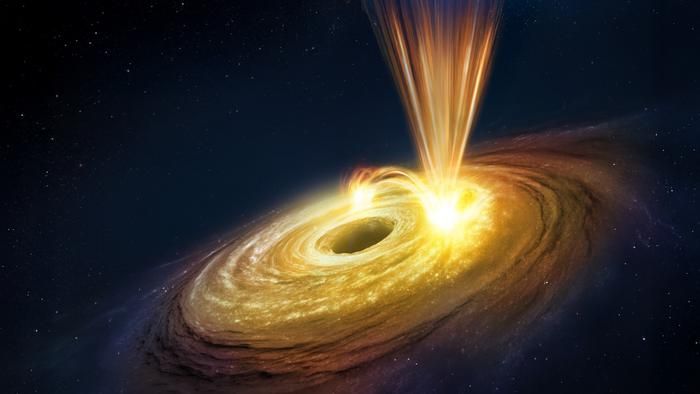
Astronomers have discovered a supermassive black hole that is whipping up cosmic winds at record speed.

The black hole, located 135 million light-years from Earth at the center of spiral galaxy NGC 3783, caught the attention of researchers after it emitted a huge X-ray flare. When the explosion subsided, winds roared at more than 37,000 miles per second (60,000 kilometers per second), one-fifth the speed of light.

“We have never seen a black hole generate winds at such speeds before,” Li Gu, an astronomer at the Netherlands Space Research Organization who led the study, said in a statement.

you may like

Gu and his colleagues were studying NGC 3783’s active galactic nucleus (AGN), a bright, crowded region surrounding the galaxy’s feeding supermassive black hole. These regions are known to burst into flames, spew out jets of material, and wind their way into space. The researchers believe that the intense X-ray bursts and subsequent strong winds they observed were caused by the black hole’s entangled magnetic field, which suddenly “untwisted”.

The researchers likened this process to Earth’s sun releasing a huge eruption of plasma, called a coronal mass ejection, shortly after a star’s magnetic field lines become entangled or broken. But in this case, the supermassive black hole has the mass of 30 million suns, making its flares and ejections “on an unimaginably large scale,” team member Matteo Guainazzi, an astronomer at the European Space Agency, said in a statement. (For reference, wind speeds from recent coronal mass ejections were a paltry 930 miles per second (1,500 km).)

The discovery was made using ESA’s XMM-Newton and XRISM X-ray space telescopes. Gu’s team used the two telescopes in tandem, tracking the initial flare with XMM-Newton’s optical monitor and analyzing the resulting winds with XRISM’s Resolve instrument. The researchers hope to take a similar collaborative approach to investigate other flare-type AGNs.

They also believe that studying AGN and the intense flares it produces could help further our understanding of how galaxies evolve.

Get the world’s most fascinating discoveries delivered straight to your inbox.

“They are so influential that learning more about the magnetism of AGNs and how they create these winds is key to understanding the history of galaxies,” Camille Diez, an astrophysicist and ESA fellow who participated in the study, said in a statement.

Scientists detailed their discovery in a paper published Dec. 9 in the journal Astronomy & Astrophysics.


Source link

#Biotechnology #ClimateScience #Health #Science #ScientificAdvances #ScientificResearch
Follow on Google News Follow on Flipboard
Share. Facebook Twitter Pinterest LinkedIn Tumblr Email Copy Link
Previous ArticleEU injects 623 million euros to boost German semiconductor manufacturing
Next Article NHS faces ‘worst-case scenario’ as super flu surges
user
  • Website

Related Posts

Children wearing bronze ‘warrior’ belts discovered in 2,500-year-old cemetery in Italy

March 12, 2026

Congo Basin’s ‘blackwater’ lakes and rivers are now releasing ancient carbon into the atmosphere

March 12, 2026

Scientists use ‘negative light’ to send secret messages hidden in heat

March 12, 2026
Add A Comment
Leave A Reply Cancel Reply

Latest Posts

‘Wasn’t built right from the start’ — Musk’s xAI starts all over again

AI mental illness lawyer warns of risk of mass casualties

Digg lays off staff and closes app as company reorganizes

Founded by father-son duo, Nyne provides AI agents with the human context they lack

Trending Posts

Subscribe to News

Subscribe to our newsletter and never miss our latest news

Please enable JavaScript in your browser to complete this form.
Loading

Welcome to Fyself News, your go-to platform for the latest in tech, startups, inventions, sustainability, and fintech! We are a passionate team of enthusiasts committed to bringing you timely, insightful, and accurate information on the most pressing developments across these industries. Whether you’re an entrepreneur, investor, or just someone curious about the future of technology and innovation, Fyself News has something for you.

Castilla-La Mancha Ignites Innovation: fiveclmsummit Redefines Tech Future

Local Power, Health Innovation: Alcolea de Calatrava Boosts FiveCLM PoC with Community Engagement

The Future of Digital Twins in Healthcare: From Virtual Replicas to Personalized Medical Models

Human Digital Twins: The Next Tech Frontier Set to Transform Healthcare and Beyond

Facebook X (Twitter) Instagram Pinterest YouTube
  • Home
  • About Us
  • Advertise with Us
  • Contact Us
  • DMCA
  • Privacy Policy
  • Terms & Conditions
  • User-Submitted Posts
© 2026 news.fyself. Designed by by fyself.

Type above and press Enter to search. Press Esc to cancel.