
PoET telescope makes first observation in exoplanet research
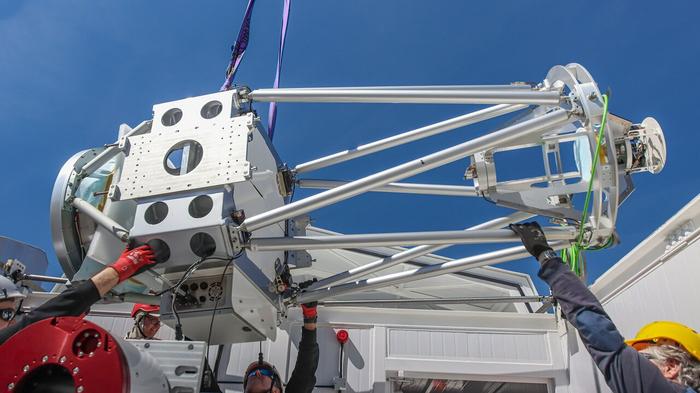
The Paranal Solar ESPRESSO Telescope (PoET) collects sunlight and redirects it to ESO’s ESPRESSO instrument to obtain highly detailed spectra of both the entire Sun and specific regions such as sunspots. These observations will be key to understanding the “noise” that similar features of other stars introduce into observations aimed at detecting surrounding exoplanets.
PoET, installed at the Paranal Site of the European Southern Observatory (ESO) in Chile, made its first observation. The telescope will work with ESO’s ESPRESSO instrument to study the Sun in detail. Dubbed the Solar Telescope for Planet Hunters, PoET aims to understand how changes in light from stars like the Sun can obscure the presence of planets orbiting them and help explore worlds beyond our solar system.
PoET’s main telescope, seen above, is lowered into the dome and has a 60 cm mirror. PoET also has a second, smaller telescope that collects light from the entire solar disk.
“One of the biggest challenges in detecting other Earths orbiting other Suns is the astrophysical ‘noise’ emanating from their host stars,” explains Nuno Santos, principal investigator at PoET, based at the Instituto de Astrofísica e Ciências do Espaço. [IA])) and Faculty of Science, University of Porto, Portugal. “PoET observations could be key to discovering and characterizing exoplanets that may currently be hidden in noise.”
Exoplanets are easily missed by other stars’ signals
Exoplanets, planets outside our solar system, are detected and studied primarily by observing the light from their host star, but often by observing small changes in the star’s spectrum (the division of light into its component colors or frequencies). But stellar activity can produce signals that drown out or mimic signals expected from orbiting planets.
Just as sunspots alter sunlight, the surface activity of other stars distorts spectra in ways that can be measured as “noise” with current exoplanet-hunting instruments. However, removing this noise from the spectra of distant stars is difficult. That’s because we don’t fully understand how star activity changes the light we observe. The solution is to learn from our nearest star, the Sun.
PoET’s design allows us to use the Sun to understand the spectra of distant stars.
It has a telescope with a mirror 60 centimeters in diameter that collects light from specific regions of the sun, such as individual sunspots, to examine signs of star activity. PoET also includes a small telescope that collects light from the entire visible surface of the Sun (the solar disk).
“We will be able to analyze very specific regions of the Sun in a way that has never been done before and at very high resolution,” said PoET co-principal investigator Alexandre Cabral, a researcher at the IA and the Faculty of Science of the University of Lisbon.
By observing both the solar disk and individual surface features simultaneously, astronomers can accurately determine how stellar activity changes the solar spectrum. This can be used as a guide to accurately filter out “noise” from distant stars that may harbor exoplanets.
To be able to reliably compare the Sun to distant solar-like stars, the researchers needed precision equipment designed for exoplanet research. “Espresso is the best equipment in the field, so it was an obvious choice,” says Santos.
Because ESPRESSO is a highly accurate, high-resolution spectrometer, it can detect small changes in a star’s spectrum, which can typically help find and characterize planets orbiting stars. ESPRESSO, the exoplanet instrument aboard ESO’s Very Large Telescope (VLT) that targets distant stars at night, will now be used alongside PoET to analyze the solar spectrum during the day.
“Having ESPRESSO function in this way is a huge advantage. By switching from nighttime VLT to daytime PoET, we maximize the usage of this instrument to help discover and characterize exoplanets,” said Alan Smet, ESO’s VLT operations staff astronomer and ESO’s PoET contact. “Thanks to the excellent location of Paranal Observatory, we expect that the number of days with suitable weather conditions for solar observations will be approximately the same as for nighttime observations.”
Initiatives in Europe and Chile
PoET successfully completed test observations in early April at ESO’s Paranal Observatory in Chile’s Atacama Desert, a process known as first light. Initial observations showed that the system operated within the requirements and was able to obtain spectra of both the entire solar disk and specific regions of it. Over the coming weeks, the team will test and optimize the system before starting scientific observations.
PoET was designed and developed in Portugal with funding from the European Research Council. [1]and a team of 12 Portuguese researchers were present to install and test the solar telescope. Some components of PoET, including the main telescope, were built in Italy, and the telescope dome was built by a Chilean company.
The project is currently being operated remotely from the Center for Astrophysics at the University of Porto in Portugal. PoET data analyzed by ESPRESSO will be made available to other scientists through the ESO Science Archive Facility.
Source link

