
DAMPE telescope reshapes our understanding of cosmic rays
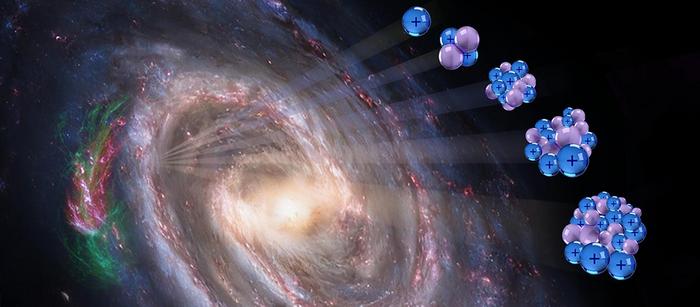
A multinational team of scientists working with the Dark Matter Particle Explorer (DAMPE) space telescope has discovered a consistent pattern of cosmic rays, providing new insights into their origin and behavior.
The study, which included experts from the University of Geneva, identified characteristics common to several types of high-energy particles. The results of this study were peer-reviewed and published in the journal Nature.
The research focuses on cosmic rays, which are high-energy particles that travel through space and sometimes hit Earth. Despite being discovered over a century ago, its exact origins remain unresolved.
By analyzing detailed measurements from the DAMPE satellite, researchers observed a phenomenon known as “spectral softening” that occurs consistently across different types of particles.
This result is important. This provides strong support for the theory that the acceleration and motion of cosmic rays depends not on energy per particle, but on a property called stiffness.
This narrows the range of viable explanations and represents a meaningful step toward understanding how these particles are produced and propagate through galaxies.
What are cosmic rays?
Cosmic rays are among the most energetic particles known in the universe. They are primarily composed of protons, but also contain heavier nuclei such as helium, carbon, oxygen, and iron.
These particles travel at speeds close to the speed of light and carry energy far exceeding that produced by man-made particle accelerators.
Scientists believe that cosmic rays originate from extreme astrophysical environments, such as supernova explosions, rapidly spinning neutron stars (pulsars), and jets emitted from black holes.
However, determining its exact source has proven difficult because of how magnetic fields bend their paths through space.
Understanding cosmic rays is critical because they provide indirect evidence about the most violent processes in the universe.
It also plays a role in shaping interstellar chemistry, can influence space weather, and has implications for the safety of satellites and astronauts.
DAMPE mission provides highly accurate data
The DAMPE satellite, launched in December 2015, was designed to study high-energy particles with unprecedented precision. One of its main goals is to investigate whether dark matter contributes to the production of cosmic rays.
This mission has benefited from significant contributions from the University of Geneva, in particular the Department of Nuclear and Particle Physics.
The Geneva team developed advanced artificial intelligence (AI) methods to reconstruct particle events and played a key role in the analysis of proton, helium and carbon data.
A key component of the satellite is the Silicon Tungsten Tracker (STK), a detector that allows precise measurements of particle trajectories and charges. This technique helped identify subtle patterns in cosmic ray data.
Discovery of universal characteristics
A central finding of this study is the identification of common behavior across all cosmic-ray nuclei investigated.
The researchers observed that once the stiffness exceeded a certain threshold of about 15 teraelectronvolts (TV), the number of particles decreased more rapidly than expected.
This effect, known as spectral softening, shows that the energy distribution of cosmic rays changes consistently, regardless of the particle type.
This pattern suggests a universal mechanism governing how these particles are accelerated and transported.
Importantly, this data rules out competing theories that favor energy per nucleon as the main factor. The statistical confidence in this conclusion is greater than 99.999%, making it one of the most robust results in this field to date.
Impact on astrophysical research
This discovery puts tighter constraints on theoretical models that describe the origin and propagation of cosmic rays.
This supports the idea that magnetic fields and particle stiffness play a dominant role in shaping particle behavior throughout the galaxy.
The discovery also improves our understanding of high-energy astrophysical sources and the interstellar medium through which these particles travel.
By improving existing models, researchers can better interpret future observations and design more targeted experiments.
Cosmic rays remain a complex puzzle, but the DAMPE mission provided an important piece. With the universal signature identified, the field moves closer to solving long-standing questions about where these particles come from and how they acquire such unusual energy.
Source link

