
PFAS-free training solution for lithium-ion battery fires
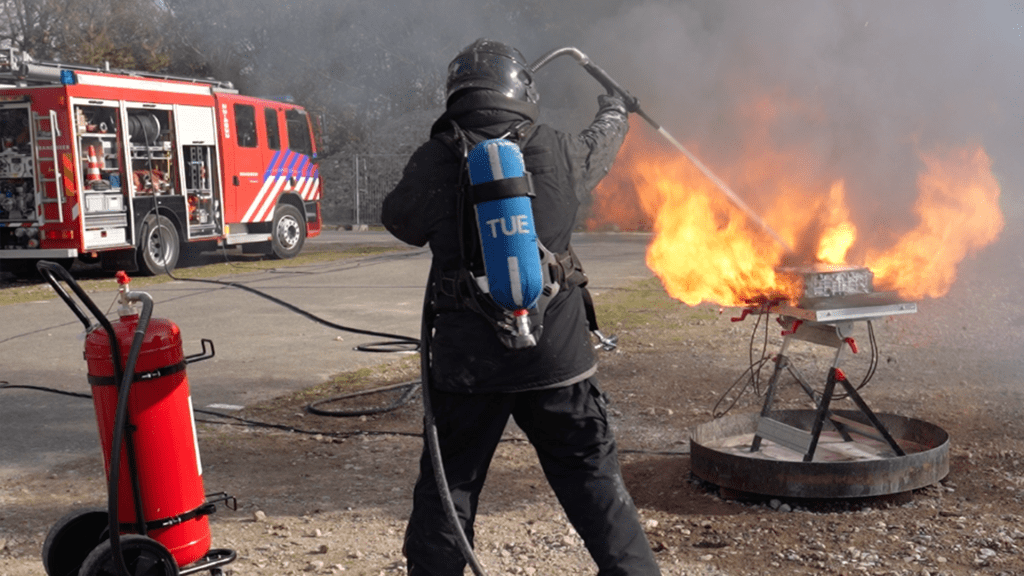
Anogas has developed a PFAS-free hydrogel technology for firefighting training, addressing the environmental and health risks associated with traditional fluorinated foams and providing realistic simulation of lithium-ion battery fires.
For decades, fire training ranges around the world have been heavily contaminated with PFAS due to the widespread use of firefighting foams containing PFAS, particularly aqueous film-forming foam (AFFF). During the exercise, large quantities of foam were repeatedly released directly into the open air without proper collection or containment systems. As a result, PFAS compounds seeped into soil and groundwater, causing long-term environmental pollution. PFAS substances are commonly referred to as “forever chemicals” because they rarely break down naturally.
Contamination of fire training ranges is a major environmental and public health concern. PFAS can travel through groundwater systems and contaminate drinking water sources, agricultural land, and surrounding ecosystems. Scientific studies have linked exposure to certain PFAS compounds to serious health risks, including immune system disruption, hormonal imbalances, liver damage, and certain types of cancer. These concerns have led governments and regulators around the world to increasingly limit or ban the use of fluorinated firefighting foams.
Anogas’ PFAS-free hydrogel technology
To address these environmental challenges, Anogas has developed a PFAS-free training extinguishing agent based on advanced hydrogel technology. This innovative fire extinguishing agent provides a sustainable alternative for realistic firefighting training without the environmental risks associated with traditional fluorinated foams. The hydrogel training agent is specifically designed for use in modern firefighting scenarios, including incidents involving lithium-ion batteries.
The increasing use of lithium-ion batteries in electric bicycles, electric vehicles, energy storage systems, and household appliances has increased the need for specialized firefighting training. Many people question whether lithium-ion battery fires can actually be extinguished, and whether it is safe to intervene at all. The dilemma is that fires in lithium-ion batteries can progress very quickly due to thermal runaway, leading to explosions, intense heat release, and the release of highly toxic gases. Immediate and effective intervention is often essential to prevent significant consequential damage to buildings, vehicles, and surrounding property.
The importance of realistic lithium-ion battery fire training
Responding safely and effectively to a lithium-ion battery incident requires specialized knowledge, tactical understanding, and practical skills that can only be acquired through realistic training. Traditional live-fire exercises using actual lithium-ion batteries are often too dangerous, unpredictable, and environmentally undesirable for routine firefighter training purposes.


To address this challenge, Anogas collaborated with Pyroworks to develop a safe and highly realistic lithium-ion battery fire simulation system. This simulation recreates a common real-world scenario where an e-bike battery experiences thermal runaway while charging in a residential environment. These types of incidents are occurring more and more frequently in homes, apartments, garages, bicycle storage facilities, etc.
A lithium-ion battery fire is simulated using a specially designed fire torch that is installed inside the e-bike’s battery module and ignited electrically. The system realistically reproduces the rupture of a battery case, followed by intense smoke and a rapidly developing jet flame, much like the behavior of a real thermal runaway event. This creates a highly realistic training environment where firefighters can safely experience the dynamics, risks, and progression of lithium-ion battery fires under controlled conditions.
Professional firefighting techniques training
This training system allows firefighters to practice critical operating procedures such as scene assessment, hazard recognition, safe approach techniques, ventilation strategies, cooling methods, firefighting tactics, and reignition prevention. Because this scenario closely simulates a real-life incident, firefighters gain valuable hands-on experience that improves their confidence, decision-making, and operational efficiency in real-life emergencies.
Extinguishing lithium-ion battery fires also requires special firefighting techniques that are significantly different from traditional firefighting. Anogas Hydrogel Training Extinguishing Agents allow you to realistically train and continually perfect these techniques. In the training module, the hydrogel extinguishing agent behaves the same way it would in a real lithium-ion battery fire. This allows firefighters to realistically observe cooling performance, adhesive properties, vapor suppression, and firefighting behavior while operating in a safe training environment.
Reduce fear and limit damage
This innovative training method also helps reduce fear and anxiety surrounding lithium-ion battery fires and their potential effects. It is important to remember that approximately 80% of initial fires can be extinguished with the correct use of portable fire extinguishing equipment. By providing realistic training and hands-on experience for firefighters and first responders, they will be better prepared to act quickly and effectively in the early stages of a lithium-ion battery fire.
Prompt and appropriate intervention, supported by appropriate training, can significantly reduce the impact, spread, and damage associated with emerging lithium-ion battery incidents. Early recognition and immediate response are essential to prevent a small battery failure from turning into a major fire or explosion.
The importance of detection and personal protection
In addition to selecting the appropriate extinguishing agent, proper personal safety equipment and early fire detection are essential when dealing with a lithium-ion battery fire. A lithium-ion battery fire can release highly toxic and dangerous gases, so a suitable gas mask or respiratory protection system is required. Additionally, smoke detectors play a critical role in the early detection of thermal runaway incidents, providing valuable time for evacuation and rapid intervention.
A combination of early detection, appropriate personal protective equipment, and effective fire suppression techniques greatly increases the likelihood that an incipient lithium-ion battery fire can be safely controlled before it escalates into a serious incident.
Sustainable and future-proof training solutions
The combination of an advanced lithium-ion battery fire simulator and a PFAS-free hydrogel extinguishing agent provides a unique, environmentally friendly solution to modern firefighter training. Firefighters can now realistically train for one of the fastest growing fire risks in today’s society while avoiding the environmental contamination associated with traditional PFAS-containing firefighting foams.
By combining safety, realism, sustainability, and innovation, Anogas and Pyroworks provide fire organizations with a future-proof training solution to prepare emergency responders for the challenges of lithium-ion battery incidents in a responsible and effective manner.
Please note: This is a commercial profile
This article will be published in an upcoming PFAS Special Focus Publication.
Source link

