
“Stopping Was Not the Answer”: Fashion Week in a Political Crisis
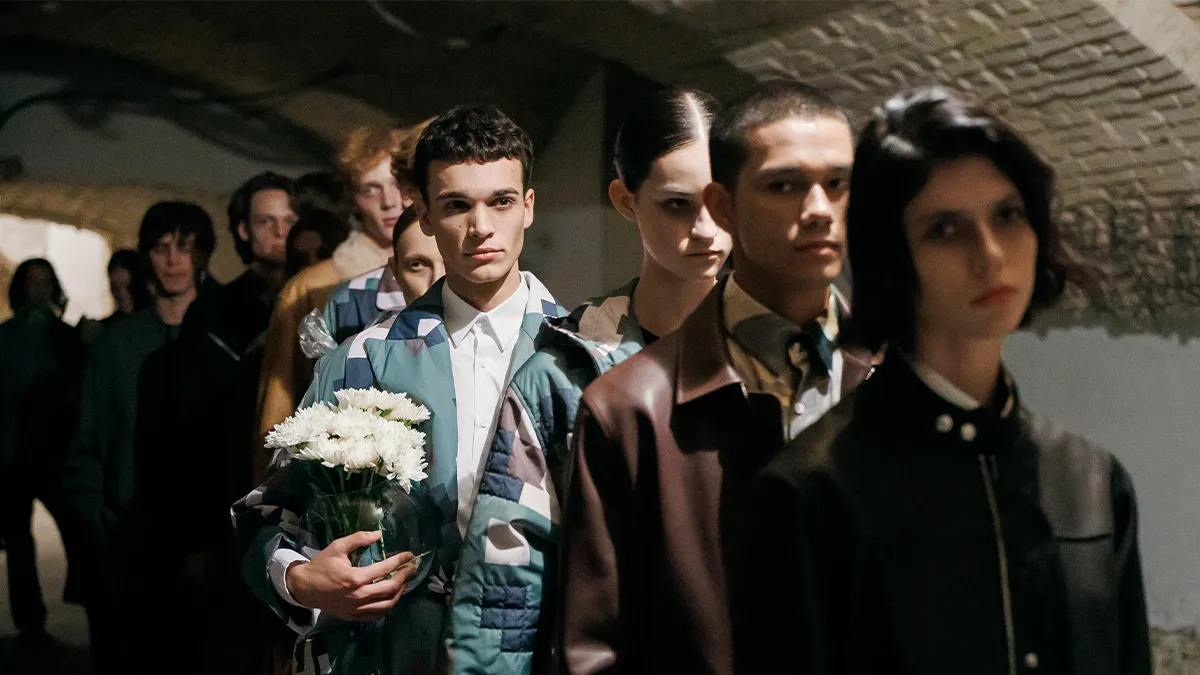
Just days before Ukrainian Fashion Week Spring/Summer 2027 began, Russian air strikes intensified on the city of Kyiv. The schedule, which ran from September 2-6, continued with strict safety protocols. Any time an air raid alert sounded, events were suspended immediately as guests, designers, and teams took shelter. Three shows — Viktor Anisimov, Darja Donezz, and Vorozhbyt & Zemskova — took place inside allocated bomb shelters near their venues. Five alerts sounded during a business conference, with guests and speakers leaving and returning after the all-clear, each time. Heroically, 50 brands managed to show against the odds.
“We all live and work within the same reality, and there is a strong shared understanding of the context,” says Iryna Danylevska, founder of Ukrainian Fashion Week. “Nevertheless, of the five wartime seasons we’ve held in Ukraine, this 59th season was by far the most demanding, while also becoming truly historic — both for the Ukrainian fashion industry and in the broader context of the global fashion week experience.”
Since 1997, Ukrainian Fashion Week has been a platform for the development and international visibility of Ukrainian fashion, says CEO Yelyzaveta Ushcheka. “For us, it’s essential to [maintain] that platform despite every challenge.”
It’s a brave and risky move, but Ushcheka is not alone. From Georgia to Dubai, designers, business owners, and founders are clubbing together to produce or engage in fashion weeks outside the big four, amid conflict or hostility. Meanwhile, some pioneers have developed satellite events, such as the UA in UK fashion show, to showcase Ukrainian fashion on a global stage.
The ripple effect
The Russian invasion has impacted other fashion cities, too. Back in May, 11 shows, three exhibitions, and a tight program of concerts, dinners and a drag ball took place as part of Mercedes-Benz Fashion Week (MBFW) Tbilisi FW26 — all within an increasingly volatile and socially conservative climate that threw the Georgian fashion industry into disarray.
Following Russia’s invasion of Ukraine, pro-Russia populist party, Georgian Dream, has ruled Georgia, making international headlines in 2024 for its anti-LGBTQ+ legislation prohibiting gender transition and queer “propaganda”. As Vogue Business reported, this has impacted the fashion sector creatively and financially, culminating in a mass exodus of design talent. “Lots of queer designers left Georgia because of the danger. So many Georgian designers are 1789712921 refugees or have chosen a different career,” says Matt Shally, the stylist behind God Era’s FW26 show and one of the drag ball’s original organizers.

Source link

