
‘Cameron Winter at Carnegie Hall’ Review: Paul Thomas Anderson’s Doc
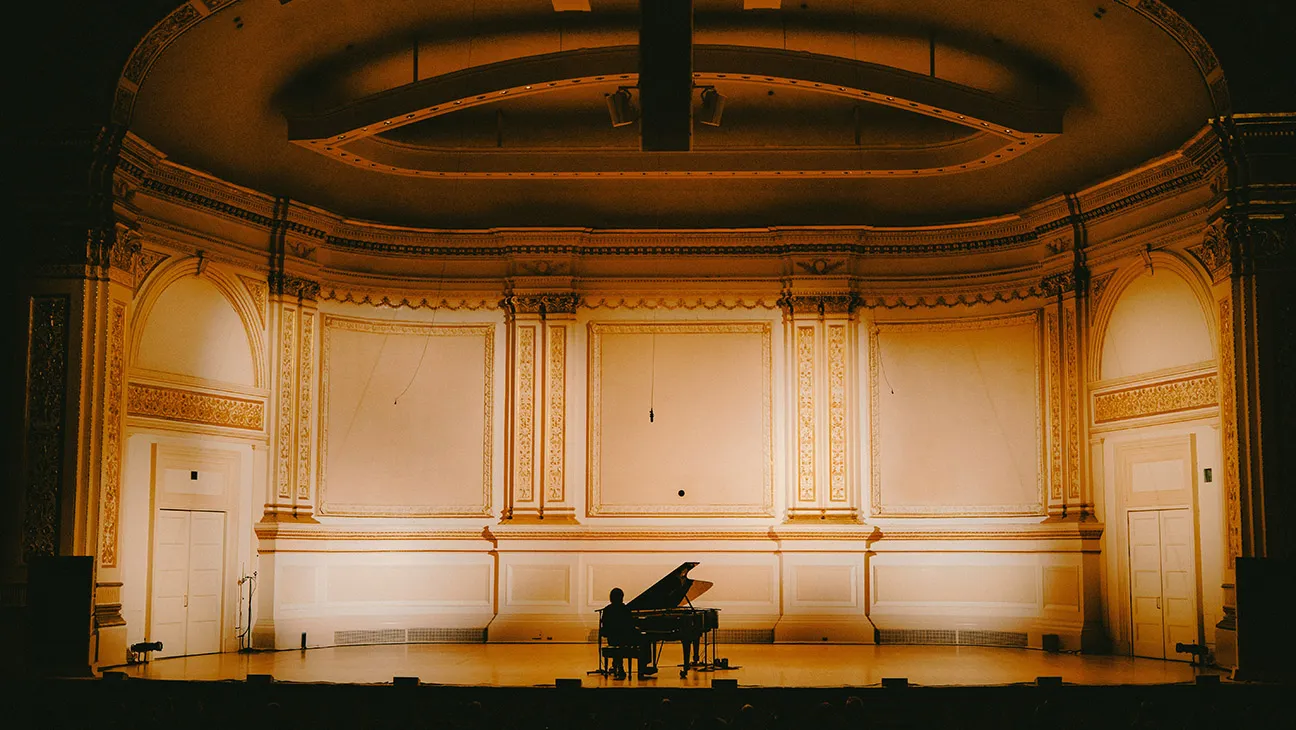
Concerts, and concert films, don’t come much starker than Cameron Winter at Carnegie Hall. Oscar-winning director Paul Thomas Anderson offers an unusual follow-up to his Oscar-winning One Battle After Another with this 72-minute effort chronicling a solo concert by the Geese frontman in December, 2025, at New York City’s legendary concert venue. Receiving its world premiere at the New York Film Festival, the movie will be receiving roadshow-type engagements around the country with 35mm projection.
Winter, only 23 years old at the time of filming, is very much in the Miles Davis mode of performers. Delivering his stripped-down set of songs, many of them taken from his acclaimed debut solo album Heavy Metal, while accompanying himself on a Steinway grand piano, he sits in near-darkness with his back mostly to the audience. Stage patter is virtually non-existent, and when he walks away from the piano briefly, seemingly in search of a stage exit, it produces one of the few laughs of the evening. You can feel the relief of the audience being given a break from the overall somberness.
Cameron Winter at Carnegie Hall
The Bottom Line
Beautifully done, though not for all tastes.
Venue: New York Film Festival (Spotlight)
Director: Paul Thomas Anderson
1 hour 12 minutes
Nonetheless, he’s an arresting performer, singing in a haunting baritone with occasional flourishes of falsetto and seemingly lost in a meditative trance. His songs — featuring such titles as “Cancer of the Skull,” “Take It With You” and “If You Turn Back Now” — aren’t exactly easy listening, and their lyrics, referencing such figures as the Devil, Jesus, God, and the Rolling Stones’ Brian Jones, are even darker.
That is, when you can discern their meaning, as they tend toward the elliptical — although there’s no mistaking the message in “Vines” when he sings, “I feel loneliest when I’m with you.” Indeed, he seems to relish the vitriol in his song “Take It With You” with the lyric, “I found a keepsake of you by the window in the kitchen, babe/Take it with you when you leave.” His style, reminiscent of Nick Cave, is incantatory, and the result is that the not-especially-melodic songs tend to bleed into each other with a sameness that ultimately proves monotonous.
Anderson matches his subject’s reticence with a similarly spartan approach. Other than a brief opening montage in which we see eager audience members having their tickets scanned upon entering, the film consists simply of the concert from beginning to end. The end credits are featured at the close of the show, followed by an encore song and a title graphic proclaiming Winter to be “Dead at 23,” as if jokingly hinting at his already seemingly mythical status at such a young age.
The movie certainly allows a better view of Winter than the one that was afforded the live audience, since Anderson provides plenty of close-ups of the singer in all his art cabaret-style intensity, even if the shadowy lighting often obscures his features. Performing instrumental passages, the singer often lowers his head so much that his forehead nearly touches the piano keys. Although the cinematography is largely straightforward, Anderson occasionally mixes it up with shots taken from various parts of the auditorium, including the rear of the stage and the ceiling. At one point, we watch from the POV of someone walking down the aisle toward the stage, the camera bouncing up and down in his hand. Later, there’s a jarring cut from Winter to the perspective of a camera entering the stage area through opened doors, as if desiring to make its presence known. During one number, we see an image of Winter’s shadow on one of the venue’s walls.
It’s all very arty and self-conscious, but undeniably effective. Like most good concert films, Cameron Winter at Carnegie Hall makes you feel as if you were actually at the show but provides an even better aesthetic experience.
Source link

