
Drew Henry Steps Into the Limelight With His Courrèges Debut
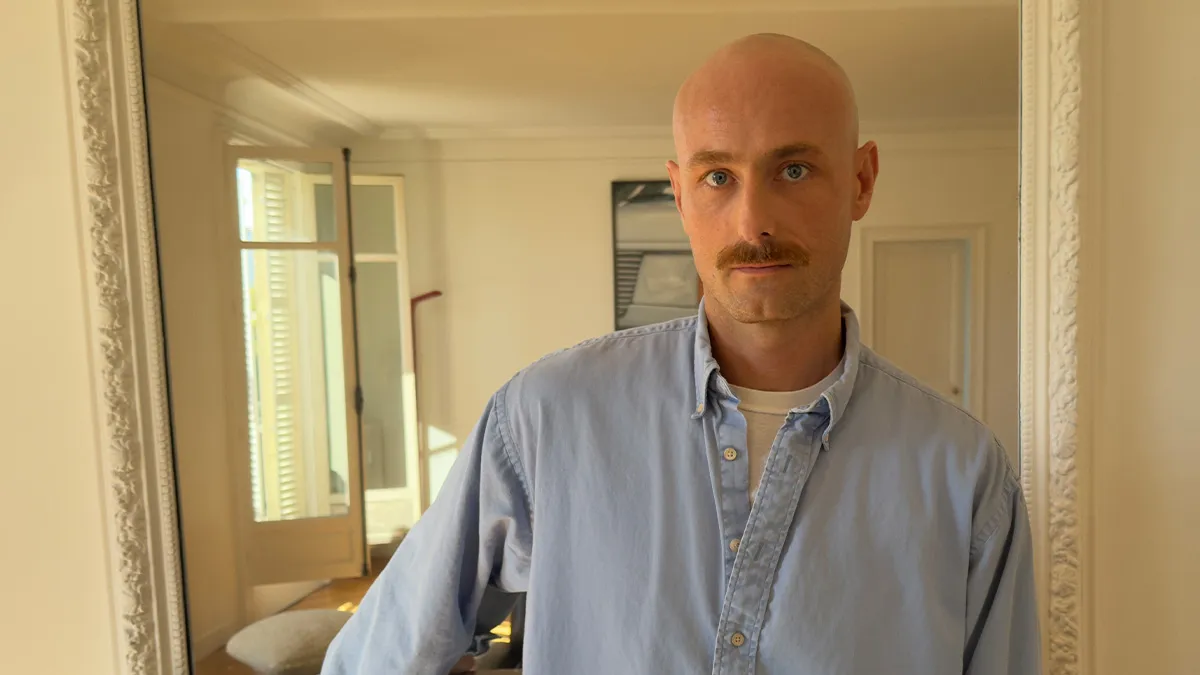
At 20, he moved to London to study at Central Saint Martins, enrolling on the BA Fashion Design and Marketing course in 2008 before continuing on to the MA. He graduated in 2014 under Louise Wilson. Grace Wales Bonner and Daniel Lee were also studying at Central Saint Martins around that time.
What drew Drew to Courrèges? (Yes, we had to make the pun.) “I have always had references from the house in mind. Diving into the archives, I was struck by how colorful this brand is. Its soul is something optimistic. There’s so much joy, playfulness, but also a strong sense of sentimentality. People come up to me and tell me that their mother got married in Courrèges,” he says. “What also excites me about Courrèges is the size of the house. There’s a real sense of intimacy, and I feel there’s an incredible opportunity to grow.”
Courrèges is part of Artémis, the Pinault family’s holding company, which controls Kering. Artémis took a minority stake in Courrèges in 2014 and became its majority shareholder in 2018. Its portfolio includes the renowned Hollywood talent agency CAA and global auction house Christie’s. It sold its majority stake in Giambattista Valli to the designer in May.
After years of creative instability, Courrèges started regaining momentum in 2021 under Nicolas Di Felice, alongside former CEO Adrien Da Maia and current CEO Marie Leblanc, who previously served as CEO of Victoria Beckham. Di Felice’s re-edition of the iconic vinyl mini skirts and jackets was an instant success, while his figure-hugging clubwear and boot-cut jeans cemented his reputation for a bold, distinctive style. During his tenure, the brand opened a flurry of stores. Today, the brand has nine boutiques and concessions, including five in Paris, two in South Korea, and two in the US, plus roughly 200 points of sale worldwide. Still, Courrèges is not immune to the broader challenges facing the luxury sector.
Where does Henry position himself between aesthetic continuity and disruption? “I think there’s something modern about being between the two,” he says.
Like Di Felice, Henry also immersed himself fully in the archives, but drew out different facets: where Di Felice initially focused on the minimalist side of late-’60s Space Age, Henry says he’s been exploring the more colorful side of the very early ’60s. (As I walked through the showroom adjoining his office, I caught sight of archive pieces in vivid orange, bubblegum pink, and mimosa yellow.)
Asked about the key silhouettes of his SS27 collection, Henry replies: “I wouldn’t say there are any key silhouettes. It’s more about playing with knitwear and color, and seeing where that takes us.”
The few photographs displayed on the walls are all images he took himself. Photography is an integral part of his creative process. “I’m a very visual person. I need that visual impact, so my process starts with photography. I take my own photographs and build from there,” he explains.
One photograph shows his friend and model, Daniela, from behind, wearing navy blue flared pants from the archives, featuring the brand’s AC logo — short for “André and Coqueline” — paired with a navy blue jumper he designed. Another image captures the Courrèges logo from 1967, which he chose to revive. Another photograph shows the white Courrèges biker pants from 1977, inspired by Formula 1, with the word “Paris” printed across the back. A look inspired by that photograph could very well make its way onto the runway on Wednesday, in a different fabric.
Source link

