
Ex-U.S. defense secretary Esper: No end in sight for the Iran war
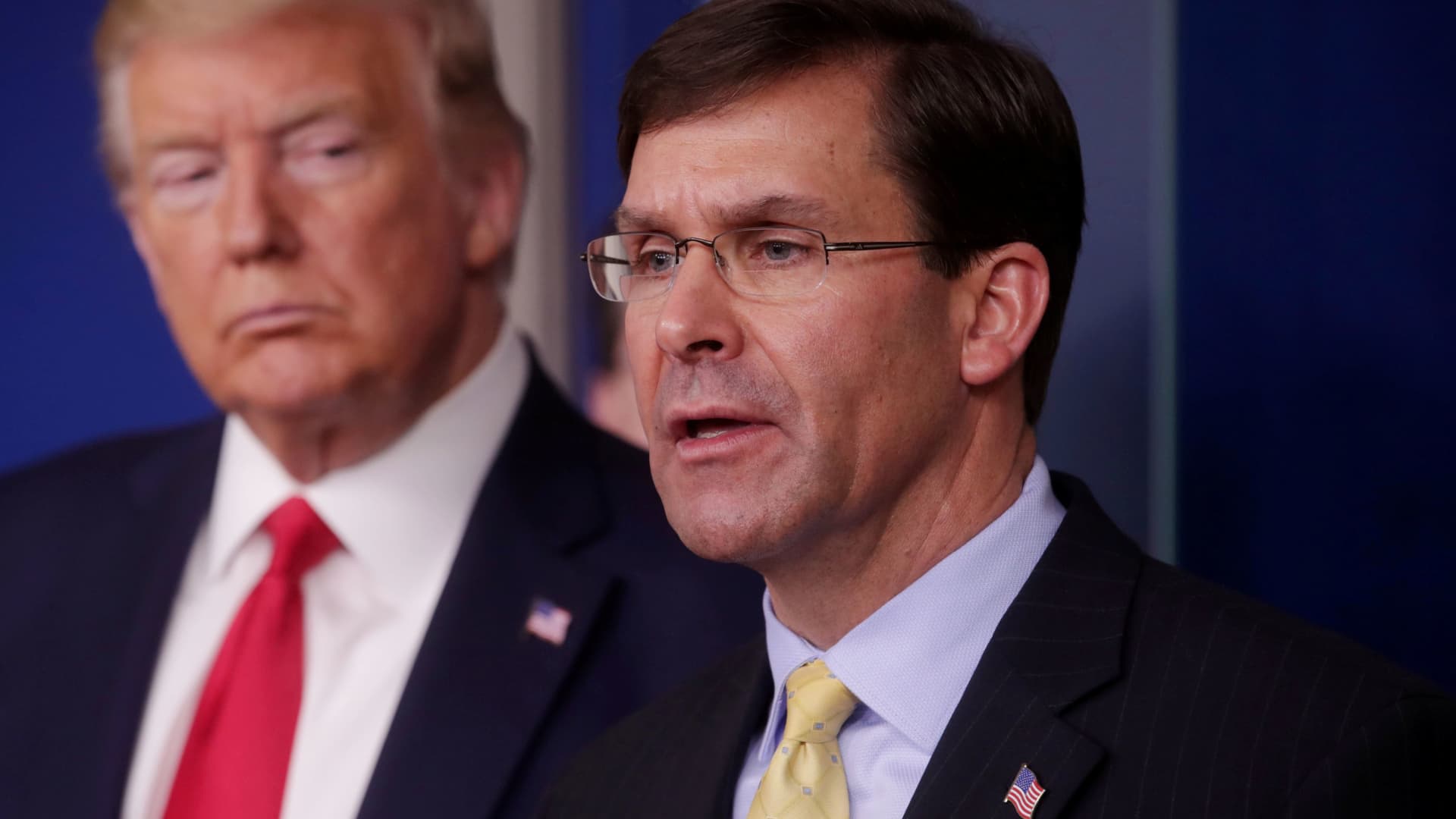
President Donald Trump listens to Secretary of Defense Mark Esper address the daily White House coronavirus response briefing with members of the administration’s coronavirus task force at the White House in Washington, March 18, 2020.
Jonathan Ernst | Reuters
The U.S.-Iran war could drag on for years, putting America at risk of overlooking China’s rise to power, according to President Donald Trump’s former defense secretary.
During a panel discussion at LSEG and Eurasia Group’s GZERO Summit in London, Mark Esper said on Thursday he saw the conflict continuing “well into 2027,” with a possibility that it could be handed to the next U.S. administration in three years’ time.
“At some point, we will reach a point where maybe both sides are willing to come to the table and find a negotiated settlement, but the challenge for president Trump will be he’s going to have to get a deal that returns the Strait of Hormuz to the status quo, which is going to be really hard, and is a deal that’s better than what [former President Barack Obama] got out of the JCPOA, and I think that’s going to be very difficult too,” he said.
“So the question is, will he be willing to make that deal and live with the consequences or how the critics judge that deal? And so you can see another path where it gets handed off to the next administration in 2029.”
Speaking to CNBC on the sidelines of the event, Esper said he does not see an end to the war “in the foreseeable future.”
Islamic Revolutionary Guard Corps (IRGC) servicemen stand in front of an Iranian national flag at Iran’s first military training base for ”self-sacrificing” forces in southern Tehran, Iran, on September 24, 2026.
Morteza Nikoubazl | Nurphoto | Getty Images
“I think it continues at this type of pace where we see the American blockade continue, we see occasional outbursts from either side, and it drags along,” he said.
The war, now in its eighth month, has reached an impasse, with Trump saying Wednesday that making a deal with Tehran “isn’t really something that I want to do.” According to reports, U.S. officials are considering a resumption of large-scale military operations in the coming weeks.
Esper, who served as U.S. Secretary of Defense during Trump’s first presidential term from July 2019 to November 2020, said he had long been an advocate for “the economic strangulation” of Iran. But he said such a policy was vulnerable to impatience in Washington.
“The challenge is that policy requires time, discipline and patience, and those aren’t things that the states are typically good at doing,” he said. “So, if allowed to, I think it could have an impact. It doesn’t mean it’ll actually bring them back to the table, which would be my end, but it’s the least worst option at this point in time.”
Over the summer, Trump announced an intensification of sanctions and economic restrictions on Iran, a strategy he labeled “Economic D-Day.” The administration has since touted the success of its economic warfare strategies.
A White House official told CNBC Thursday that the U.S. was in “a very strong position with control of the Strait of Hormuz and the Iranian economy collapsing.”
“Iran has been decimated, and things will go one of two ways; the easy way or the hard way,” they said.
“President Trump will not be played by the Iranian regime,” the official added. “The President is satisfied letting the inevitable Iranian collapse play out.”
Advantage China
But Esper warned Thursday that with attention in Washington focused on the Iran war, America’s “greatest adversary” was building up its capabilities.
“China is our greatest adversary,” he said. “It’s the lurking threat out there that we’re not paying attention to because we’re so focused, and have been for 20 plus years now, on the Middle East, and Europe is focused on Russia.”
Beijing, he said, was continuing to build economic, technological and diplomatic power, having executed “the largest military buildup in history.”
“We’re just not paying enough attention to the Chinese,” Esper told CNBC. “They’ve told us by 2049 they want to dominate the Indo-Pacific region and the world for all intents and purposes. They want to be able to call the shots and dictate global governance.”
China had been working to this end for at least 30 years, he said.
“Certainly, since their entry into the WTO, they’ve used the world trading system against us to build their own economic and military power, and they have a game plan,” Esper said.
He highlighted Beijing’s domination of certain industries and goods, such as electric vehicles, rare earths, solar panels and critical materials. This, he said, had been achieved thanks to the Chinese government’s ability to “consolidate control” and direct the country’s economy in a certain direction.
“They have a game plan, and they’re and they’re executing it,” Esper said.
“I would focus our efforts on China, and I would do it in partnership with our European and Asian allies, and that would include not just military [alliances], but diplomatic, economic and technological as well.”
CNBC reached out to the Chinese government for comment.
Source link

