
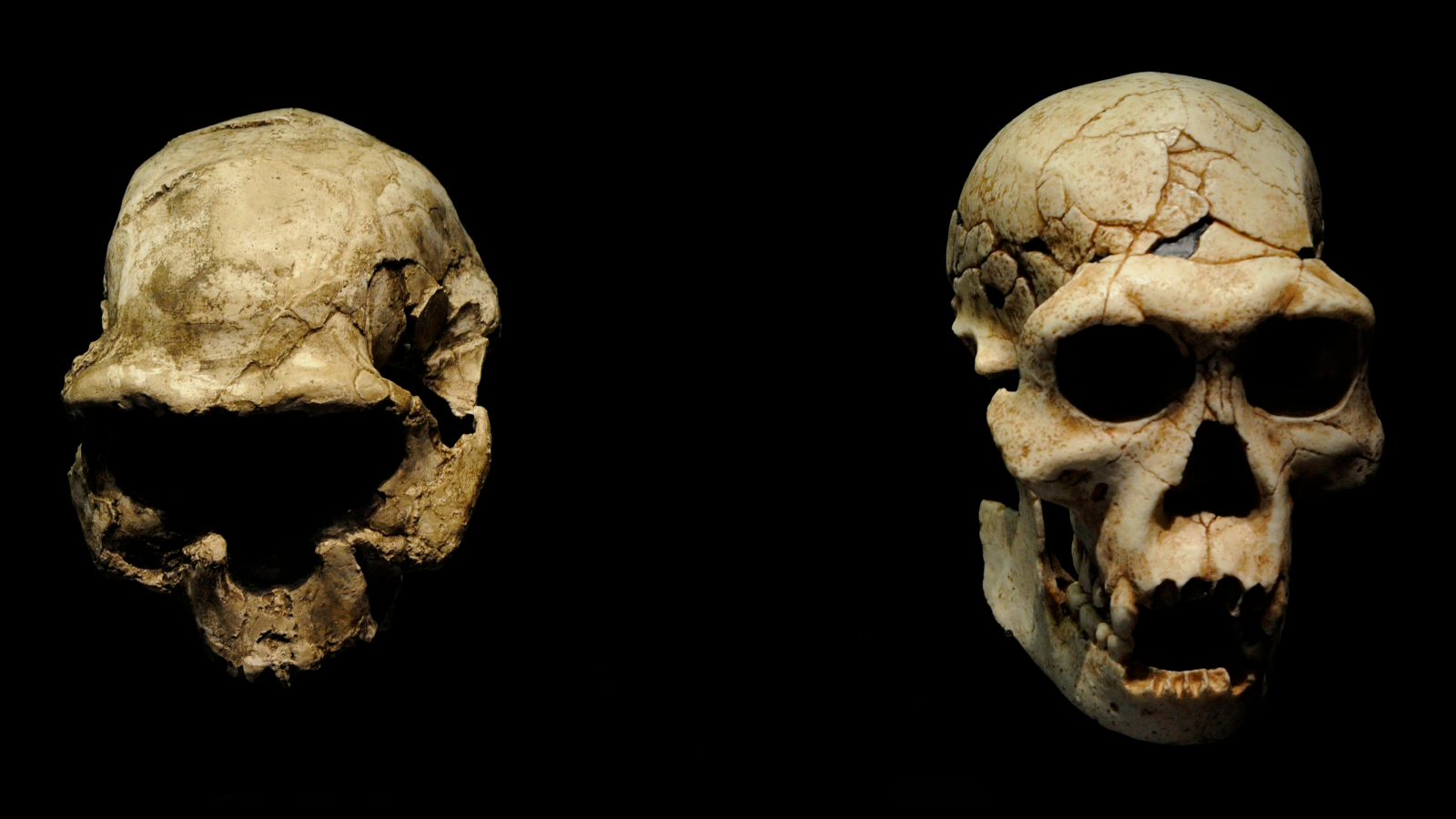
Early ancestral members of the human lineage may have left Africa earlier than widely thought, a new study of fossil teeth suggests.
Modern humans, Homo sapiens, are the only extant member of the genus Homo, which is thought to have originated in Africa about 2 to 3 million years ago and first left the African continent several hundred thousand years ago. But many other extinct human species have roamed the Earth in the past, including Homo habilis, suspected of being one of the first stone tool makers, and Homo erectus, the first to regularly store stone tools they made.
you may like
The Dmanisi fossils have sparked intense debate because they show an unusual level of variation. Many researchers suggest that all of these specimens belong to H. erectus and that the anatomical variation seen among them is due to factors such as natural differences between the sexes. Other scientists argue that the Dmanisi fossils represent two different hominins. One, called Homo georgicus, was thought to be more closely related to a human ancestor known as australopiths, and the other, called Homo caucasi, was thought to be more closely related to early human species.
Resolving this controversy may reveal whether Homo erectus was the first human species to leave Africa, or whether other hominid species preceded it, study co-author Victor Nelly, a historian and archaeologist at Brazil’s University of São Paulo, told Live Science.
Previous analyzes of Dmanisi fossils have focused primarily on the skull. In a new study published Dec. 3 in the journal PLOS One, researchers focused on the similarities and differences between teeth.
Scientists analyzed 24 teeth taken from three individuals in Dmanisi. They compared them not only to each other, but also to 559 teeth from other species, including australopiths, early humans such as Homo habilis and Homo erectus, and modern humans.
The researchers found that the teeth appear to be divided into two groups, one closer to australopiths and one closer to early humans. Differences between these groups were particularly pronounced in the maxillary teeth.
The discovery of these teeth suggests that “more than one species was likely present in the Dmanisi region,” study co-author Mark Hubbe, chair and professor of anthropology at the University of Tennessee, Knoxville, told Live Science.
The scientists noted that the differences in the teeth of these two groups are similar to the level of differences found between male and female chimpanzees and gorillas. This raises the possibility that they represent teeth of both sexes of one species. However, the researchers argued that the Dmanisi fossils do not belong to a single species of hominin. This is because the more australopith-like groups had relatively large third molars. This is in contrast to the tendency for humans to have smaller third molars when compared to related species.
you may like
“I agree with the authors that there are probably multiple lineages of Dmanisi,” paleoanthropologist Chris Stringer of London’s Natural History Museum, who was not involved in the study, told Live Science. Big but small brain ‘The skull looks much more primitive than other skulls, at least [H.] It resembles a habilis, if not an australopithecus. Others may still represent very primitive forms. [H.] Until now, the idea of erectus has been the mainstream. ”
If we accept the new study’s conclusion that two species were present at the same time on Dmanisi, the biggest implication is that “a more ‘primitive’ species migrated out of Africa earlier than generally thought, which is very interesting,” Karen Barb, a paleoanthropologist at Midwestern University in Glendale, Arizona, who was not involved in the study, told Live Science.
If the human species left Africa before Homo erectus, these early humans “may have produced distant descendants.” [H.] Luzonensis, [H.] (Fossils of the extinct primate Meganthropus were first discovered in Indonesia in the 1940s, but scientists have long debated whether they were an ape, an australopith, or a member of an early human species.)
Still, Barb cautioned that these new discoveries do not conclusively prove that multiple species existed at Dmanisi. For example, she pointed out that the new study’s analysis of lower jaw teeth suggests that these fossils may belong only to H. erectus, rather than two species.
Although the new study claims that the simplest explanation for its results is that there were multiple species in Dmanisi, Barb said the simplest explanation may actually be “to propose a single, albeit highly diverse, species, with some individuals retaining more ancestral features and others descending in the direction of a later Homo erectus.”
