Close Menu
  • Start
  • Celebrities
  • Music
  • Influencers
  • Tendencies
  • Exclusives
  • Business & Brands
  • TwinH
  • Spanish
What's Hot

This lifetime AI-powered piano app teaches you as you play for $99.97 during Deal Day.

Bonnie Tyler has recovered from coma but remains ‘very unwell’ after emergency surgery

Choose a new language (or 25 languages) with this $127 Rosetta Stone sale

Facebook X (Twitter) Instagram
  • Home
  • About The FYMOUS
  • Advertising / Promotion
  • Contact
  • DMCA
  • Privacy Policy
  • Terms
  • Publish News
Facebook X (Twitter) Instagram
FYMOUS News
  • Start
  • Celebrities
  • Music
  • Influencers
  • Tendencies
  • Exclusives
  • Business & Brands
  • TwinH
  • Spanish
FYMOUS News
Home » Giant iceberg A23a, once the world’s largest iceberg, finally dies after 40 years at sea, turning into a bright “blue mush”
Tendencies

Giant iceberg A23a, once the world’s largest iceberg, finally dies after 40 years at sea, turning into a bright “blue mush”

By January 13, 2026No Comments4 Mins Read
Share Facebook Twitter Pinterest Telegram LinkedIn Tumblr Email Copy Link
Follow Us
Google News Flipboard
Share
Facebook Twitter LinkedIn Pinterest Email Copy Link

New satellite images show that once the world’s largest iceberg, A23a, has turned into a beautiful mass of striped “blue mush”, signaling its imminent demise. This moribund ice mass, until recently three times the size of New York City, is one of the oldest ice masses on record and is currently celebrating its 40th anniversary.

A23a is unique among icebergs. Dubbed the “Queen of the Icebergs,” the megaberg broke away from Antarctica’s Filchner-Ronne Ice Sheet in the summer of 1986, but quickly became stuck in place when its submerged bottom caught on the ocean floor. For most of the past 40 years, this ice has remained confined and so close to its parent ice shelf that it has decreased little in size. However, in 2020, A23a finally broke free from its ocean floor restraints and began drifting away from Antarctica.

His journey after that was eventful. First, a huge chunk of ice became trapped again in a huge ocean current, or gyre, and rotated in place for several months. After emerging from the vortex in December 2024, the dizzy burg then headed straight to South Georgia Island, raising concerns among researchers that it could run aground again and pose a potential ecological disaster for the island’s resident penguins. However, this worst-case scenario was averted when A23a began to disintegrate in May 2025, just before reaching the island.

you may like

Since then, the largest remaining chunk of the iceberg has drifted further north into the South Atlantic Ocean, where warm ocean water circulating from South America is taking its toll.

New photos taken by NASA’s Terra satellite on December 26 reveal a completely unrecognizable version of A23a. The iceberg, now about a third of its original size, is shown covered in a blue puddle surrounded by a thick border of white ice called a “castle.” The image also shows a pool of gray sludge, known as ice melange, on the side of A23a, which likely leaked from beneath the iceberg. In addition, it is surrounded by hundreds of small mountains with broken edges.

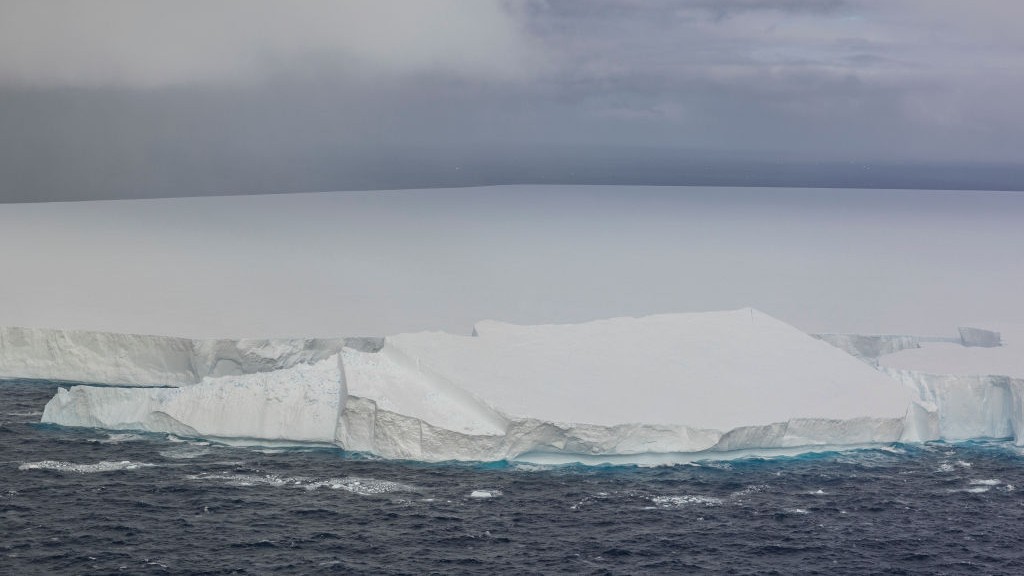
Image 1/4
Iceberg A23a breaks free from the Larsen Ice Shelf and drifts in the southern ocean.
(Image credit: Samuel J Coe/Getty Images)

A23a was about three times the size of New York City before colliding with South Georgia last year.

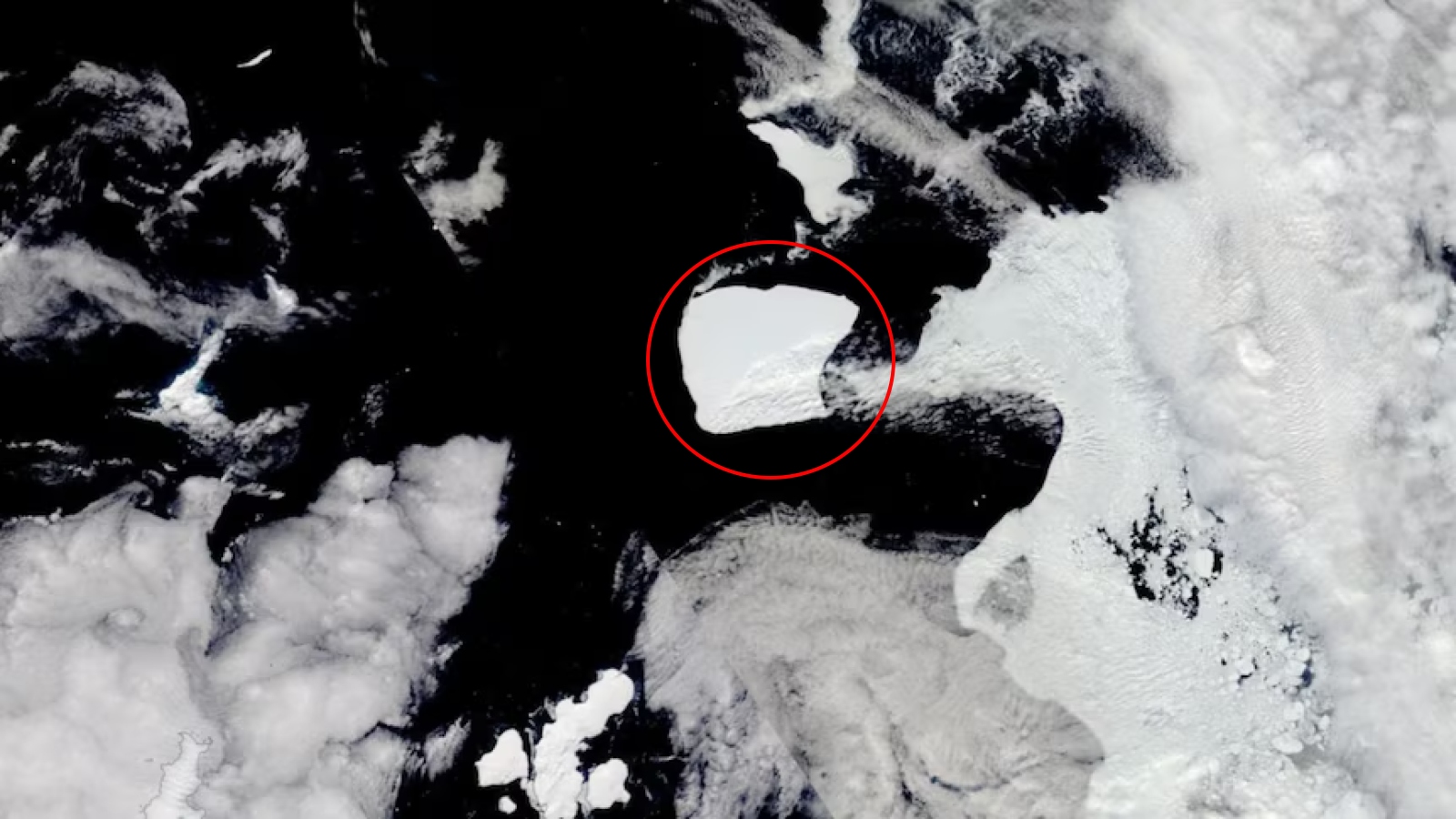
big iceberg in the sea surrounded by clouds
(Image credit: NASA Worldview)

A23a (circled) was captured just offshore of the Filchner-Ronne Ice Sheet in Antarctica between 1986 and 2020.

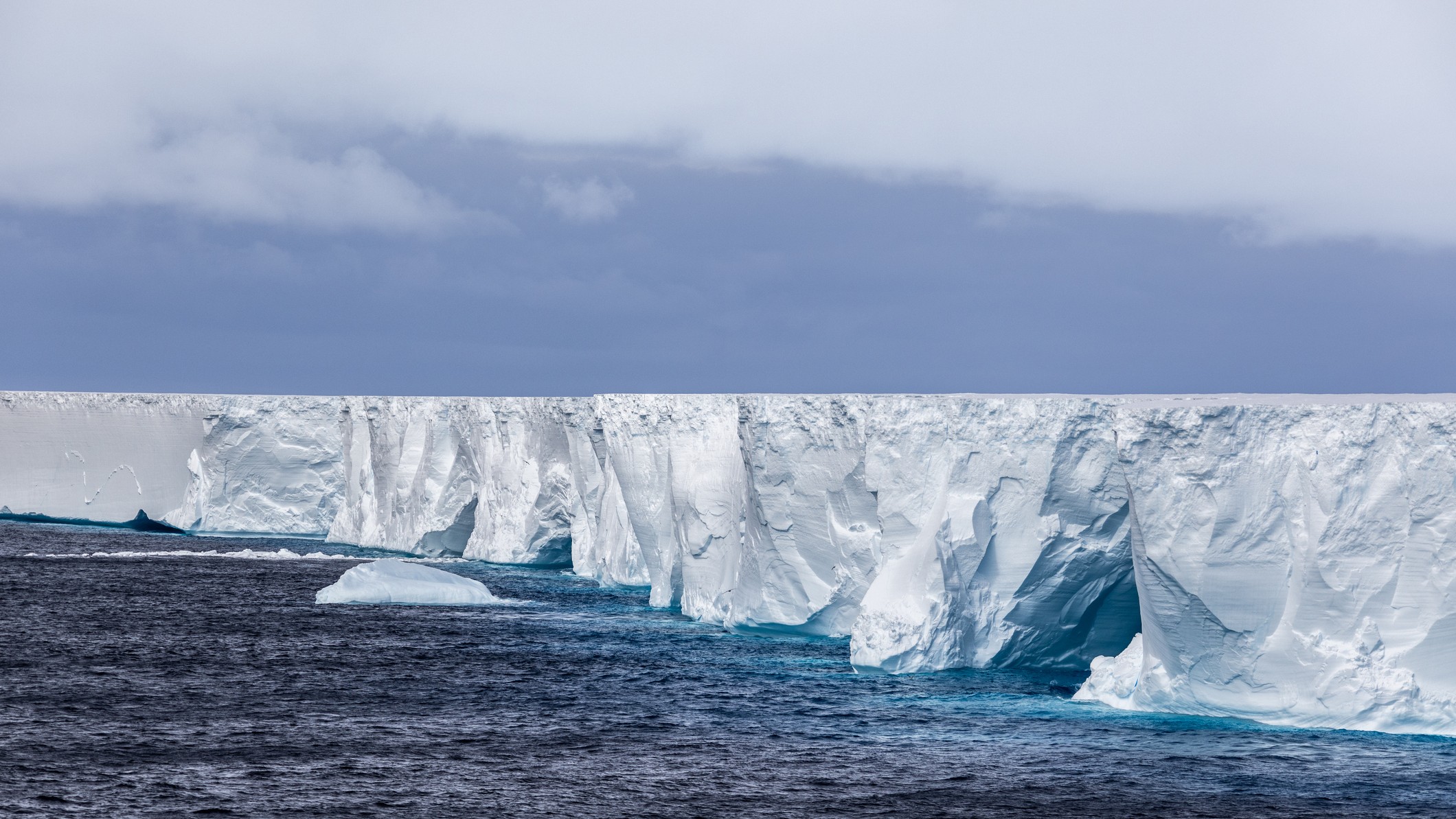
A large chunk of the iceberg, called A23a, can be seen breaking off and falling into the ocean.
(Image credit: UK MOD Crown Copyright via Getty Images)

Large chunks have been breaking up over several months as A23a moves into warmer waters.

Satellite photo showing a giant iceberg next to the island, surrounded by hundreds of smaller icebergs.
(Image credit: NASA/Aqua)

A23a briefly became stranded off the coast of South Georgia, but soon began to break up and move further north.

Ted Scambos, a climate scientist at the University of Colorado Boulder, said in a NASA statement that the “blue mush” visible on A23a consists of melt ponds that form when surface ice loses its structural integrity. These ponds are streaked, Scambos added, likely caused by “the weight of water trapped in the ice cracks causing the ice to open up.”

Walter Meyer, a senior researcher at the National Snow and Ice Data Center (NSIDC), said in a statement that the cracks likely ran parallel to grooves on the iceberg’s underside, carved into the ice by centuries of movement over the ground while attached to the Filchner-Ronne Ice Sheet. “It’s amazing that these stripes are still there after so many years,” added Chris Schuman, a retired glaciologist at the University of Maryland.

Get the world’s most fascinating discoveries delivered straight to your inbox.

Another photo taken on Dec. 27 by an anonymous astronaut aboard the International Space Station suggests that the bright stripes may already be starting to fade. This subsequent image shows a more uniform pool of blue water on the surface of the iceberg (see below).

It is currently unclear how much A23a remains, or if it has already begun to disappear completely.
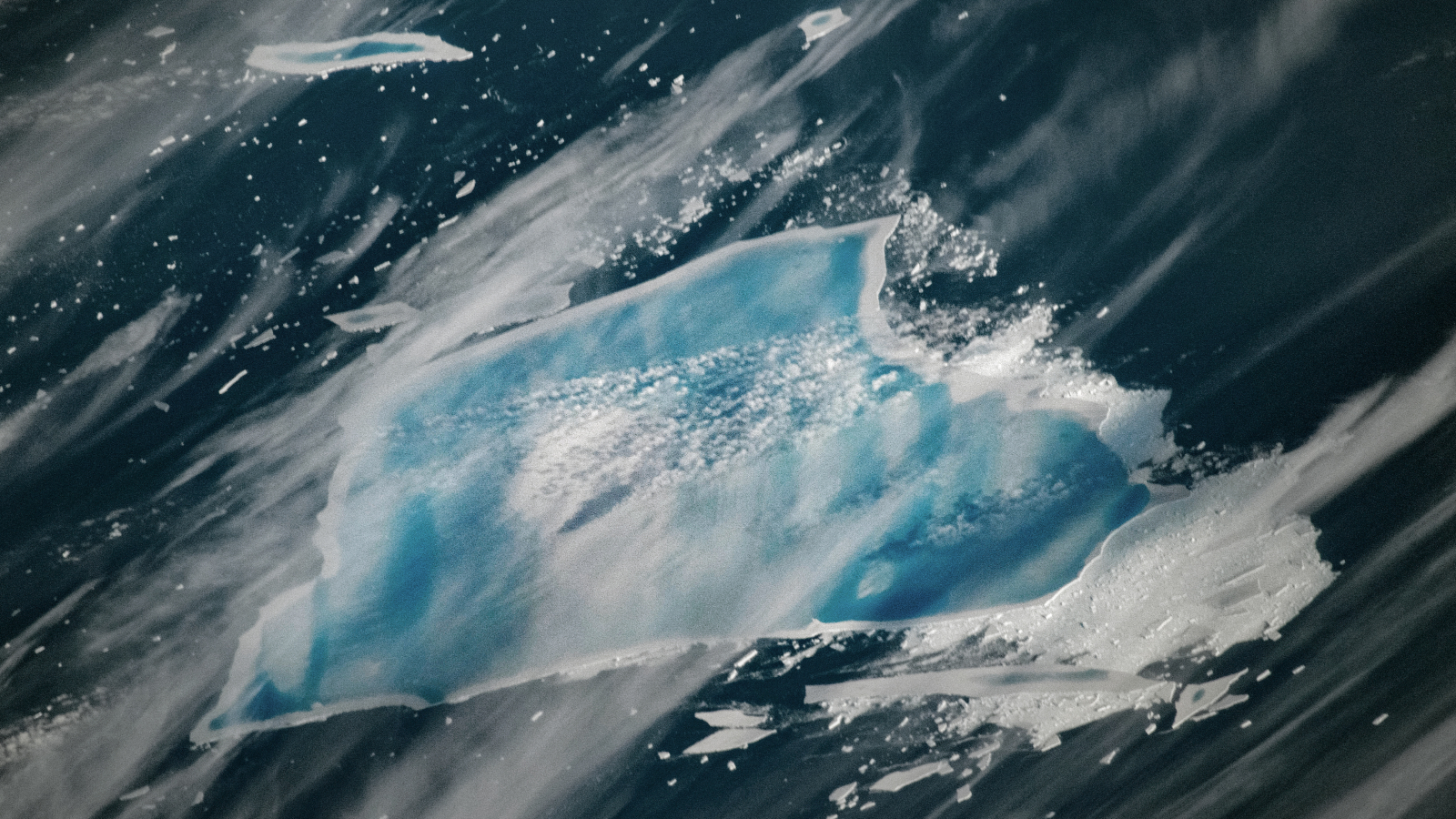
Photo of an astronaut covered in clouds of icebergs covered in bright blue melting ponds

Astronaut photos taken on Dec. 27 revealed more uniform weld pools on A23a’s surface, suggesting that its bright stripes have already disappeared. (Image credit: NASA/ISS Program)

A23a has repeatedly held the title of “world’s largest iceberg” throughout its long life due to its persistently huge size.

Most recently, in June 2023, the previous largest iceberg, A-76A, broke apart and regained the title. He then lost the honor again in September 2025, shortly after a matchup against South Georgia State. (Some news outlets incorrectly report that A23a is still the world’s largest iceberg, probably because the Guinness World Records page is outdated.)

According to NSIDC, the world’s largest iceberg is currently D15A, which has a surface area of ​​about 1,200 square miles (3,100 square kilometers), making it several hundred square miles smaller than A23a at its peak.

For more amazing satellite photos and astronaut images, check out Earth from the Space Archives.


Source link

#Biotechnology #ClimateScience #Health #Science #ScientificAdvances #ScientificResearch
Follow on Google News Follow on Flipboard
Share. Facebook Twitter Pinterest LinkedIn Tumblr Email Copy Link
Previous ArticleLong-running web skimming campaign steals credit cards from online checkout pages
Next Article Doctors think AI can play a role in medicine, but maybe not as chatbots

Related Posts

Merlin, a common roadside duck in Mexico City, will be the World Cup mascot.

June 15, 2026

Far from the pitch, David Beckham remains soccer’s biggest star

June 14, 2026

Taylor Swift makes history as the youngest girl to be inducted into the Songwriters Hall of Fame

June 12, 2026
Add A Comment
Leave A Reply Cancel Reply

Latest Posts

This lifetime AI-powered piano app teaches you as you play for $99.97 during Deal Day.

Bonnie Tyler has recovered from coma but remains ‘very unwell’ after emergency surgery

Choose a new language (or 25 languages) with this $127 Rosetta Stone sale

Jelly Roll files for divorce from Bunny XO after 10 years of marriage

Trending Posts

Bonnie Tyler has recovered from coma but remains ‘very unwell’ after emergency surgery

June 16, 2026

Jelly Roll files for divorce from Bunny XO after 10 years of marriage

June 16, 2026

BTS is the group fans are most looking forward to seeing perform at the 2026 World Cup

June 15, 2026

Subscribe to News

Subscribe to our newsletter and never miss our latest news

Please enable JavaScript in your browser to complete this form.
Loading

Welcome to The FYMOUS, a modern digital media platform dedicated to celebrities, artists, influencers, brands, entertainment culture, and the growing TwinH ecosystem.

We bring audiences closer to the people, stories, trends, and collaborations shaping today’s culture. From exclusive celebrity news and music releases to influencer highlights, brand partnerships, and TwinH activations, The FYMOUS delivers engaging content designed for the next generation of digital audiences.

Castilla-La Mancha Ignites Innovation: fiveclmsummit Redefines Tech Future

Local Power, Health Innovation: Alcolea de Calatrava Boosts FiveCLM PoC with Community Engagement

The Future of Digital Twins in Healthcare: From Virtual Replicas to Personalized Medical Models

Human Digital Twins: The Next Tech Frontier Set to Transform Healthcare and Beyond

Facebook X (Twitter) Instagram Pinterest YouTube
  • Home
  • About The FYMOUS
  • Advertising / Promotion
  • Contact
  • DMCA
  • Privacy Policy
  • Terms
  • Publish News
© 2026 news.fyself. Designed by by fyself.

Type above and press Enter to search. Press Esc to cancel.