

Olivia Colman and Alexander Skarsgard continue to make bold career moves with Wicker.
Everett Collection


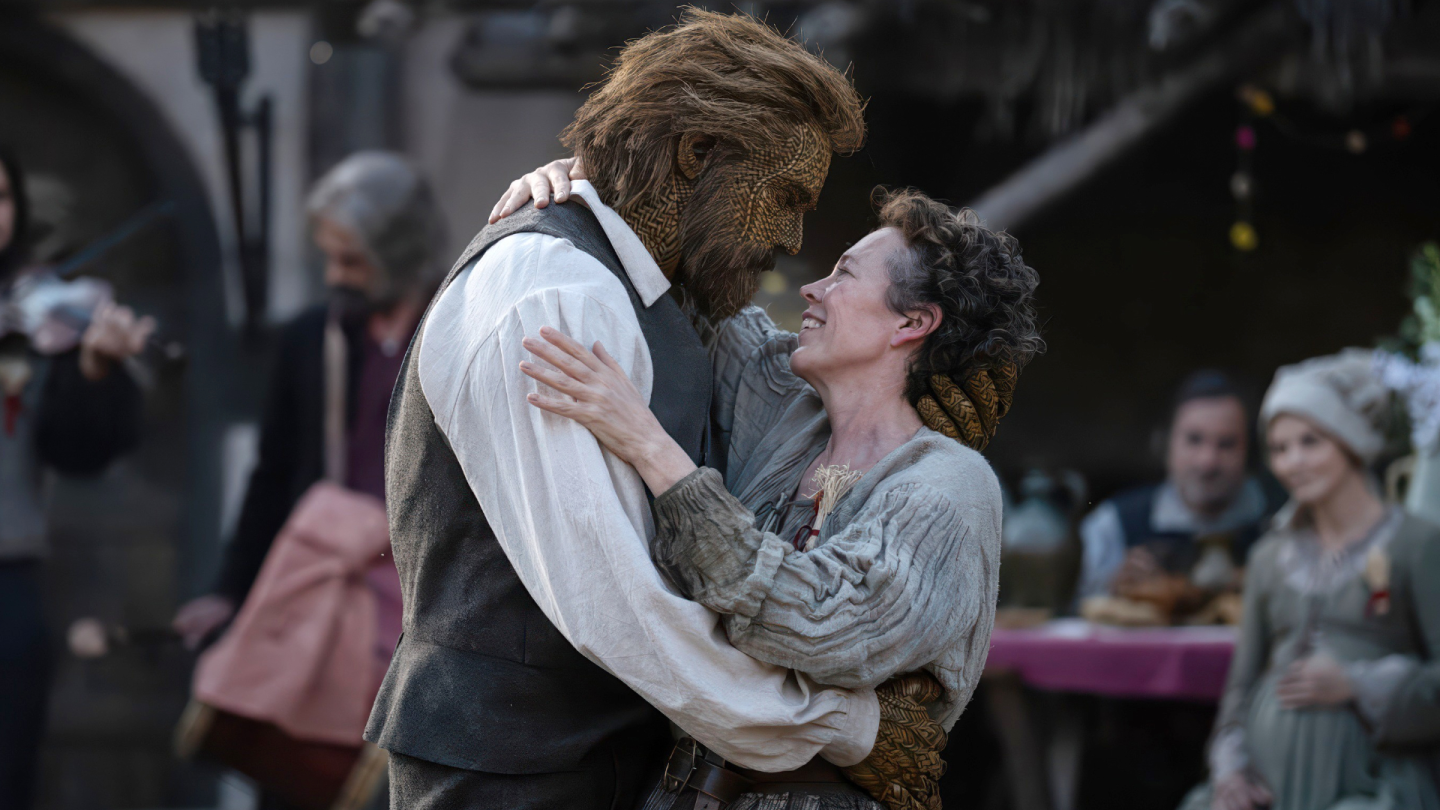
If you’re online, Wicker, a fantasy rom-com focused on an ostracized fisherwoman who enjoys many a noisy night with her wicker husband, will ring a bell.
From directors, co-writers and real-life married couple Eleanor Wilson and Alex Huston Fischer, the feature has taken on a life of its own since social media and the meme-spawning corner of the internet happened upon this intimately made indie.
And can you blame them? Adapted from Ursula Wills-Jones’ 14-page short story The Wicker Husband, the movie stars British Oscar winner Olivia Colman as the aforementioned village outcast, who becomes fed up with the snarky remarks from her fellow women (led by The Crown‘s Elizabeth Debicki) and implores the local basket weaver (Peter Dinklage) to craft her a husband out of his materials. Enter Alexander Skarsgård as an enchanted spouse made entirely of wicker, whose raw sex appeal and tender devotion to the fisherwoman flusters — in both good and bad ways — the whole village.
Oddly enough, Wicker might have been considered a hard sell until Colman jumped on board as its lead star and executive producer. “You’re always trying to push the rock up the hill,” begins Fischer to The Hollywood Reporter. “But then Olivia signed on. And then, boom!” Things turbocharged. Skarsgård, who, like Colman, has made some daring career moves in recent years, became the only man to do this knight-in-shining-wicker justice. “We wanted him to be strikingly beautiful and in the actor’s likeness,” Wilson tells THR.
But even with two full-fledged Hollywood A-listers game, the couple couldn’t have predicted how horny Wicker — and its online image — would become. “Everyone fell in love with them as a couple on set, even from the camera test,” says Fischer. “So then, when the trailer came out, we learned a lot about the internet and the viral loop.”
Below, Wilson and Fischer dive into a candid conversation about the journey of Black Bear‘s Wicker, from its Sundance premiere to hitting the BFI London Film Festival just last week. They discuss the insanely impressive work from a New Zealand-based effects studio to create Skarsgård’s practical wicker suit, how the film’s shockingly tender messaging sneaks up on you, and why a project partly centered on the power of a wicker penis might just be what everyone was waiting for.
This must have been years in the making. Tell me about the origin story.
ALEX HUSTON FISCHER It’s been now five years since we wrote it, which is suprising.
ELEANOR WILSON Yeah, it’s amazing how time flies. And that’s from first draft to here, talking to The Hollywood Reporter, [which] is actually kind of normal-slash-fast! We shot the film two years ago and we finished it a year ago now, and then it played at Sundance. The origin story is [that] it’s based on a short story by Ursula Wills called The Wicker Husband, and that short story was shared with us by one of our producers, Justin Lothrop, who was a fan of her writing and brought the short story to us with the view to make it into a film — and we just loved it. It’s a short, short story. I think it’s 14 pages, but it’s a really beautiful structure, which is a rare gift to be given as screenwriters. We worked on the script for a while. We sent the script to Olivia Colman. She said yes, which was insane.
FISCHER You’re always trying to push the rock up the hill. We were trying to make some other movies, and [it was] looking like, “Oh, [Wicker] will have to come after those.” But then Olivia signed on. And then, boom!
It turbocharged things I presume?
FISCHER Turbocharged exactly. She’s the jet fuel.
Did you know from an early point that Olivia would be the dream, but thought it might never happen?
WILSON (Laughs.) Precisely right.
FISCHER We never even allowed ourselves to believe in the dream. We know how it goes. Our agent was like, “Don’t bother.” But then she was the same agent who reached out to Olivia’s agent, and then, I don’t know why, but they read it and then they liked it.
Olivia Colman and Alexander Skarsgard continue to make bold career moves with Wicker.
Everett Collection
Do you remember the call?
WILSON It was like, “Olivia wants to meet.”
FISCHER And that’s usually good. That means only you can fuck it up.
WILSON You always think you’re gonna get on these calls and you have to do a big pitch and you have to explain and sound professional and make sure to…
FISCHER Articulate.
WILSON Yeah, which you can say we’re not very good at. But when we got on the call, [Colman] was just like (in a British accent), “Oh wow, thanks so much for thinking of me. I love the script. Let’s do it.”
FISCHER “You seem lovely.”
WILSON And then we mostly just talked about our kids.
FISCHER Our kid was only like, six months old.
WILSON He was like a baby, in the other room, and we didn’t know how to do everything yet. We were really nervous, but we just talked about kids the whole time. It was great.
FISCHER She’s disarmingly kind.
Did she tell you what she liked so much about the script?
FISCHER It’s funny because a lot of the communication with Olivia is like, nonverbal and instinctual, even when we’re on set.
WILSON Yeah. I don’t know that she’s ever necessarily articulated to us what she loved about it, but she does just seem to latch onto things in an instinctive way, and I think she must have seen something in the fisherwoman that really grabbed her.
FISCHER I think she understood her.
WILSON She did, for sure. All our actors are very different in the film, but [with] Olivia, we don’t talk that much about the character. She just gets it.
FISCHER She absorbs 100 percent of what is written.
WILSON And brings it to life.
So, when she came on, the money came flying a little bit?
WILSON It was still a strange film.
FISCHER It was 2023. So it was a pretty bleak time. We were coming out of the writers’ strike. There were no original films being made. “Don’t even try to make a movie“ was the vibe. So [we got] Olivia on board and [special effects studio] Wētā Workshop on board early, and they did the prosthetics. Then we went to financiers after that.
Did you find it was a hard sell? Just because, obviously, it is such a unique premise for a film.
WILSON In every step of the process of making this film, we tried to make it with people that we know. We needed…
FISCHER Some control.
WILSON To keep control of the thing and make it in a bit of a safe space. So we never actually took it out to the big studios. It was a strange film, and we wanted to make sure we could make it the way we wanted to make it. So we took it to independent financiers who we somewhat knew already.
FISCHER And it was unpitchable.
WILSON It felt unpitchable.
FISCHER The first thing our producer Justin said [was], “Do you want to take it out as a pitch, or do you want to write it basically on spec with a little bit of development money?” And we said, “We won’t be able to pitch it. We want to be able to figure out what it is and write it for what it is.” So we always went for the control version.
WILSON Less money, more control.
FISCHER And when we had the script and Olivia and the workshop attached, then we also went to financiers [who] we knew.
WILSON And who knew us already a little bit and knew what our sensibilities were and were on board with that.
FISCHER Because the worst thing you can have is a movie that has its own DNA and then someone takes it and tries to make it something it’s not. That was the worst-case scenario. That’s worse than not making the movie at all.
WILSON Yeah. So we were we were very protective of it. But I think it worked out. You never quite have enough money. I think everyone feels like that all the time. But we had just enough. We got to make the movie we wanted to make.
We’ve spoken about Olivia, but I want to talk about Alexander. At what point did you know that you wanted to make a pretty horny film?
FISCHER (Laughs.) There was a line in the short story that said, after their first night of marriage, the wicker husband said, “The bed is broken. Bring me a chisel. I will fix it.” And that’s all it says.
Wilson and Fischer said the wicker husband had to be “beautiful.”
Everett Collection
WILSON It doesn’t describe the night before.
FISCHER So we read that and said, “Well, why don’t we show the bed breaking?” And then that was the beginning of it.
WILSON But we always thought of the sex scenes as the comedy of the film, too. They were supposed to be played for laughs, and they are. But I think once we actually had Alexander in costume, Olivia, and Ita O’Brien, our intimacy coordinator, working together on these scenes — that’s when they did become surprisingly more sexy than we thought they would.
Was the casting of Alexander quite crucial? Did you envision a conventionally attractive actor for the role?
FISCHER He had to be beautiful.
WILSON Yeah, I think for everything that happens with the villagers, he needed to be very striking. That was the brief with the workshop — we wanted him to be strikingly beautiful and in the actor’s likeness, which was huge because we really wanted Alexander’s performance to be able to shine through the prosthetic. And just that the prosthetic could move to his facial [expressions].
FISCHER So it reacts to his face.
WILSON And we wouldn’t have to CG any movement.
FISCHER But both of these roles… As a movie fan, you don’t really think about it. But when you’re making a movie, you realize who you can cast in a movie, who parts are written for, and this movie only really had two actors. It was Olivia and Alex. When you think about the whole range of actors, you’re like, “Well, I don’t know if it works quite as well with anybody else.“ These are the only two people who exist that make this movie work, and you’re always working within a limited number of — I don’t know how to say it… famous people to get a movie financed. Olivia has carved out this career for herself, and Alex has carved out this career for himself, where they’re deciding to choose interesting roles, and they’re so incredibly talented and successful in doing that. It allows movies like this to exist, and movies like this wouldn’t exist if they didn’t take risks like that.
A quick moment for the suit. You guys tried to use as little VFX as possible, I presume.
FISCHER It was used for some of his hollowness.
WILSON There’s a ton of invisible VFX in the film. VFX is a hugely important tool, but it’s all hand-done VFX, by humans.
FISCHER We’re all sitting in the same room in Adelaide, Australia.
WILSON The work that they did is hugely important. Obviously, it’s a practical [suit]; what Alexander looks like [in the film] is what he looks like on set. The work that VFX did made him hollow, which is very subtle throughout the film, and we intentionally wanted to make it not too showy because the performance is the showpiece, and the practical effects suit is the showpiece. So it’s somewhat thankless VFX, but it was really important to just adding that layer of this fragility to the to the character.
What’s the suit made of?
FISCHER 3D-printed materials.
WILSON And some natural fibers as well, woven into it. But it’s 18 months of [research and development]. Wētā Workshop started with us 18 months before we shot the film. They [had] concept art and early materials testing.
FISCHER And they sort of invented a new technique for this 3D-printed technology.
WILSON But it’s a prosthetic that is glued to his face, which is pretty intense.
FISCHER Totally glued. It’s a modular prosthetic, so anything he does, it responds to any [movement]. Then the weave pattern is very specifically chosen over the course of a year, basically, to be able to mimic a real facial expression.
WILSON The great thing about Wētā Workshop was that they were so invested. Not only in the design but also in the practicality of how we were going to get him in this suit every day. They got the whole process down to 90 minutes, which is really remarkable for this type of thing. I’m sure you’ve heard stories of how people sit in the chair for eight hours. And we just knew that we’re an indie film, and we wouldn’t have that kind of time.
FISCHER It’s a very human film, very tactile. That was always the plan, so he needed to be real.
From left: Wicker co-director Eleanor Wilson, Elizabeth Debicki, Alexander Skarsgard, Olivia Colman, Peter Dinklage and co-director Alex Huston Fischer at the film’s BFI London Film Festival premiere.
Courtesy of Getty
That striking eroticism has done wonders for this movie’s marketing campaign too, which maybe has come as a surprise to you both. What’s been your reaction to the reception on the festival circuit so far?
WILSON Taking it to Sundance was wonderful and beautiful. Our first film played at Sundance too [2020’s Save Yourselves!], and it was a real homecoming. It was…
FISCHER Very emotional. Last Sundance in Park City.
WILSON Yeah. But that was more of a regular movie-going experience. Since the trailer has come out, it has definitely felt like the film has taken on a life of its own. That’s very outside of us because we’re not really that present on the internet. We didn’t really know about all this stuff. (Laughs.)
FISCHER No, we’re not on TikTok or anything. (Laughs.) But we were always very confident that what Wētā Workshop had and what Alex had done with the character was noteworthy. Everyone fell in love with them as a couple on set, even from the camera test. Everybody sort of went, ‘I’m just in love with these guys.’ So then, when the trailer came out, we learned a lot about the internet and the viral loop, but it really was a testament to Alex and his career and that prosthetic suit looking as incredible as it does, and Olivia… It’s just that combination.
WILSON [It’s a] time and place thing as well. It feels 2026.
FISCHER Everybody was ready for it.
WILSON Yeah, it does kind of feel like that. I mean, it’s an incredible year for movies in general. It also seems to be a year where audiences are really asking for originality in film. [It’s] an incredible year to put out a practical effects movie as well because everyone’s pushing back against AI, which is wonderful.
FISCHER And I feel like people are rediscovering movie theaters, and they’re thinking, “I want to have some visual spectacle and some kind of excitement, but I can’t get it at home.“
WILSON It’s also great for comedies. We were so excited by films like The Invite doing so well in theaters. We just loved that film. I think I saw it in the third or fourth week of it being in cinemas, and it was still a packed house — of young people! These young people who know nothing of marriage and came to see this talky marriage comedy. It was so fun.
In the U.K. so far this year, 12 of the top 20 films at the box office are original movies. I think Wicker is totally riding the wave of this year that we’ve had. It’s come at the perfect time.
WILSON Yeah. I think it’s also about the themes of the film as well, speaking to people in this moment. It is kind of a sex positive film — a film about female pleasure, in a way.
FISCHER And masculinity.
WILSON Right? And how we examine masculinity, for sure. So all of those things are being talked about more in the cultural conversation than ever before.
Part of the enjoyment for me was the film’s silliness and jovial surface, cleverly masking what is really important messaging around the patriarchy, the inherent misogyny of marriage and societal othering. These topics are the beating heart of the film.
FISCHER And when we read the short story, it was this really witty allegory about jealousy and envy. But we saw it as an opportunity to satirize the whole institution of marriage.
WILSON That scene in the bar, I think, is something we talk about amongst ourselves — this instinct, when groups of men or women are together, to shit-talk your partners.
FISCHER And that was very much in the short story.
WILSON But it’s a funny thing. Why do we do that? Why is that…
FISCHER The most socially acceptable way to talk about your spouse?
WILSON Yeah, is just to complain about them. And when somebody does drop this bomb into that type of conversation, that you love your wife… It’s all of a sudden very rattling. Most of it is presented as a comedy, but we love that it’s a comedy that could make you think about the way that you relate to your partner and to your friends as well.
How has it been letting the movie go out into the world? Has the buzz around Wicker enabled you to think about what you want to do next?
FISCHER Watching the movie in the theater with audiences is electric. It’s very fun, and we have a great time doing it. We like to sit in the middle. (Laughs.)
WILSON When we did some test screenings, we had a great time because nobody knew who we were.
Peter Dinklage plays the local basket weaver in Wicker.
Everett Collection
FISCHER But I also think what’s happening is that everybody can identify with this village. It feels like everybody lives in a village, everybody’s from their own village, and everybody knows a fisherwoman, and everybody knows a tailor’s wife, and everybody knows a baker man. It’s very connected to people’s true experience.
WILSON We always hoped that it would be very relatable even though it’s a strange, dressed-up fantasy fable. It should still feel like people that you know. We all feel like the fisherwoman.
FISCHER We feel very proud of the film and we feel very lucky that we got to make it. It does feel like for the next one, the pressure’s on a little. What we’ve also learned is that people just like to see something wild and human. Something crazy, but also that they can identify with. So I feel like for future projects, [we’ll] just go for it. Go big as [we] want. A lot of time, when you’re trying to write a movie, make a movie, get a movie financed, the wisdom is to play it safe. Follow the classic narrative structure of a Hollywood film, and try to make it as good as possible. [But] you should just throw everything out the window and make whatever you want, and that’s what people respond to.
Lastly, how do you find working as a married couple? Does it make the job harder, or easier?
WILSON I like it. It makes it easier. I mean, all of filmmaking and directing is communication, as is our relationship. So one sort of informs the other.
FISCHER And we don’t get jealous of each other. If Eleanor made Wicker and I didn’t get to make a movie, I’d be so fucking jealous.
WILSON (Laughs.)