

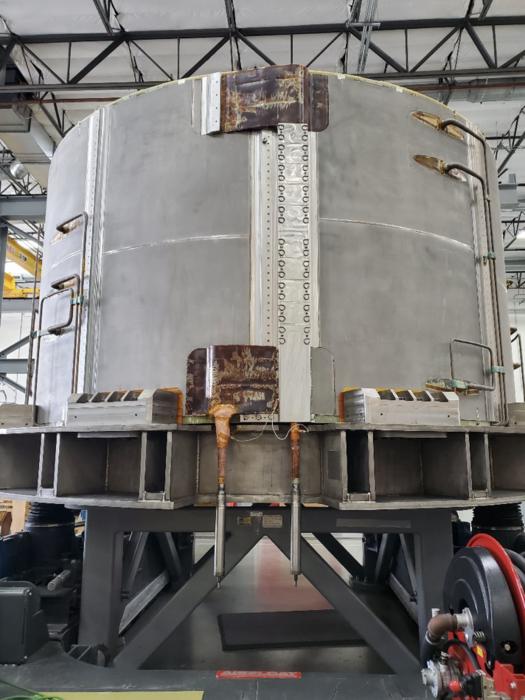
With a monumental leap from Fusion Energy, the Iter Reactor project has completed all the major components of its huge superconducting magnet system.
This achievement presents the turning point of the world’s largest and most advanced fusion experiments designed to prove that not only is it possible to replicate solar energy, but it is also scalable and sustainable.
At the heart of this breakthrough is Iter’s most powerful magnet, the final module of the central solenoid, ready to be assembled at the site of a project in southern France.
Measuring in thousands of tons and reaching magnets strong enough to lift aircraft carriers, the system drives the fusion process at the heart of Iter’s mission, which is clean, safe, and produces virtually infinite energy.
Iter explained
Iter Reactor, short for International Thermonuclear Test Reactor, is a global scientific partnership involving over 30 countries.
Its purpose is to use the fusion of stars (the same energy process that moves stars) to create a viable, carbon-free energy source for the Earth.
When fully operational, Iter will become the first fusion device to generate more energy than it consumes, achieving net energy gain.
The main structure of the reactor is the tokamac, a donut-shaped chamber in which hydrogen isotopes are overheated and fused together.
Unlike nuclear fission, which divides atoms, fusions combine them and release huge amounts of energy without producing long-lived radioactive waste or greenhouse gases.
How a magnetic system enables fusion
At the heart of Iter’s Tokamak is a sophisticated pulsed superconducting magnet system that operates the plasma.
Fuel injection: Two hydrogen isotopes, deuterium and tritium, are introduced into the chamber. Ionization: Magnet systems cause currents that turn gas into plasma. Magnetic Containment: The superconducting magnet becomes shaped and traps the plasma in a stable position. Extreme Heating: The auxiliary system raises the plasma temperature to 150 million degrees Celsius. This is 10 times the solar core. Fusion Ignition: Under these conditions, the nucleus fuses and releases a huge amount of thermal energy.
This sequence is designed to produce an output of 10 times the energy return – 500 megawatts from an input of just 50 megawatts. It will turn the system into a self-supporting “combustion plasma.”
The role of the central solenoid
The recently completed central solenoid in the US is the most powerful magnet of Iter.
It consists of six large modules and is designed to provide pulsed currents that start and maintain plasma currents within the tokamac.
The sophisticated exoskeleton, consisting of over 9,000 components, supports the intense mechanical forces generated during operation.
This magnet works in cooperation with six polloid magnetic field magnets built by Russia, Europe and China to control the vertical stability and shape of the plasma.
Global collaboration in action
The ITER reactor is not only a scientific milestone, but also a victory for international engineering.
The seven major member entities, China, Europe, India, Japan, Korea, Russia, and the United States, each have played an important role in building magnet systems.
US: Building and testing the central solenoid and its support structure, contributing 8% of the superconductors in the toroidal field. Russia: Supplied the top polloid magnetic field magnet and produced 40% of the superconductors of the polloid magnetic field. It also supplied 20% of the superconductors of the toroidal field and critical power supply infrastructure. Europe: Four polloid magnetic field magnets were produced in France, contributing to 10 toroidal magnetic field magnets, producing a large amount of superconductors and tokamac components. China: One 10m polloid magnetic field magnet was fed, generating superconductors for the other four PF magnets, supplying magnet feeders, and 18 correction coils were manufactured for precision plasma control. Japan: Provided 43km of superconductors to the central solenoid and constructed eight toroidal field magnets. It also produced 25% of the superconductors in the toroidal field. Korea: 20% of the superconductors of manufactured assembly tooling, four vacuum vessel sectors, thermal shields, and toroidal field. India: Built a large cryostat housing for Tokamak, developed crylines and plasma heating systems, and handled major parts of the cooling infrastructure.
Commenting on the collaboration, Iter Director Pietro Barabaschi said, “What makes Iter unique is not just its technical complexity, but its framework of international cooperation that has maintained it through changing political landscapes.”
“This achievement proves that when humanity faces existential challenges such as climate change and energy security, we can overcome national differences in order to advance solutions.”
“The Iter project is a representation of hope. With Iter, it demonstrates the possibility of a sustainable energy future and a peaceful path.”
Building the foundations of commercial fusion
The scale of Iter’s magnetic system is unprecedented. With over 10,000 tons of superconducting magnets, 100,000 km of superconducting chains, and 51 gigajoules of total conserved magnetic energy, the infrastructure is designed to test and refine the technology that drives future fusion power plants.
By integrating the entire system required for industrial-scale fusion, the ITER reactor serves as a real-world proof foundation for commercial deployments.
The knowledge and experience gained here will be communicated to the next generation of nuclear reactors that can power cities without carbon emissions.
This milestone – the perfection of a pulsed superconducting magnet system – shows that the age of practical fusion energy is closer than ever, built on global cooperation, technological accuracy and the ruthless pursuit of a cleaner energy future.
Source link
