
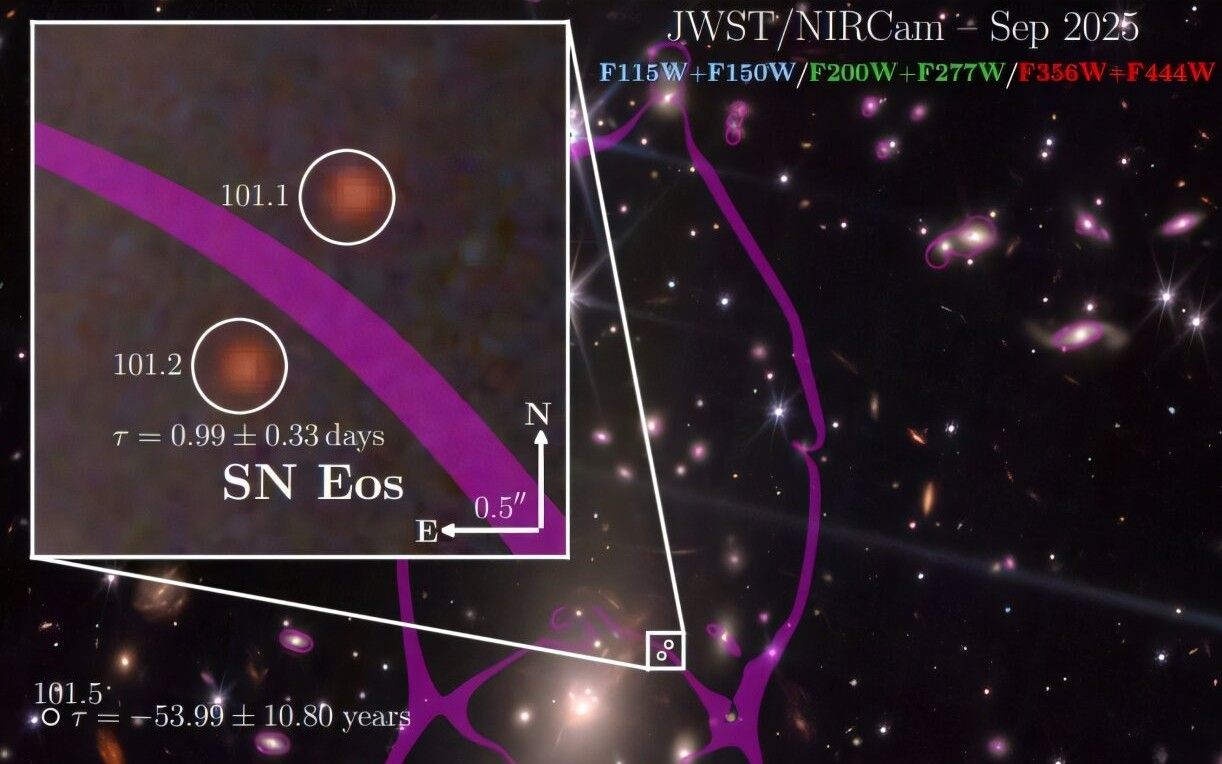
Scientists have discovered a distant supernova caused by a collapsing star just a billion years after the universe’s birth.
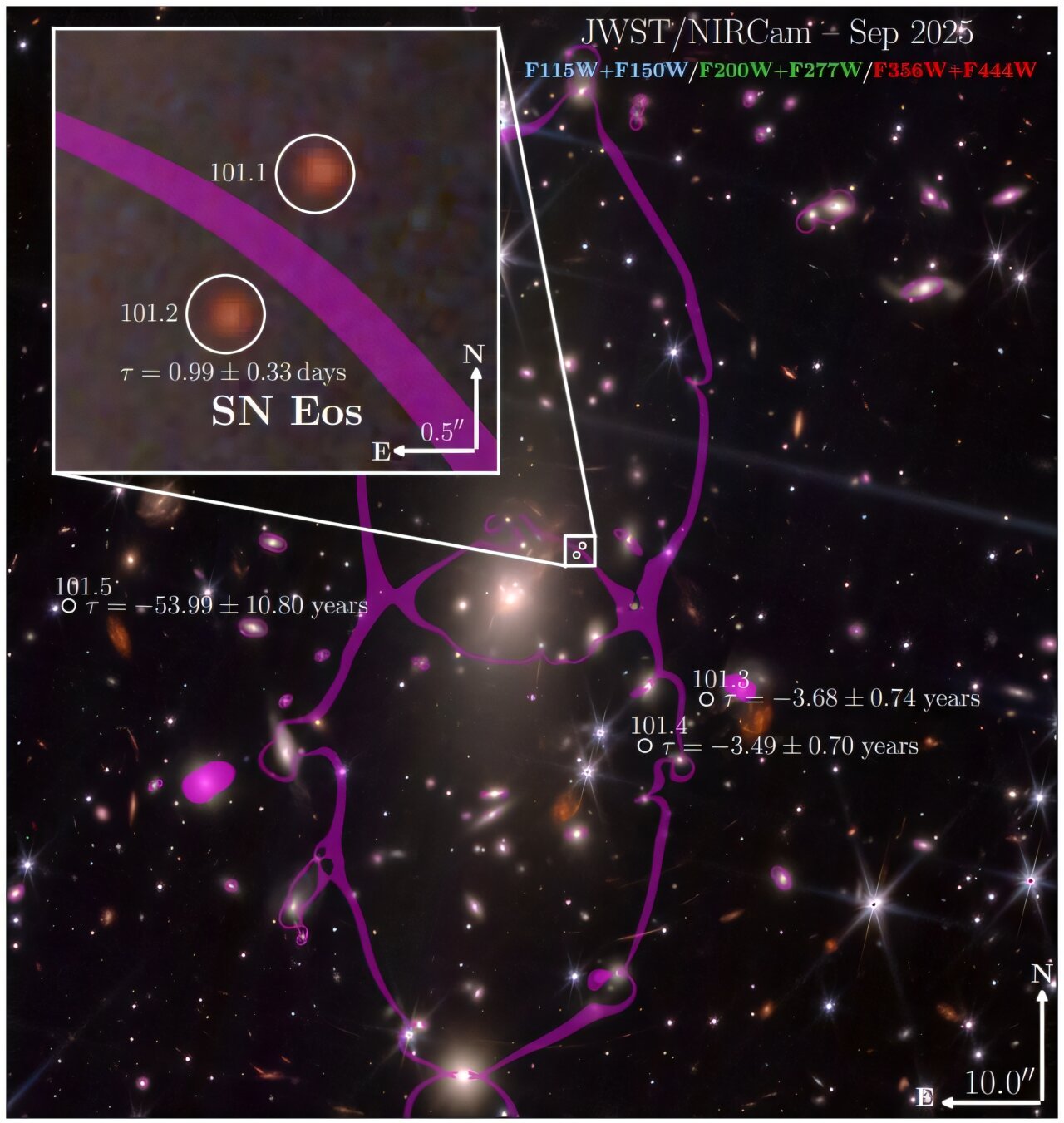
The James Webb Space Telescope (JWST) captured images of a Type II supernova on September 1 and October 8, 2025. The supernova, called Eos after Titan, the Greek goddess of the dawn, could help scientists understand how stars and galaxies evolve over billions of years, researchers reported on the preprint server arXiv on January 7.
you may like
death of the oldest star
A supernova occurs when a massive star explodes at the end of its life. Type I supernovae include supernovae that do not contain hydrogen in their spectra, while type II supernovae have some evidence of hydrogen. Regardless of type, supernovae are much less common. In a galaxy the size of the Milky Way, only two or three occur per century.
In a new study, scientists used a phenomenon known as gravitational lensing to capture images of distant supernovae. Gravitational lensing occurs when light passes through regions of space-time that are distorted by the enormous gravity of massive objects such as black holes or galaxy clusters. The distortion magnifies the light, allowing scientists to see objects that would otherwise be too dim to see.
Supernovae are hydrogen-rich, and the star exploded in an environment with very low concentrations of elements heavier than hydrogen. In fact, the researchers found that the ancestral star likely contained less than 10% of elements heavier than our Sun. This apparent lack of heavy elements is further evidence that supernovae were at a very early stage, since stellar nuclear fusion had not yet filled the universe with abundant heavy elements.
By analyzing the ultraviolet light from the burst, researchers determined that Eos was a Type II-P supernova. The light from a type II-P supernova remains bright for a while after reaching its peak, and then slowly fades away. (In contrast, type II-L supernovae steadily dim over time.) Eos is likely nearing the end of its brightness plateau, the researchers found.
Scientists need to observe even earlier supernovae to see if Eos’ properties are typical of massive stars and supernovae of this age. But these discoveries could help scientists chart the evolution of stars and galaxies from the early universe to today.
“The discovery of SN Eos represents an important step toward achieving JWST’s core mission goals of understanding the life and death of the first stars, the origin of elements, and the assembly and evolution of the youngest galaxies,” the researchers wrote.
