
Close Menu
  • Start
  • Celebrities
  • Music
  • Influencers
  • Tendencies
  • Exclusives
  • Business & Brands
  • TwinH
  • Spanish
What's Hot

Rama Dowaj Styles Upcycled Knicks Shirt by Claire Sullivan

Knicks parade ends with Alicia Keys singing “Empire State of Mind”

Role Models announce dates for fall 2026 North American tour

Facebook X (Twitter) Instagram
  • Home
  • About The FYMOUS
  • Advertising / Promotion
  • Contact
  • DMCA
  • Privacy Policy
  • Terms
  • Publish News
Facebook X (Twitter) Instagram
FYMOUS News
  • Start
  • Celebrities
  • Music
  • Influencers
  • Tendencies
  • Exclusives
  • Business & Brands
  • TwinH
  • Spanish
FYMOUS News
Home » James Webb Telescope finds ‘remarkable’ evidence that a black hole has punched through a galaxy and left a huge scar
Tendencies

James Webb Telescope finds ‘remarkable’ evidence that a black hole has punched through a galaxy and left a huge scar

By October 8, 2025No Comments3 Mins Read
Share Facebook Twitter Pinterest Telegram LinkedIn Tumblr Email Copy Link
Follow Us
Google News Flipboard
Share
Facebook Twitter LinkedIn Pinterest Email Copy Link

Astronomers have observed a giant cosmic “contrail” in a distant galaxy. The gas and dust signatures may have been produced in large quantities by a passing supermassive black hole, but there are other possible causes, scientists report in a new study.

The contrail was discovered in the spiral galaxy NGC 3627, about 31 light-years from our solar system in the constellation Leo.

Contrails have been seen in the Milky Way before, but NGC 3627’s contrail is the most well-defined contrail ever discovered, and “its size is surprising,” study co-author Mengke Zhao, a doctoral student in astronomy at Nanjing University in China, told Live Science in an email. The contrail is approximately 20,000 light-years long, about one-fifth of the diameter of the entire galaxy, but very narrow, only 650 light-years wide.

you may like

Zhao and co-author Guang-Xing Li encountered the galactic contrail while analyzing data collected by the High-Angle-Resolution Physics of Nearby Galaxies (PHANGS) survey. This study aims to use a variety of telescopes, including the James Webb Space Telescope (JWST) and the Atacama Large Millimeter/Submillimeter Array (ALMA) in Chile, to study how gas and star formation affect and are influenced by the structure and evolution of galaxies. PHANGS-JWST data revealed that NGC 3627’s contrail contained dust particles, while PHANGS-ALMA data suggested that it was also rich in carbon monoxide.
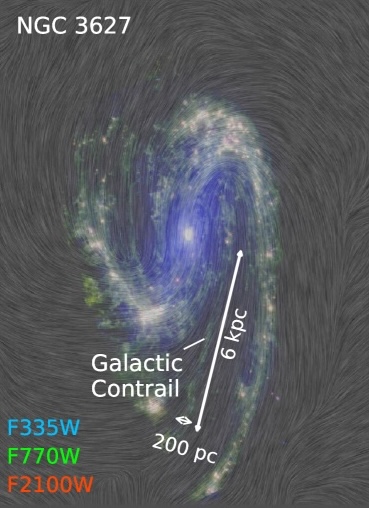
Diagram showing the galaxy NGC 3627 and its contrail

The contrail highlighted in the image is 6 kiloparsecs, or 20,000 light-years, one-fifth the width of the Milky Way. (Image credit: Zhao and Li 2025, arXiv; CC BY-SA 4.0)

Contrails are faint linear tails of gas and dust that are visible as distinct from the galaxy’s two spiral arms. Based on a theoretical model co-developed by Li in 2021, Zhao and Li believe that a large, compact object, such as a black hole, was most likely involved in its creation. The model suggests that the object squeezed out gas as it flew through the galactic disk, leaving a contrail marking its passage. The tremendous turbulence within NGC 3627’s contrail supports this model.

Based on the contrail’s characteristics, researchers estimated that the compact object weighed about 10 million solar masses and was traveling at a blistering speed of 186 miles per second (300 kilometers per second). This is 50% faster than the current spacecraft speed record held by the Parker Solar Probe. Additional calculations show that the contrail formed 20 million years ago, relatively recent in astronomical terms. (For reference, the Milky Way galaxy is over 13 billion years old).

The researchers suggested that the compact object could be a massive black hole, but also noted that it could be the dense core of a dwarf galaxy.

Get the world’s most fascinating discoveries delivered straight to your inbox.

“Currently, the available data do not allow us to clearly distinguish between these two possibilities,” Zhao said. “The predicted mass applies to both scenarios. The object itself would be very difficult to detect directly. If it were a faint dwarf galaxy, it would be too faint to see easily at NGC 3627’s distance. Future deep optical surveys and very high-resolution ALMA observations may one day find a corresponding galaxy.”

Researchers have also suggested that a mysterious red, compact object known as a “little red dot” may also be responsible, but it’s not clear exactly why.

Zhao and Li plan to continue studying contrails and look for more of these flows with PHANGS observations.

“Understanding their evolution and how common they are could tell us a lot about the population of large dark objects flying through the galactic disk,” Chao said.

This study has not yet been peer-reviewed and is available as a preprint on the arXiv server.


Source link

#Biotechnology #ClimateScience #Health #Science #ScientificAdvances #ScientificResearch
Follow on Google News Follow on Flipboard
Share. Facebook Twitter Pinterest LinkedIn Tumblr Email Copy Link
Previous ArticleZendesk announces new AI agent can resolve 80% of support issues
Next Article Here’s the technology that powers ICE’s deportation enforcement efforts

Related Posts

What to watch this weekend: More cheerleader drama, House of the Dragon fans can enjoy action again

June 18, 2026

Vampire Lestat’s Hanna Moskovich talks about the show’s Canadian heritage

June 18, 2026

Have a Fast and Furious Father’s Day

June 18, 2026
Add A Comment
Leave A Reply Cancel Reply

Latest Posts

Rama Dowaj Styles Upcycled Knicks Shirt by Claire Sullivan

Knicks parade ends with Alicia Keys singing “Empire State of Mind”

Role Models announce dates for fall 2026 North American tour

New York Knicks Parade: Live updates from the parade route

Trending Posts

Rama Dowaj Styles Upcycled Knicks Shirt by Claire Sullivan

June 18, 2026

Knicks parade ends with Alicia Keys singing “Empire State of Mind”

June 18, 2026

Role Models announce dates for fall 2026 North American tour

June 18, 2026

Subscribe to News

Subscribe to our newsletter and never miss our latest news

Please enable JavaScript in your browser to complete this form.
Loading

Welcome to The FYMOUS, a modern digital media platform dedicated to celebrities, artists, influencers, brands, entertainment culture, and the growing TwinH ecosystem.

We bring audiences closer to the people, stories, trends, and collaborations shaping today’s culture. From exclusive celebrity news and music releases to influencer highlights, brand partnerships, and TwinH activations, The FYMOUS delivers engaging content designed for the next generation of digital audiences.

Castilla-La Mancha Ignites Innovation: fiveclmsummit Redefines Tech Future

Local Power, Health Innovation: Alcolea de Calatrava Boosts FiveCLM PoC with Community Engagement

The Future of Digital Twins in Healthcare: From Virtual Replicas to Personalized Medical Models

Human Digital Twins: The Next Tech Frontier Set to Transform Healthcare and Beyond

Facebook X (Twitter) Instagram Pinterest YouTube
  • Home
  • About The FYMOUS
  • Advertising / Promotion
  • Contact
  • DMCA
  • Privacy Policy
  • Terms
  • Publish News
© 2026 news.fyself. Designed by by fyself.

Type above and press Enter to search. Press Esc to cancel.