

Simon & Schuster Books for Young Readers


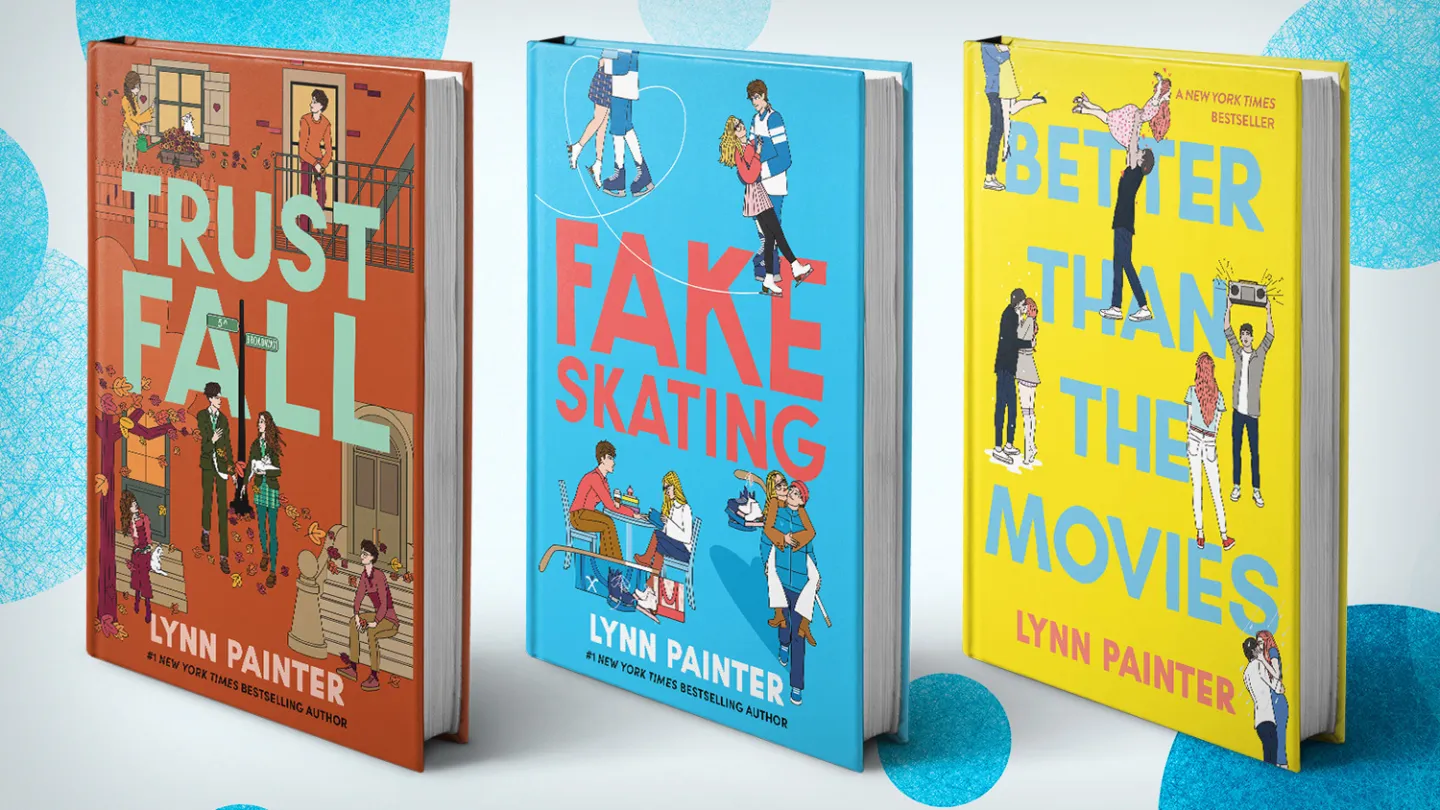
Author Lynn Painter still can’t quite believe her own life.
Fifteen years of rejection letters trying to land a literary agent has given way to a run that reads like one of her own plots: a Sony adaptation of her breakout YA novel Better Than the Movies now in production, a set visit with her family watching actors bring her characters to life, a casting announcement for the next adaptation of her book and a growing shelf of romance titles that stretch from teen rom-coms to adult fiction.
“Every single day, there’s something,” Painter tells The Hollywood Reporter. “I get an email from Sony like, ‘Hey, we’re gonna announce the cast today,’ and I’m like, what? Every day in my life right now is me just going, ‘What?’ It’s the greatest thing ever.”
Moments before the author’s chat with THR, the casting for Sony’s film adaptation of her novel Fake Skating was announced to be Amélie Hoeferle and Graham Campbell. Josh Boone is directing from a script penned by Morgan Lehmann and Victoria Bata and revised by Boone and his writing partner Knate Lee.
Painter says she saw Hoeferle and Campbell’s chemistry reads and couldn’t be happier with the decision. She recalls Boon sending her a video of the two actors with the author immediately thinking, “This could be magic.”
As the adaptation for Fake Skating is making leeway, Painter’s other adaptation Better Than the Movies is already filming with Julia Hart directing and David Iacono and Beatrice Kitsos starring. The author says she visited the set just last week. Seeing her debut novel come to life has been a “surreal” experience for the author who is still trying to comprehend it’s even happening in the first place.
“I don’t know anything about the movie industry, or I didn’t, [but] I’m learning really quickly,” she says. The author may not be steering the adaptation herself, but credits the team of creatives for instilling a genuine back-and-forth collaboration, given that it was readers, not studios, she says, who first found her characters Wes, Liz, Dani and Alec.
Hart and producer Jordan Horowitz, who also wrote the Better Than the Movies script, kept a line open throughout the writing process, regularly texting Painter to check whether specific scenes matched her original intent. “They’re very protective of the fact that readers found them first,” Painter says, adding that she trusts the filmmakers to hear her out if something felt off — though so far, nothing has: “They also are so good at what they do. … It’s kind of a perfect world.”
She also found solace knowing she and Hart were aligned from their very first conversation, largely because Hart immediately zeroed in on what Painter sees as the real engine of the book: Liz’s relationship with her mother and her coming-of-age arc, rather than the will-they-won’t-they romance alone.
“Right away from the get-go, I could tell that she and I see the story from the same place,” she tells THR. “Yes, it’s a rom-com, but I feel like the story isn’t just Wes and Liz finding each other attractive. It’s so much more nuanced than that with their lifetime of moments. I told them I feel like we wrote this whole thing together because they get it so much. The way they see it is the way I see it.”
She also teases that there isn’t “a lot that is different from the book” in the film and any changes are made to make sequences more concise while still hitting the same “emotional point.”
“I could never do an adaptation on my own because you’re taking a 350-page book and making it into a 100-page script. It takes a lot of knowing what you’re doing to not feel like you’re losing two-thirds of a book when you do it,” she says.
Painter is mum when it comes to delving further secrets from the set but did tease she got a glimpse of the machinery behind a single scripted moment — a rain-soaked car accident scene (book fans know the one) that required a full stunt team, safety vests and rigged rain towers.
Painter quips that she simply sat at her computer at the time and wrote “rain“ but now had to watch a meeting about how to logistically film the scene. She laughs, “Now they have 25 people out on a road in safety vests trying to figure out where they go off the road and how to make the rain towers work.”
As for Iacono and Kitsos’ take on her beloved characters Wes and Liz, Painter admits it was “a little bit freaky” with how good they were with portraying what she originally imagined. “Almost a better Wes and Liz than Wes and Liz in my head,” she assures. She says now she only pictures them when thinking of the characters: “Beatriz and David just blew me away.“
With filming already underway for one of her book adaptations and the other slated for a 2027 release, Painter can’t help but be reflective with the whirlwind of her career thus far. But Painter’s path to this moment wasn’t fast.
She spent roughly 15 years trying to land a literary agent before getting traditionally published, absorbing rejection after rejection with no guarantee of a breakthrough. “All I ever wanted was to see my book in a bookstore,” she said. That drawn-out struggle, she said, is precisely what makes the current moment feel earned rather than expected, and it sharpened her instinct to protect what got her here in the first place: the writing itself. “I don’t ever want to do anything to mess with that,” she said, “because first and foremost, that’s my favorite thing.”
Painter’s next book spotlight falls on Trust Fall, a book she describes as unusually personal. The book, released on Tuesday, is set in New York in the fall, something Painter drew on from her lifelong love of autumnal rom-coms and a fascination with the city she’d never visited while growing up in small-town Nebraska. Writing it gave her an excuse to travel there for research. “You see it on TV, and you just know, ‘That’s my place.’ And then the first time I went, I was like, I was right. It is my place.”
Simon & Schuster Books for Young Readers
The novel’s fish-out-of-water premise — a Midwestern protagonist dropped into a Gossip Girl-style world — comes directly from Painter’s own background, growing up outside a small town “where people socialize in cornfields on summer nights because there’s nowhere else to go.” Pairing her protagonist Julia against a wealthy, city-bred love interest Damion let her build the enemies-to-lovers dynamic she keeps returning to. And returning to it, by her own admission, is unavoidable. She admits that even while drafting her current work-in-progress, she pitched her editor a fake-dating plot yet again. “She’s like, ‘Maybe we don’t want to do fake dating again,’” Painter said. “And I’m just like, ‘But are you sure?’”
Fake-dating or not, Painter hopes to keep delivering romance stories both in the YA and adult genres. Thus far her novels have covered hockey romance, fake dating, cowboys, football and more. When it’s suggested there’s a Lynn Painter novel to align with any interest, she laughs and says “I got you!”
Inspiration for her novels comes at random moments, she says. She cites her next adult romance releasing in the spring, Cowboy Like Me, as an example given it was her “riff off of an old black-and-white Christmas movie Christmas in Connecticut.”
Other times she could be driving when an idea sparks: “I’ll be at a stoplight and I’ll put some notes in my notes app, and then I’ll go back to it later and make it into a story. So it’s really random. My brain is a chaotic, weird place.”
Lynn Painter
Jackson Okun
Asked about the difference between writing YA and adult romance, Painter said she doesn’t consciously shift approach — she starts every book simply wanting to write a rom-com, and the age of the characters imposes its own constraints later. As for what keeps her drawn to YA, the author explains it’s the specific emotional volatility of adolescence: “This strange time in your life where you straddle adulthood and childhood,” she says, describing how a single song tied to a two-week crush can still ache years later. However, she notes, “Adult books feel easier for me to draft and a little bit lighter even though reality is probably a little more harsh when you’re an adult.”
But whatever the concept, Painter knows the story will be a romance, a genre she has always loved and read. “It’s the joy of the happy ending and the comfort of what that entails,” she explains. “And seeing which trip this is gonna take. Which journey am I gonna go on before they end up together? That’s what I love about the genre.”
Painter is bullish on where romance is headed, pointing to the genre’s notable renaissance in adaptations and expansion into broader representation on the page and screen — with room still to grow. “Is there enough? Probably not. But it’s nice that it’s expanded in a thoughtful way,” she says.
But amid a rom-com renaissance, the author has a theory on the genre’s decline in the 2010s: It wasn’t audience fatigue but a notable drift away from what made rom-coms work in the first place — and what’s always existed in romance books. “They started trying to make rom-coms that were missing all the elements,” she said — the sense of two people truly seeing each other, rather than a thin premise for attraction. “The joy and the comfort of a rom-com is you know they’re gonna end up together,” she said. “We want those relationships, those [stories of] this person’s really seeing the other person, and those moments that bring people together. And that’s always been there in books.”
But her closest read on the current moment is personal: after years of a career that felt “impossible,” she’s now shuttling between book tours and adaptation meetings, still stunned by what has become of her work so far.
“Not to make it sound like a total after school special thing, but you literally have no idea what’s in store tomorrow. All of the years where I was trying so hard to make something happen in publishing and it wasn’t happening, I didn’t daydream about stuff like this, and it was impossible that it would happen,” she says.
No matter how big the Hollywood buzz gets, Painter remains fiercely grounded in the simple spark that started it all.
“I just want to sit and write my stupid little ‘Are they gonna kiss stories?’ So as long as I stay true to that it’s bringing me joy, and hopefully that joy filters through the process and comes out the other end.”