
Reinventing optical networks to promote the future of 6G

We have built the fast, energy efficient optical backbone needed to support future demand for 6G networks.
Our communications network needs to make significant progress to support future demand for 6G applications. To achieve the ambitious 6G goals, major upgrades will be required in the way optical networks (those that use light to transmit data) are designed and managed. These improvements include faster data transfer, lower latency, greater flexibility, greater energy efficiency, and smarter resource allocation with AI. This article outlines the new approach developed by the Proteus-6G project.
Innovating network infrastructure connectivity
One of the most important components of a 6G network is the infrastructure that connects the different parts of the system, especially the links between the central hub and the cell site. Proteus-6G introduces a new connection architecture (see Figure 1) that can better adapt to fluctuating traffic demands. In this system, each cell site receives data via dedicated optical fibers connected to a central hub. These hubs can dynamically allocate additional data signals when needed. If one site experiences an increase in demand, the system can reroute traffic over an alternative signal path with available capacity. Multiple transmitters work together to select the best path and reduce energy consumption.
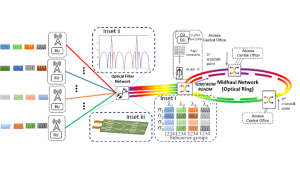
Photonic filter
This architecture adapts strategies used in modern data centers and applies them to mobile network infrastructure. However, traditional data center tools cannot handle the fine grain adjustments needed in this context. To address this, the Proteus-6G is used to better control signaling and reception using the advanced photonic filtering techniques highlighted in the inset of Figure 1. These techniques increase network efficiency by accurately dictating traffic where necessary.
Enabling 6G: Energy-efficient Transmission
Another co-innovation is the development of simplified, energy-efficient transmitters and receivers. These components transmit and detect optical signals without relying on complex, power-intensive digital processors. The Proteus-6G has developed two new components that manage signals optically rather than electronically, resulting in faster and more efficient performance. One of these components shown in Figure 2 can double the data throughput of a single optical channel compared to existing technologies. This is achieved by sending two data streams simultaneously using both polarized states of light.
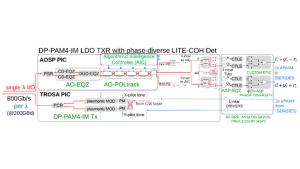
This configuration offers impressive speeds per channel up to 800 Gigabits. By aggregating some of these channels, the system can achieve 6 terabits per second on a single fiber. Such speeds are essential to enable high-performance 6G applications, such as large antenna arrays and boundless network systems. Additionally, the receiver is designed to handle signal distortion and delays, ensuring a stable and reliable connection over long distances.
Intelligent Management: Streamline Network Efficiency with Unified Control
Coordinating these various system elements requires intelligent management. Today’s networks often separate packet switching and optical path management, leading to inefficiency. For example, one controller can manage packet routing and another can handle physical optical paths. This fragmented control hinders network adaptability.
To solve this, Proteus-6G introduces an integrated control platform (see Figure 3) that integrates both packet and optical management into a single AI-enabled decision-making system. This allows the network to adapt quickly and intelligently, reroute traffic and relocate resources in real time. The system can manage routing, security, and service quality across all layers, from local cell sites to local hubs, while also supervising optical path management through advanced photonic equipment.
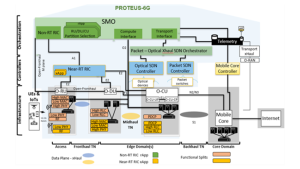
This integrated approach is important to support new 6G technologies. For example, modern routers need to manage fragmented data signals that travel across multiple paths. Only a unified controller can adjust this complexity and ensure efficient network operation.
Conversion Network: The Future of Proteus-6G Technology
In summary, Proteus-6G – Introduced with New Hardware, Advanced Signal Routing and centralized control, the innovation creates a fast, flexible, energy-efficient transport system tailored to 6G. The architecture supports the next generation of mobile networks. Here, multiple antennas work together to provide consistent coverage, and network components are dynamically adjusted based on real-time conditions. Energy savings are achieved by turning off the idle elements while only activating the required components.
Future efforts aim to make these technologies smaller and more integrated. Researchers also plan to eliminate digital processing in additional areas and apply AI to greater automation. These advances make networks more manageable and even more responsive.
The Proteus-6G initiative shows what is possible with cutting-edge hardware, intelligent software, and Visionary Design Converge. With ongoing development, this approach provides the backbone for next-generation mobile networks, supporting everything from smart cities to immersive virtual experiences.
This article will also be featured in the 23rd edition of Quarterly Publication.
Source link

