
Close Menu
  • Start
  • Celebrities
  • Music
  • Influencers
  • Tendencies
  • Exclusives
  • Business & Brands
  • TwinH
  • Spanish
What's Hot

This lifetime AI-powered piano app teaches you as you play for $99.97 during Deal Day.

Bonnie Tyler has recovered from coma but remains ‘very unwell’ after emergency surgery

Choose a new language (or 25 languages) with this $127 Rosetta Stone sale

Facebook X (Twitter) Instagram
  • Home
  • About The FYMOUS
  • Advertising / Promotion
  • Contact
  • DMCA
  • Privacy Policy
  • Terms
  • Publish News
Facebook X (Twitter) Instagram
FYMOUS News
  • Start
  • Celebrities
  • Music
  • Influencers
  • Tendencies
  • Exclusives
  • Business & Brands
  • TwinH
  • Spanish
FYMOUS News
Home » The world’s oldest known rock art, dating from before modern humans invaded Europe, was discovered in a cave in Indonesia.
Tendencies

The world’s oldest known rock art, dating from before modern humans invaded Europe, was discovered in a cave in Indonesia.

By January 21, 2026No Comments5 Mins Read
Share Facebook Twitter Pinterest Telegram LinkedIn Tumblr Email Copy Link
Follow Us
Google News Flipboard
Share
Facebook Twitter LinkedIn Pinterest Email Copy Link

Scientists have identified the world’s oldest known rock art. This is a hand-painted stencil created in Indonesia that is at least 67,800 years old.

The work, located in a cave on the southeastern island of Sulawesi, is also the earliest archaeological evidence of modern humans (Homo sapiens) living on the islands between the Asian and Australian continental shelves, according to a study published Wednesday (January 21) in the journal Nature. The hand stencil is surrounded by younger rock art, including another hand stencil.

The discovery could fill a major gap in scientists’ understanding of the journey that Australia’s indigenous ancestors took to reach the continent at least 60,000 years ago. “The people who painted these paintings in Sulawesi were very likely part of a broader population that later spread to the region and eventually reached Australia,” study lead author Adi Agus Octaviana, an archaeologist at Indonesia’s National Research and Innovation Agency, said in a statement.

you may like

Although the original meaning of the rock art is unknown, the hand stencils suggest that the artists belonged to a relatively large group with its own cultural identity, study co-author Maxime Aubert, an archaeologist and geochemist at Australia’s Griffith University, told Live Science. Aubert said the hand stencils may have been made to indicate group membership. “If you know about that cave and you know about this rock art, you’re part of that group, you’re part of that culture,” he said.

prehistoric art

Prehistoric rock art, art painted on rock surfaces such as cave walls and rock shelters, is found around the world, from 12,000-year-old carvings in Saudi Arabia to 4,000-year-old paintings along the U.S.-Mexico border. The oldest known rock art to date – a roughly 66,700-year-old handprint in Spain – is thought to have been created by Neanderthals, and current evidence suggests that modern humans arrived in Europe 54,000 years ago. However, the dating techniques used in its discovery are controversial.

However, humans have been creating art for even longer than these examples. The oldest known drawing is a 73,000-year-old hashtag on a stone in South Africa, and a 540,000-year-old seashell with zigzag carvings in Indonesia may have been made by Homo erectus.

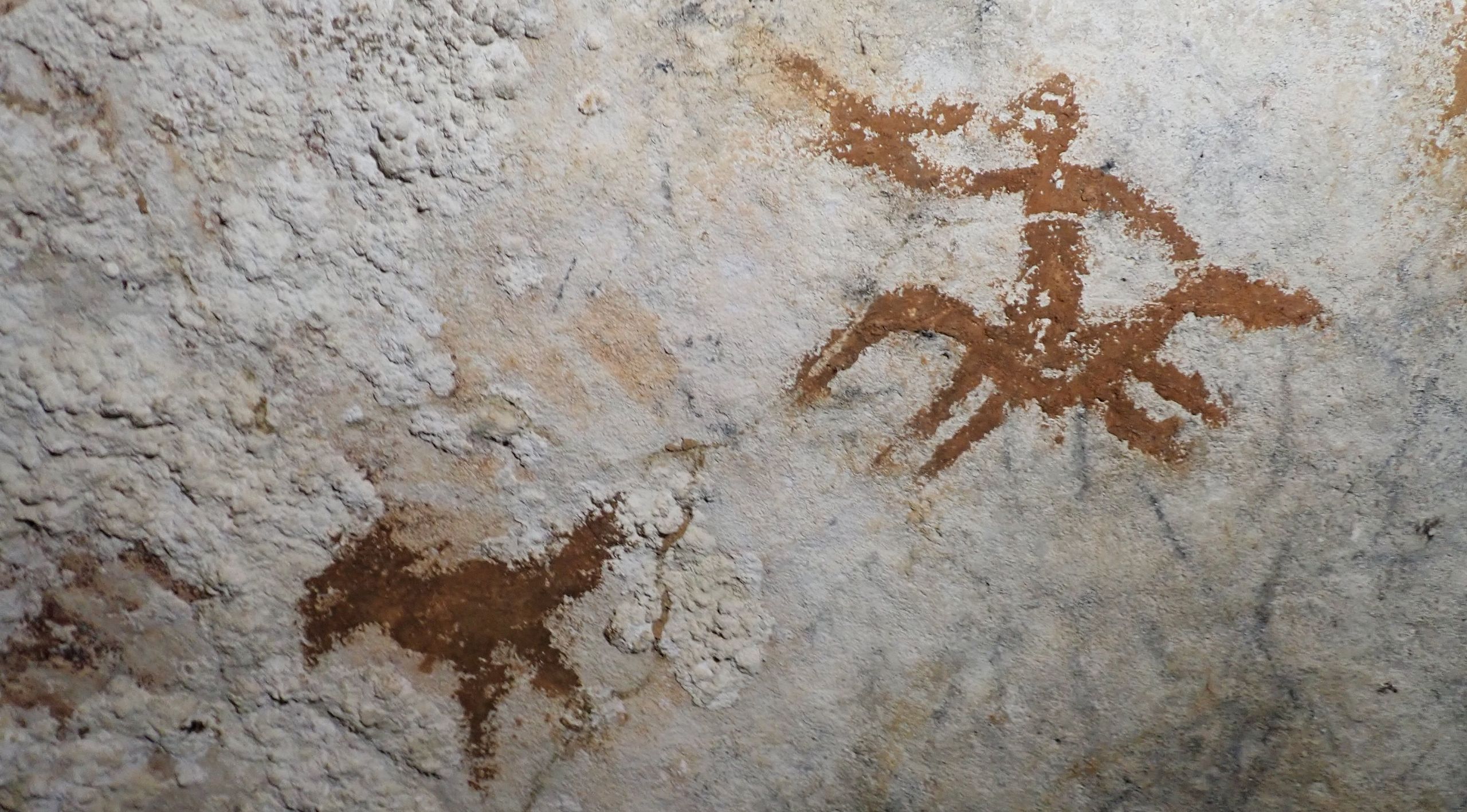
Sulawesi also has a long-standing artistic heritage, including depictions of humans interacting with wart-covered pigs dating back 51,200 years. As part of a broader project to document Sulawesi’s prehistoric artwork, Aubert and his team examined 11 designs (seven hand stencils, two human figures, and two geometric patterns) found in eight caves.

Get the world’s most fascinating discoveries delivered straight to your inbox.

All of these prehistoric creations were covered with lumps of calcium carbonate called “cave popcorn.” The cave popcorn must have grown after the artwork was created, so dating these growths can tell us the minimum age of the underlying image. In a few cases, maximum age may be obtained when pigment covers one of these mineral deposits.

As part of the project, researchers dated a 5.5-by-3.9-inch (14-by-10-centimeter) stencil to be at least 67,800 years old, making it 1,100 years older than rock art associated with Neanderthals in Spain. The color has faded considerably, but faint remains of fingers and palms remain. The fingers are intentionally thin, an artistic technique found only on the island of Sulawesi.
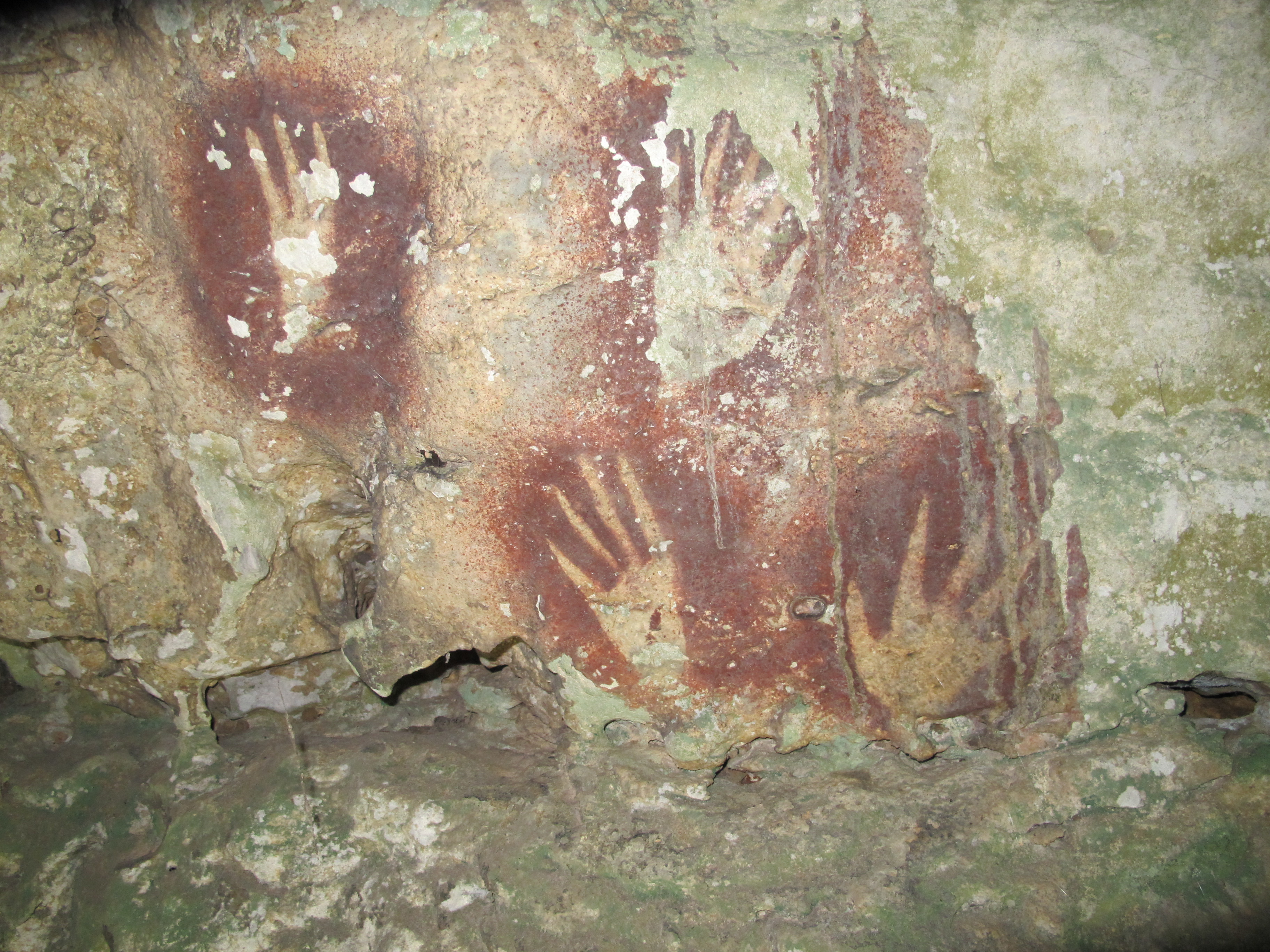
4 hand stencils make fingers slim

Hand stencils with intentionally narrowed fingers have been found elsewhere in Sulawesi, such as Lian Jarie in southern Sulawesi (shown here). (Image credit: Ahdi Agus Oktaviana)

Approximately 4.4 inches (11 cm) to the left of this artwork is a hand-drawn stencil created using darker pigment that is 32,800 years old. This indicates that prehistoric humans have been using the cave as a canvas for at least 35,000 years.

you may like

Although other human species once called Sulawesi home, researchers believe that Homo sapiens created these artifacts because creating tapered fingers is technically complex and modern humans are known to have lived in the area at the time.

This stencil may have been created by an individual spraying pigment on their hands with their mouth. This opens up the possibility of extracting DNA from works of art. “We might be able to learn about the genetic characteristics of the people who are doing this,” Aubert said. “That would be amazing.”

The identification of the oldest rock art on Sulawesi is an important discovery as it adds another data point on the path humans took to spread from the islands of Southeast Asia to Australia. Significantly, the discovery supports suggestions that modern humans navigated the northern passage from present-day Borneo to Sulawesi, then reached Australia via West Papua (the western half of New Guinea) or Indonesia’s Misool island, the authors said in their paper.
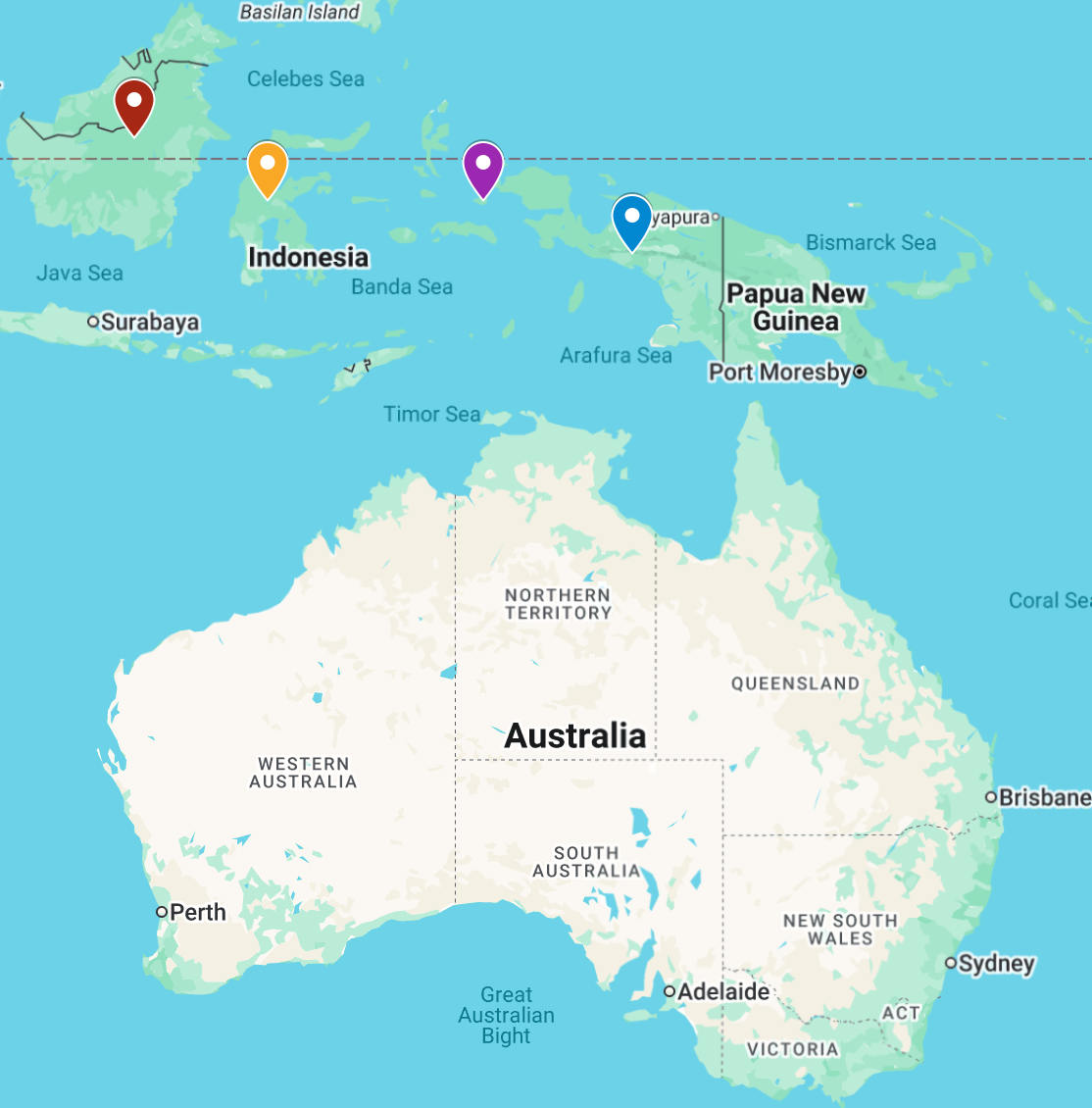
Map with points on Borneo, Sulawesi, Misool and West Papua

Newly dated rock art and other discoveries suggest that modern humans reached Australia via a sea route from present-day Borneo (red) to Sulawesi (orange) and then via western Papua (blue) or Indonesia’s Misuru Island (purple). (Image credit: Google Maps, map data copyright 2026, INEGI)

“This is an amazing discovery,” Chris Clarkson, also a professor of archeology at Griffith University who was not involved in the new study, told Live Science via email.

He agreed with the conclusion that ancient modern humans were most likely the hand stencil artists, since the dates are perfectly consistent with when they arrived in the region.

“What struck me most was that these works of art were placed directly on the immigration route to Australia,” he said. It also shows that Australia’s first settlers had rich cultural lives. “The first people to cross the islands of Southeast Asia and reach Australia didn’t just survive, they created art, crossed oceans and carried complex symbolic traditions,” Mr Clarkson said.


Source link

#Biotechnology #ClimateScience #Health #Science #ScientificAdvances #ScientificResearch
Follow on Google News Follow on Flipboard
Share. Facebook Twitter Pinterest LinkedIn Tumblr Email Copy Link
Previous ArticleThe 2.6 million-year-old jaw of the extinct ‘Nutcracker Man’ is discovered in an unexpected location
Next Article We’re not nostalgic for 2016 – we’re nostalgic for the internet before everything went crazy

Related Posts

Merlin, a common roadside duck in Mexico City, will be the World Cup mascot.

June 15, 2026

Far from the pitch, David Beckham remains soccer’s biggest star

June 14, 2026

Taylor Swift makes history as the youngest girl to be inducted into the Songwriters Hall of Fame

June 12, 2026
Add A Comment
Leave A Reply Cancel Reply

Latest Posts

This lifetime AI-powered piano app teaches you as you play for $99.97 during Deal Day.

Bonnie Tyler has recovered from coma but remains ‘very unwell’ after emergency surgery

Choose a new language (or 25 languages) with this $127 Rosetta Stone sale

Jelly Roll files for divorce from Bunny XO after 10 years of marriage

Trending Posts

Bonnie Tyler has recovered from coma but remains ‘very unwell’ after emergency surgery

June 16, 2026

Jelly Roll files for divorce from Bunny XO after 10 years of marriage

June 16, 2026

BTS is the group fans are most looking forward to seeing perform at the 2026 World Cup

June 15, 2026

Subscribe to News

Subscribe to our newsletter and never miss our latest news

Please enable JavaScript in your browser to complete this form.
Loading

Welcome to The FYMOUS, a modern digital media platform dedicated to celebrities, artists, influencers, brands, entertainment culture, and the growing TwinH ecosystem.

We bring audiences closer to the people, stories, trends, and collaborations shaping today’s culture. From exclusive celebrity news and music releases to influencer highlights, brand partnerships, and TwinH activations, The FYMOUS delivers engaging content designed for the next generation of digital audiences.

Castilla-La Mancha Ignites Innovation: fiveclmsummit Redefines Tech Future

Local Power, Health Innovation: Alcolea de Calatrava Boosts FiveCLM PoC with Community Engagement

The Future of Digital Twins in Healthcare: From Virtual Replicas to Personalized Medical Models

Human Digital Twins: The Next Tech Frontier Set to Transform Healthcare and Beyond

Facebook X (Twitter) Instagram Pinterest YouTube
  • Home
  • About The FYMOUS
  • Advertising / Promotion
  • Contact
  • DMCA
  • Privacy Policy
  • Terms
  • Publish News
© 2026 news.fyself. Designed by by fyself.

Type above and press Enter to search. Press Esc to cancel.