
Start searching for planets similar to Earth
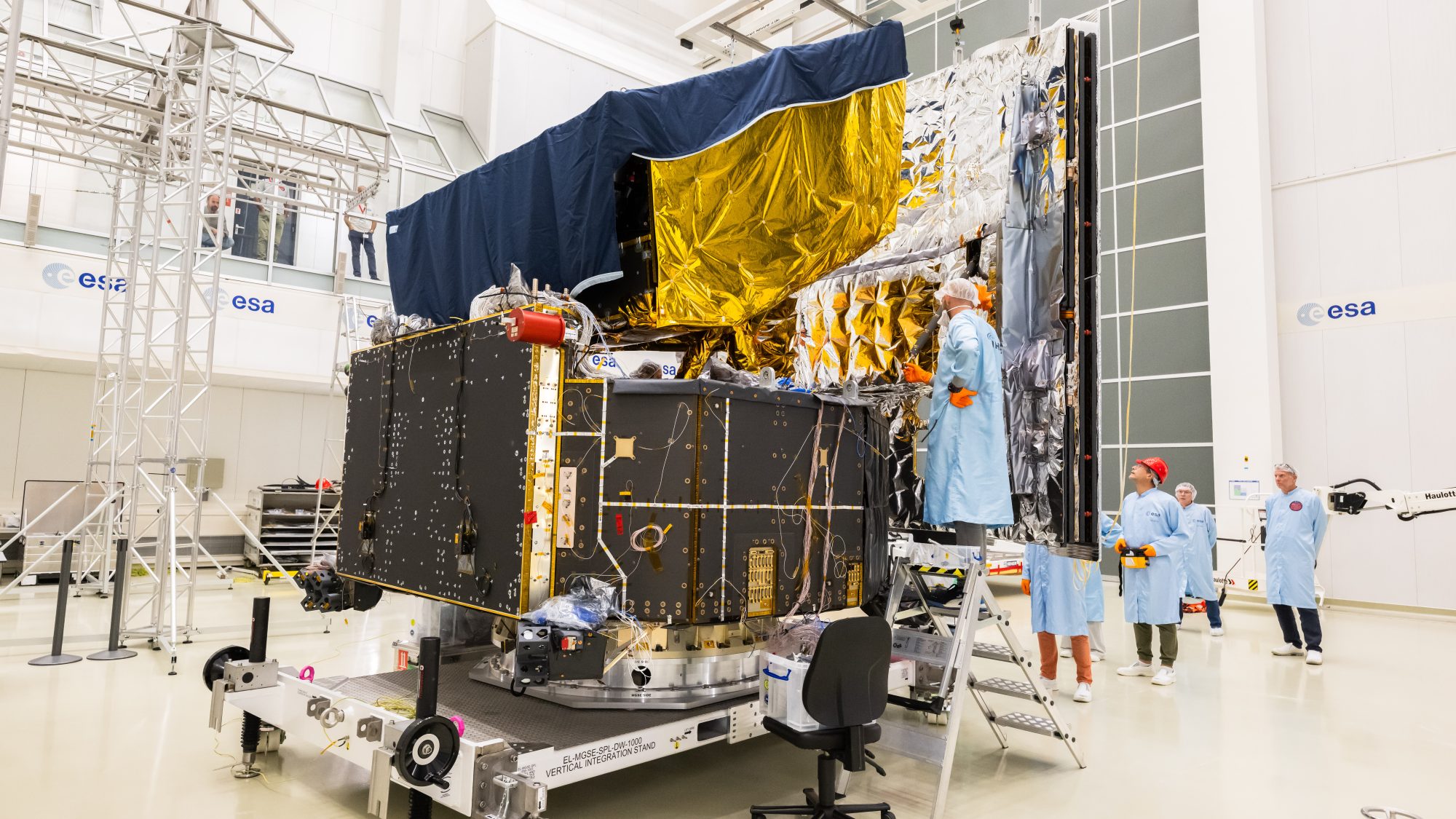
The European Space Agency (ESA) has officially completed the construction of its newest deep space observatory, Plato, taking an important step in its mission to discover Earth-like planets outside the solar system.
The spacecraft is designed to detect and study rocky exoplanets orbiting sun-like stars, and its final structural component, a combination sunshade and solar panel module, was recently successfully installed.
Engineers carried out the precision assembly at ESA’s test center in the Netherlands. The module was suspended from a specialized rig, carefully aligned and attached to the back of the spacecraft.
This integration completes the physical construction of Plato and puts it firmly on track for a series of rigorous environmental tests ahead of its scheduled launch in December 2026.
Telescope made for Earth-like planets
Plato, short for PLANetary Transits and Oscillations of Stars, is a space telescope designed to identify terrestrial exoplanets within the habitable zones of Sun-like stars.
These are “just right” areas where there is liquid water and conditions that could possibly support life.
To accomplish its mission, Plato is equipped with 26 advanced cameras that can observe more than 150,000 stars simultaneously.
These instruments monitor tiny dips in starlight caused by orbiting planets, a method known as transit technology.
Each camera is designed for high precision and kept at cryogenic temperatures (approximately -80°C) to ensure the best performance.
This configuration makes Plato particularly sensitive to detecting smaller Earth-sized planets. This is an important goal in the continued search for potentially habitable worlds.
Moving science from deep space
The newly installed solar panels and awnings are more than just structural additions.
Once in orbit, a sun-facing solar array will generate all the power needed to power Plato’s onboard systems, and a sunshade will keep delicate optical instruments cool and shaded.
The spacecraft’s solar panels will be deployed after launch, unfolding like wings to maximize exposure to sunlight. Engineers recently completed a successful deployment test using a pulley system to simulate weightlessness.
The test not only confirmed mechanical functionality, but also confirmed that the panels could generate sufficient power using high-intensity lamps to simulate solar radiation.
This significant success confirms that Plato is structurally and electrically ready for the next stage.
Built by Europe for the Stars
Plato is the result of a massive international collaboration. While ESA will lead the mission, its scientific instruments were developed in partnership with the Plato Mission Consortium, which includes research institutes, universities and aerospace companies from across Europe.
The spacecraft’s industrial assembly was carried out by the Plato Core team, led by German aerospace company OHB, with cooperation from Thales Alenia Space and Beyond Gravity.
This partnership demonstrates the power of pan-European cooperation in tackling some of science’s biggest challenges.
Next stop: Space simulation and stress testing
Once construction is complete, Plato must prove its readiness for space through a series of rigorous qualification tests. Engineers perform acoustic and vibration tests on the spacecraft that simulate the harsh conditions of a rocket launch.
Following this, Plato will be moved to Europe’s largest space environment simulator, a cryogenic vacuum chamber designed to mimic the cold, airless vacuum of space.
These final challenges will determine whether Plato can survive and thrive in the extreme environments he encounters after he begins his exploration of space.
A new era in the search for Earth-like planets
Plato is scheduled to launch on an Ariane 6 rocket at the end of 2026. Once operational, it will be located at the second Lagrangian point (L2), approximately 1.5 million kilometers from Earth.
From this vantage point, free from atmospheric interference, Plato begins his multi-year mission. It’s about scanning the galaxy for Earth-like planets that might one day change our understanding of life in the universe.
With its unique design, state-of-the-art equipment, and the power of multilateral collaboration, Plato is poised to usher in a new era of exoplanet discovery.
Source link

