

Close Menu
  • Home
  • Identity
  • Inventions
  • Future
  • Science
  • Startups
  • Spanish
What's Hot

European offshore wind power for a competitive EU steel industry

TeamPCP worm exploits cloud infrastructure to build criminal infrastructure

BeyondTrust fixes critical pre-authentication RCE vulnerability in remote support and PRA

Facebook X (Twitter) Instagram
  • Home
  • About Us
  • Advertise with Us
  • Contact Us
  • DMCA
  • Privacy Policy
  • Terms & Conditions
  • User-Submitted Posts
Facebook X (Twitter) Instagram
Fyself News
  • Home
  • Identity
  • Inventions
  • Future
  • Science
  • Startups
  • Spanish
Fyself News
Home » Visual confirmation: Groundbreaking images show for the first time that two black holes orbit each other
Science

Visual confirmation: Groundbreaking images show for the first time that two black holes orbit each other

userBy userOctober 9, 2025No Comments4 Mins Read
Share Facebook Twitter Pinterest Telegram LinkedIn Tumblr Email Copy Link
Follow Us
Google News Flipboard
Share
Facebook Twitter LinkedIn Pinterest Email Copy Link

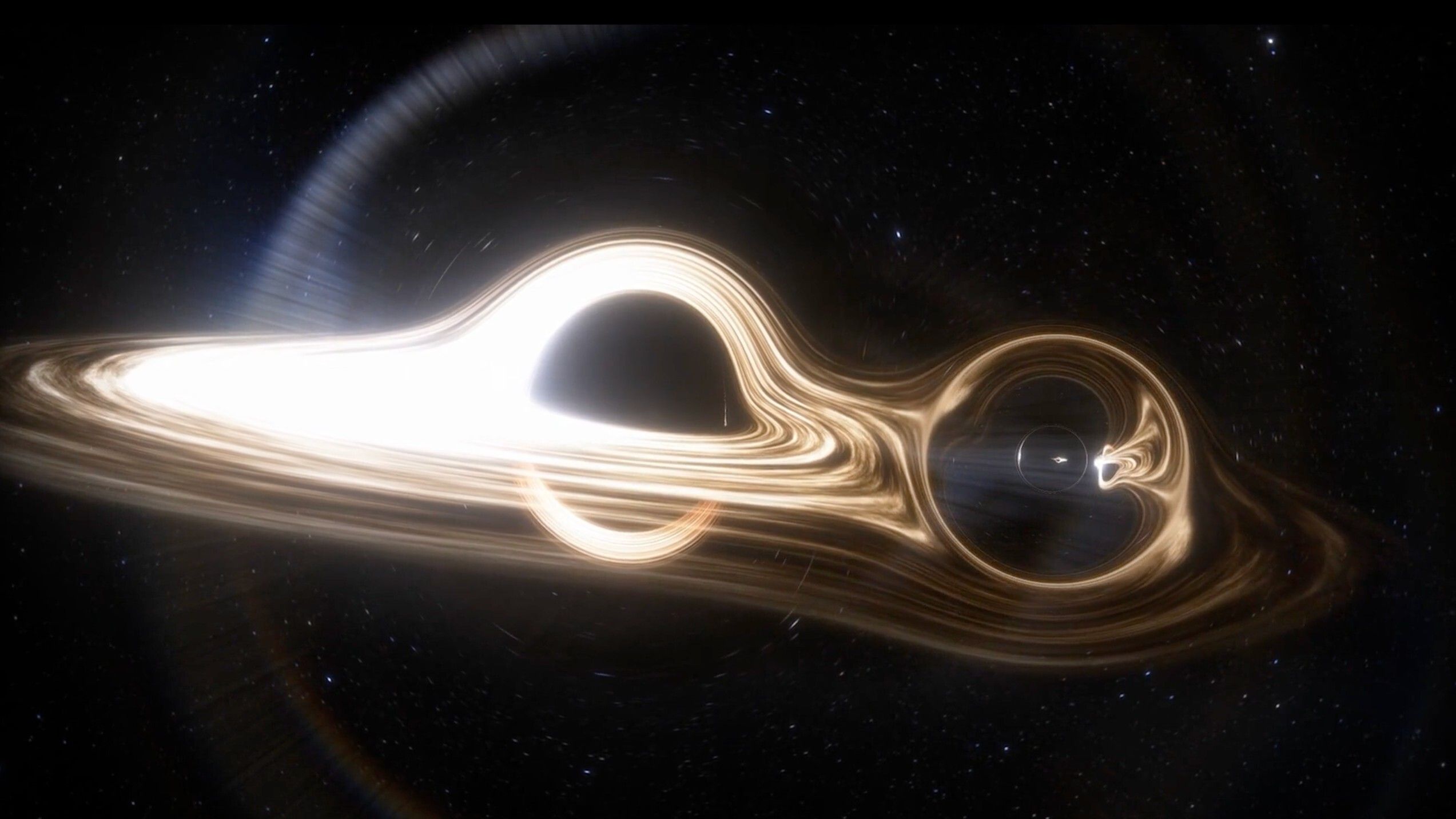
For the first time ever, astronomers have photographed two black holes orbiting each other, finally providing visual proof of the existence of a black hole pair.

The two black holes, discovered through faint fluctuations in radio light captured by both ground-based and space-based telescopes, are locked in a 12-year orbit about 5 billion light-years from Earth.

Smaller black holes were captured by jets of near-light-speed particles twisting like a spinning garden hose or a dog’s tail. The larger black hole is producing a larger cosmic fountain known as blazar OJ287, a supermassive monster with about 18 billion times the mass of the sun. The researchers published their results on October 9 in The Astrophysical Journal.

you may like

“For the first time, we have been able to obtain images of two black holes orbiting each other,” lead study author Mauri Valtonen, an astronomer at the University of Turku in Finland, said in a statement. “In images, black holes are identified by the powerful particle jets they emit. The black hole itself is completely black, but can be detected by these particle jets or by the glowing gas surrounding the hole.”

Black holes are born from the collapse of giant stars and grow by eating gas, dust, stars, and other black holes. In some of these greedy space-time ruptures, friction heats the material that spirals into its mouth, emitting light that telescopes can detect and turning it into so-called active galactic nuclei (AGNs).

The most extreme AGN is a quasar. Supermassive black holes, billions of times more massive than the sun, emit gaseous cocoons that emit light trillions of times brighter than the brightest stars. When these jets are directed into the Earth’s line of sight, they are known as blazers.

Astronomers have previously captured images of the supermassive giant at the center of the Milky Way and the nearby galaxy Messier 87, and there is ample evidence of black hole binaries and their mergers in the detection of gravitational waves. But despite long-standing suspicions that OJ287 contained an orbiting pair, telescopes lacked the resolution to separate them from a single point.

Get the world’s most fascinating discoveries delivered straight to your inbox.

In fact, observations of OJ287 date back to before astronomers knew black holes existed. The intensity of its semi-periodic flares was captured in late 19th century photographic plates made to study nearby cosmic objects. By revisiting data from these plates and follow-up observations, astronomers in the 1980s began to speculate that the system’s periodic dimming and brightening was caused by two orbiting black holes.

To arrive at visual evidence, the astronomers used radio images obtained by a network that included the RadioAstron (Spektr-R) satellite, a Russian scientific satellite carrying a radio telescope that operated from 2011 to 2019.
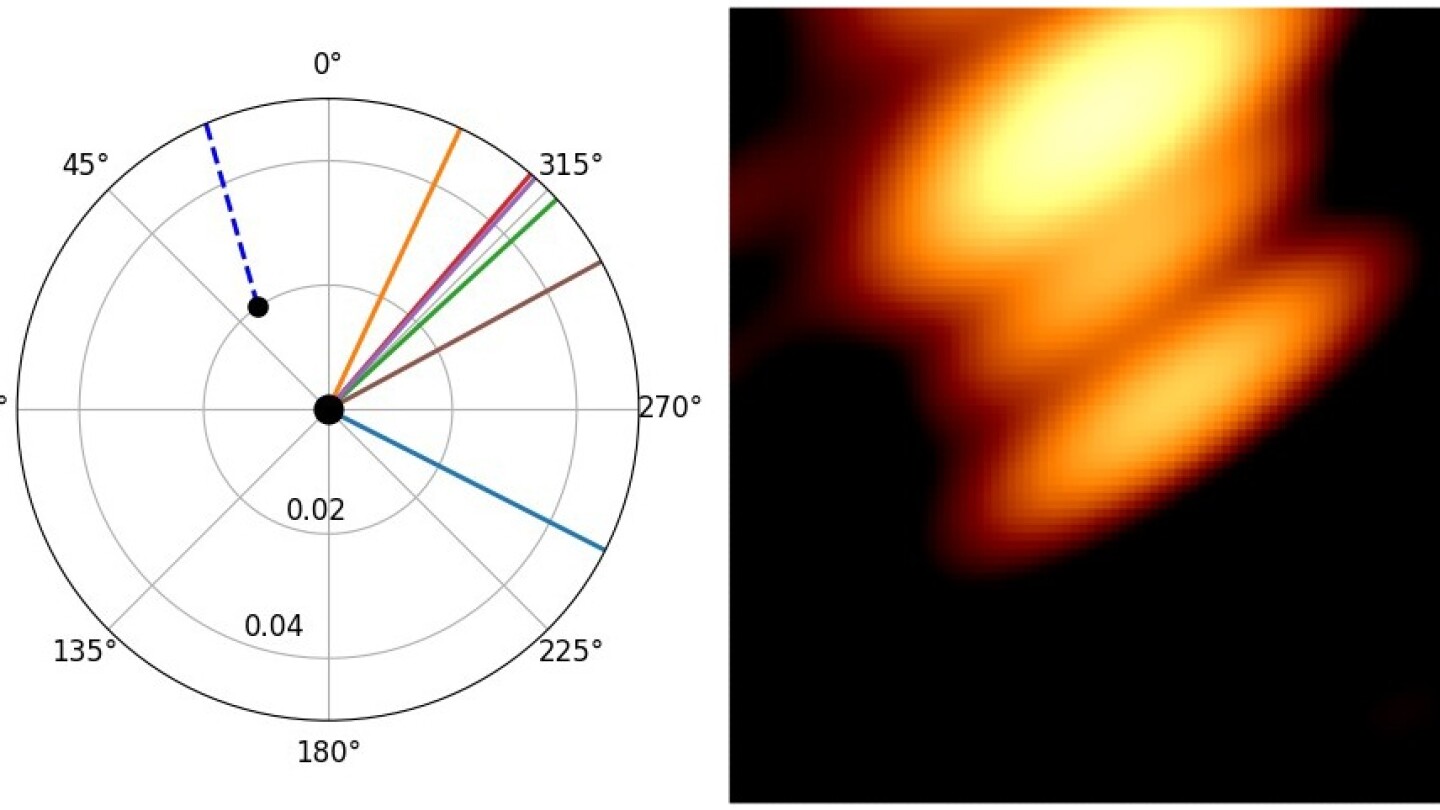
Theoretical diagram (left) and radio image (right) showing the position of the black hole and its jet at the time the image was taken.

Theoretical diagram (left) and radio image (right) showing the position of the black hole and its jet at the time the image was taken. (Image credit: Valtonen et al, 2025.)

“The satellite’s radio antenna reached halfway around the moon, which significantly improved the resolution of the images,” Valtonen said. “In recent years, we have only been able to use telescopes on Earth, where the image resolution is not very good.”

By comparing features in the images with past calculations, the researchers distinguished two components that correspond to each black hole jet appearing exactly where theory suggests.

Still, some wrinkles remain. The researchers cautioned that they still cannot completely rule out the possibility that the two jets in the image may overlap, meaning there is only one.

“In the future, if resolution close to that provided by RadioAstron is achieved again…it will be possible to examine the ‘tail wobbling’ of secondary black holes,” they write.


Source link

#Biotechnology #ClimateScience #Health #Science #ScientificAdvances #ScientificResearch
Follow on Google News Follow on Flipboard
Share. Facebook Twitter Pinterest LinkedIn Tumblr Email Copy Link
Previous ArticleJames Webb Telescope may have discovered controversial ‘dark star’ in distant space
Next Article Interstellar comet 3I/ATLAS is losing water ‘like a fire hose’ at full speed – and it’s ‘rewriting what we thought we knew’ about alien star systems
user
  • Website

Related Posts

History of Science: “Father of Modern Genetics” Describes Experiments with Peas That Prove Heredity is Transmitted in Discrete Units – February 8, 1865

February 8, 2026

This week’s science news: Anomalies inside Earth, the Artemis II leak and how psychedelics can help treat PTSD

February 7, 2026

Psychedelics may rewire the brain to treat PTSD. Scientists are finally beginning to understand how.

February 6, 2026
Add A Comment
Leave A Reply Cancel Reply

Latest Posts

European offshore wind power for a competitive EU steel industry

TeamPCP worm exploits cloud infrastructure to build criminal infrastructure

BeyondTrust fixes critical pre-authentication RCE vulnerability in remote support and PRA

Working together to build the fusion energy supply chain of the future

Trending Posts

Subscribe to News

Subscribe to our newsletter and never miss our latest news

Please enable JavaScript in your browser to complete this form.
Loading

Welcome to Fyself News, your go-to platform for the latest in tech, startups, inventions, sustainability, and fintech! We are a passionate team of enthusiasts committed to bringing you timely, insightful, and accurate information on the most pressing developments across these industries. Whether you’re an entrepreneur, investor, or just someone curious about the future of technology and innovation, Fyself News has something for you.

Castilla-La Mancha Ignites Innovation: fiveclmsummit Redefines Tech Future

Local Power, Health Innovation: Alcolea de Calatrava Boosts FiveCLM PoC with Community Engagement

The Future of Digital Twins in Healthcare: From Virtual Replicas to Personalized Medical Models

Human Digital Twins: The Next Tech Frontier Set to Transform Healthcare and Beyond

Facebook X (Twitter) Instagram Pinterest YouTube
  • Home
  • About Us
  • Advertise with Us
  • Contact Us
  • DMCA
  • Privacy Policy
  • Terms & Conditions
  • User-Submitted Posts
© 2026 news.fyself. Designed by by fyself.

Type above and press Enter to search. Press Esc to cancel.