
Close Menu
  • Home
  • Identity
  • Inventions
  • Future
  • Science
  • Startups
  • Spanish
What's Hot

From Svedka to Anthropic, brands are boldly leveraging AI in their Super Bowl ads

OpenClaw integrates VirusTotal scanning to detect malicious ClawHub skills

India changes deep tech startup rules

Facebook X (Twitter) Instagram
  • Home
  • About Us
  • Advertise with Us
  • Contact Us
  • DMCA
  • Privacy Policy
  • Terms & Conditions
  • User-Submitted Posts
Facebook X (Twitter) Instagram
Fyself News
  • Home
  • Identity
  • Inventions
  • Future
  • Science
  • Startups
  • Spanish
Fyself News
Home » Mysterious dark object could shed light on theories about the universe
Inventions

Mysterious dark object could shed light on theories about the universe

userBy userOctober 13, 2025No Comments3 Mins Read
Share Facebook Twitter Pinterest Telegram LinkedIn Tumblr Email Copy Link
Follow Us
Google News Flipboard
Share
Facebook Twitter LinkedIn Pinterest Email Copy Link

Through a worldwide network of telescopes, astronomers have discovered the lowest-mass dark object ever discovered in the universe.

By clarifying the nature of this dark object, we may be able to eliminate theories about the nature of dark matter.

This mysterious object has about 1 million times the mass of the Sun. Its nature is unknown. It could be a clump of dark matter 100 times smaller than anything detected so far. Alternatively, it could be a very compact, inactive dwarf galaxy.

“It’s an amazing feat to detect such a low-mass object at such a distance from us,” said study co-author Chris Fasnacht, a professor in the Department of Physics and Astronomy at the University of California, Davis.

“Finding such low-mass objects is very important for understanding the nature of dark matter.”

Detecting dark objects with gravitational lenses

Dark objects do not emit light or other radiation. Therefore, it was detected by the way its gravity distorts light passing through it, or near it.

This effect is known as gravitational lensing, and astronomers can infer the amount of matter in invisible objects based on the distortion.

The new object is so small that it was detected by causing a small pinch in the distorted image caused by a much larger object, such as a scratch on a mirror in the recreation room.

Global telescope collaboration

The team used instruments such as the Green Bank Telescope (GBT) in West Virginia; Very Long Baseline Array (VLBA), Hawaii. And the European Very Long Baseline Interferometry Network (EVN), which includes radio telescopes in Europe, Asia, South Africa and Puerto Rico, will build an Earth-sized supertelescope to capture the subtle signals of gravitational lensing by mysterious dark objects.
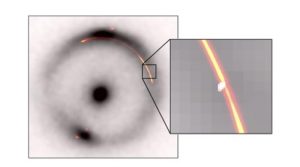
dark object
The black ring and central dot show an infrared image of a distant galaxy distorted by gravitational lensing. Orange/reg indicates radio waves from the same celestial body. The inset shows a pinch caused by another much smaller dark gravitational lens (white blob). Credit: Devon Powell, Max Planck Institute for Astrophysics

This is 100 times the lowest mass object ever discovered by this technique, suggesting the method can be used to find other similar objects.

“Given the sensitivity of the data, we expected to find at least one dark object. Our discovery is therefore consistent with the so-called ‘cold dark matter theory’, which underlies much of our understanding of galaxy formation,” explained lead author Devon Powell from Germany’s Max Planck Institute for Astrophysics (MPA).

“Now that we’ve found one, the next question is whether we can find more and whether the numbers still match the model.”

The team plans to further analyze the data to better understand the nature of dark objects. They also plan to look for more examples of such faint objects in other parts of the sky.


Source link

#CreativeSolutions #DigitalTransformation. #DisruptiveTechnology #Innovation #Patents #SocialInnovation
Follow on Google News Follow on Flipboard
Share. Facebook Twitter Pinterest LinkedIn Tumblr Email Copy Link
Previous ArticleRice University Announces Environmentally Friendly PFAS Removal Technology
Next Article What would have happened if Christopher Columbus had never reached America?
user
  • Website

Related Posts

Combat antimicrobial resistance with McGill rapid tests

February 6, 2026

How printed electronics from Tampere Uni is building a sustainable future

February 6, 2026

Puragen unveils PFAS treatment technology during UK ministerial visit

February 6, 2026
Add A Comment
Leave A Reply Cancel Reply

Latest Posts

From Svedka to Anthropic, brands are boldly leveraging AI in their Super Bowl ads

OpenClaw integrates VirusTotal scanning to detect malicious ClawHub skills

India changes deep tech startup rules

Kids ‘picked last in gym class’ prepare for Super Bowl

Trending Posts

Subscribe to News

Subscribe to our newsletter and never miss our latest news

Please enable JavaScript in your browser to complete this form.
Loading

Welcome to Fyself News, your go-to platform for the latest in tech, startups, inventions, sustainability, and fintech! We are a passionate team of enthusiasts committed to bringing you timely, insightful, and accurate information on the most pressing developments across these industries. Whether you’re an entrepreneur, investor, or just someone curious about the future of technology and innovation, Fyself News has something for you.

Castilla-La Mancha Ignites Innovation: fiveclmsummit Redefines Tech Future

Local Power, Health Innovation: Alcolea de Calatrava Boosts FiveCLM PoC with Community Engagement

The Future of Digital Twins in Healthcare: From Virtual Replicas to Personalized Medical Models

Human Digital Twins: The Next Tech Frontier Set to Transform Healthcare and Beyond

Facebook X (Twitter) Instagram Pinterest YouTube
  • Home
  • About Us
  • Advertise with Us
  • Contact Us
  • DMCA
  • Privacy Policy
  • Terms & Conditions
  • User-Submitted Posts
© 2026 news.fyself. Designed by by fyself.

Type above and press Enter to search. Press Esc to cancel.