


Close Menu
  • Home
  • Identity
  • Inventions
  • Future
  • Science
  • Startups
  • Spanish
What's Hot

OpenClaw integrates VirusTotal scanning to detect malicious ClawHub skills

Kids ‘picked last in gym class’ prepare for Super Bowl

NBA star Giannis Antetokounmpo joins Calci as an investor

Facebook X (Twitter) Instagram
  • Home
  • About Us
  • Advertise with Us
  • Contact Us
  • DMCA
  • Privacy Policy
  • Terms & Conditions
  • User-Submitted Posts
Facebook X (Twitter) Instagram
Fyself News
  • Home
  • Identity
  • Inventions
  • Future
  • Science
  • Startups
  • Spanish
Fyself News
Home » New image of interstellar object 3I/ATLAS shows giant ‘jet’ shooting towards the sun
Science

New image of interstellar object 3I/ATLAS shows giant ‘jet’ shooting towards the sun

userBy userOctober 23, 2025No Comments4 Mins Read
Share Facebook Twitter Pinterest Telegram LinkedIn Tumblr Email Copy Link
Follow Us
Google News Flipboard
Share
Facebook Twitter LinkedIn Pinterest Email Copy Link

Newly released images of interstellar comet 3I/ATLAS show the alien body spewing giant jets of gas and dust toward the sun, just as comets are expected to do.

The comet, discovered in late June and confirmed by NASA in early July, originates from an unknown star system far beyond our own. 3I/ATLAS is only the third interstellar object ever detected. Measuring somewhere between 3 and 7 miles (5 and 11 kilometers) across, it is the largest interstellar object to have ever crossed our path, and is likely the oldest, potentially dating back to billions of years before the birth of the Sun.

These and other peculiarities have led a small group of researchers to controversially claim that this object could be an alien spacecraft sent to spy on us. However, most scientists maintain that 3I/ATLAS is a high-velocity comet that moves as comets are supposed to. New images of the interstellar interloper, captured on August 2 by the Two Meter Twin Telescope (TTT) at the Teide Observatory in Spain’s Canary Islands, further solidify the object’s natural origin.

you may like

The composite image, which combines 159 exposures lasting 50 seconds each, shows 3I/ATLAS’s icy object (or core) as a large black dot surrounded by a white glow. An abrupt fan-shaped break in this glowing ring, the researchers say, marks the spot where a huge jet of high-velocity material (marked in purple) is being blown away from the comet toward the sun. The image was briefly shared to the Astronomers Telegram on October 15, but has not yet been published in a peer-reviewed study.
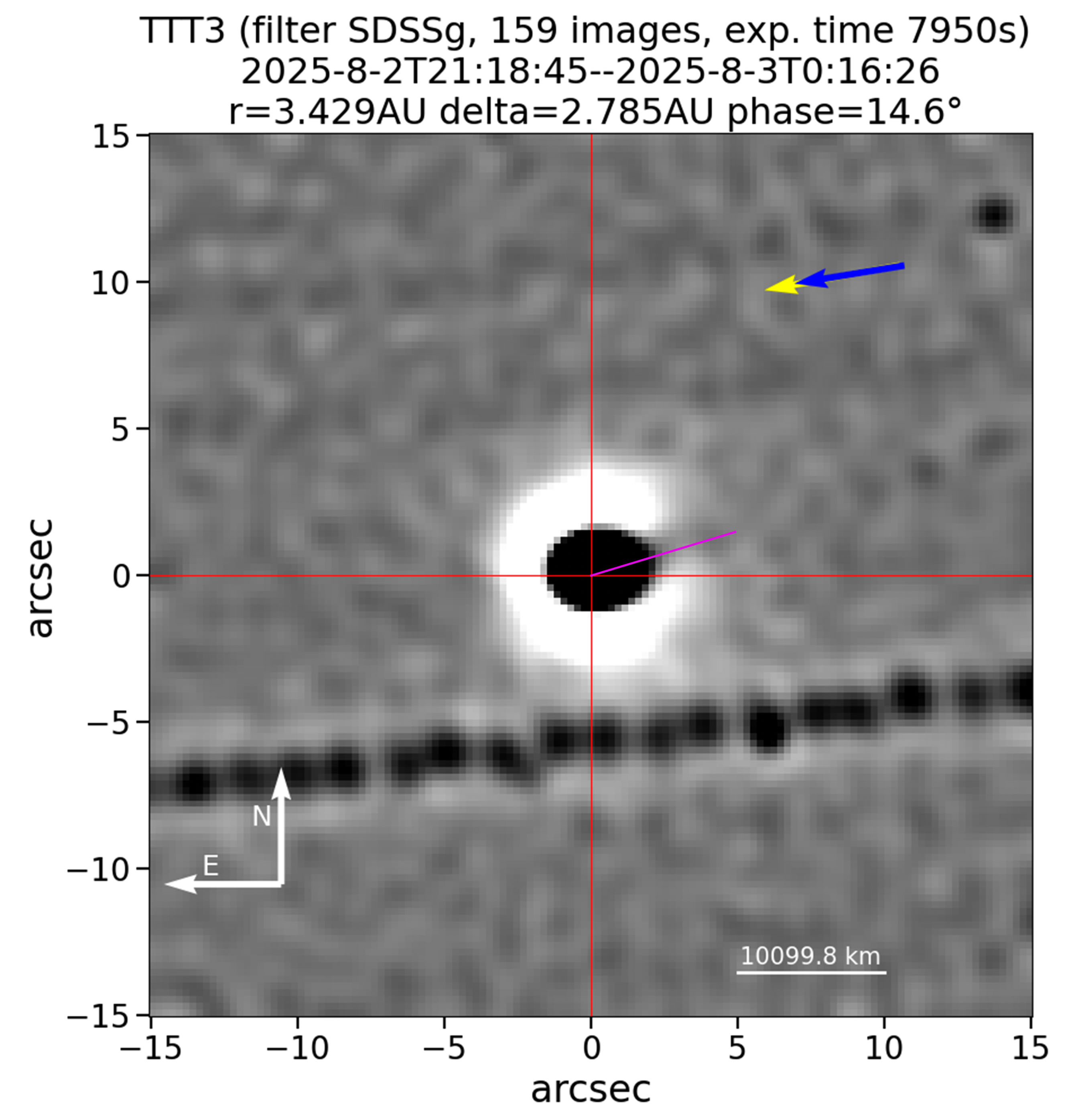
Telescope composite image of Comet 3I/ATLAS

A composite image of interstellar comet 3I/ATLAS shows a newly detected jet (purple line) pointing toward the Sun. The yellow line shows the anti-sun direction, and the blue line shows the comet’s velocity vector. (Image credits: Teide Observatory, M. Serra-Ricart, Light Bridges)

Comets are famous for their glowing tails of ionized gas, the largest of which can extend hundreds of millions of miles in the opposite direction of the Sun. In comparison, cometary jets are much smaller and can be pointed toward the Sun. A dust cannon aimed at our star may sound suspicious, but it’s just a standard part of a comet’s anatomy, Miquel Serra Ricart, an astrophysicist and scientific director at the Teide Observatory’s Lightbridge Research Institute, told Live Science in an email.

“This is always the case,” Sera Ricart, who posted the new image, told Live Science. “What the jet is pointing at is [the] direction of the sun [the] The comet’s tail points toward the sun. ”

This is because comets inevitably heat up as they approach the Sun, but it doesn’t always heat up evenly. The side of the comet facing the sun heats up fastest, and when certain weak spots on the comet’s surface heat up enough, the supply of sublimated gas can increase and erupt like a geyser, sending the comet’s material thousands of miles toward the sun.

Get the world’s most fascinating discoveries delivered straight to your inbox.

Comet blinking animation

These Hubble Space Telescope images of comet NEOWISE show a fan-shaped jet ejecting from the comet’s core after it passed close to the Sun in 2020. (Image credits: NASA, ESA, Q. Zhang (California Institute of Technology), A. Pagan (STScI), M. Kornmesser)

As the comet’s core rotates, the jets may take on a fan shape similar to the one seen in the new TTT image, Serra-Rickert added. The famous naked-eye comet Neowise also developed a fan-shaped jet after approaching the sun in 2020, Hubble Space Telescope observations at the time showed.

Some of that jet material ends up in the comet’s coma (a glowing plume of material surrounding the core), but some can be forced into the comet’s tail by radiation pressure from the onslaught of incoming solar wind. This is why comets can have both a sun-facing jet and an anti-sun-facing tail at the same time. No alien technology required.

It’s currently unclear how far this newly discovered jet extends, but Serra-Rickert estimates it could extend approximately 6,200 miles (10,000 km) from the surface of 3I/ATLAS. He added that the jet is likely composed primarily of dust particles and carbon dioxide, which is consistent with the composition of a large gaseous plume detected around the comet by the James Webb Space Telescope in August.

3I/ATLAS plunged past Mars on October 3rd and is currently approaching its closest point to the Sun (perihelion), expected to reach it on October 29th. The comet is currently on the far side of the Sun and won’t be seen again from Earth until mid-November. When it reappears, astronomers will have a rare opportunity to see how this mysterious visitor has changed after its date with the Sun, and how far its jet and tail have grown.


Source link

#Biotechnology #ClimateScience #Health #Science #ScientificAdvances #ScientificResearch
Follow on Google News Follow on Flipboard
Share. Facebook Twitter Pinterest LinkedIn Tumblr Email Copy Link
Previous ArticlePresident Trump credits Benioff and Hwang for decision not to ‘rush’ Fed troops to San Francisco
Next Article Ford doesn’t plan to increase production of the F-150 Lightning for a while
user
  • Website

Related Posts

This week’s science news: Anomalies inside Earth, the Artemis II leak and how psychedelics can help treat PTSD

February 7, 2026

Psychedelics may rewire the brain to treat PTSD. Scientists are finally beginning to understand how.

February 6, 2026

All major galaxies except one are moving away from the Milky Way – and we finally know why

February 6, 2026
Add A Comment
Leave A Reply Cancel Reply

Latest Posts

OpenClaw integrates VirusTotal scanning to detect malicious ClawHub skills

Kids ‘picked last in gym class’ prepare for Super Bowl

NBA star Giannis Antetokounmpo joins Calci as an investor

New York state lawmaker proposes three-year moratorium on new data centers

Trending Posts

Subscribe to News

Subscribe to our newsletter and never miss our latest news

Please enable JavaScript in your browser to complete this form.
Loading

Welcome to Fyself News, your go-to platform for the latest in tech, startups, inventions, sustainability, and fintech! We are a passionate team of enthusiasts committed to bringing you timely, insightful, and accurate information on the most pressing developments across these industries. Whether you’re an entrepreneur, investor, or just someone curious about the future of technology and innovation, Fyself News has something for you.

Castilla-La Mancha Ignites Innovation: fiveclmsummit Redefines Tech Future

Local Power, Health Innovation: Alcolea de Calatrava Boosts FiveCLM PoC with Community Engagement

The Future of Digital Twins in Healthcare: From Virtual Replicas to Personalized Medical Models

Human Digital Twins: The Next Tech Frontier Set to Transform Healthcare and Beyond

Facebook X (Twitter) Instagram Pinterest YouTube
  • Home
  • About Us
  • Advertise with Us
  • Contact Us
  • DMCA
  • Privacy Policy
  • Terms & Conditions
  • User-Submitted Posts
© 2026 news.fyself. Designed by by fyself.

Type above and press Enter to search. Press Esc to cancel.