


The ability to create art has long been considered a hallmark of our species. More than a century ago, prehistorians could not believe that modern humans from the Upper Paleolithic period (45,000 to 12,000 years ago) were capable of artistic talent.
Their doubts were soon dispelled by the discovery of undisputed ancient works of art in the caves and rock caves of Europe. But what about Neanderthals? An ancient big-brained sister group to our own species? We now know that they also had the ability to make art.
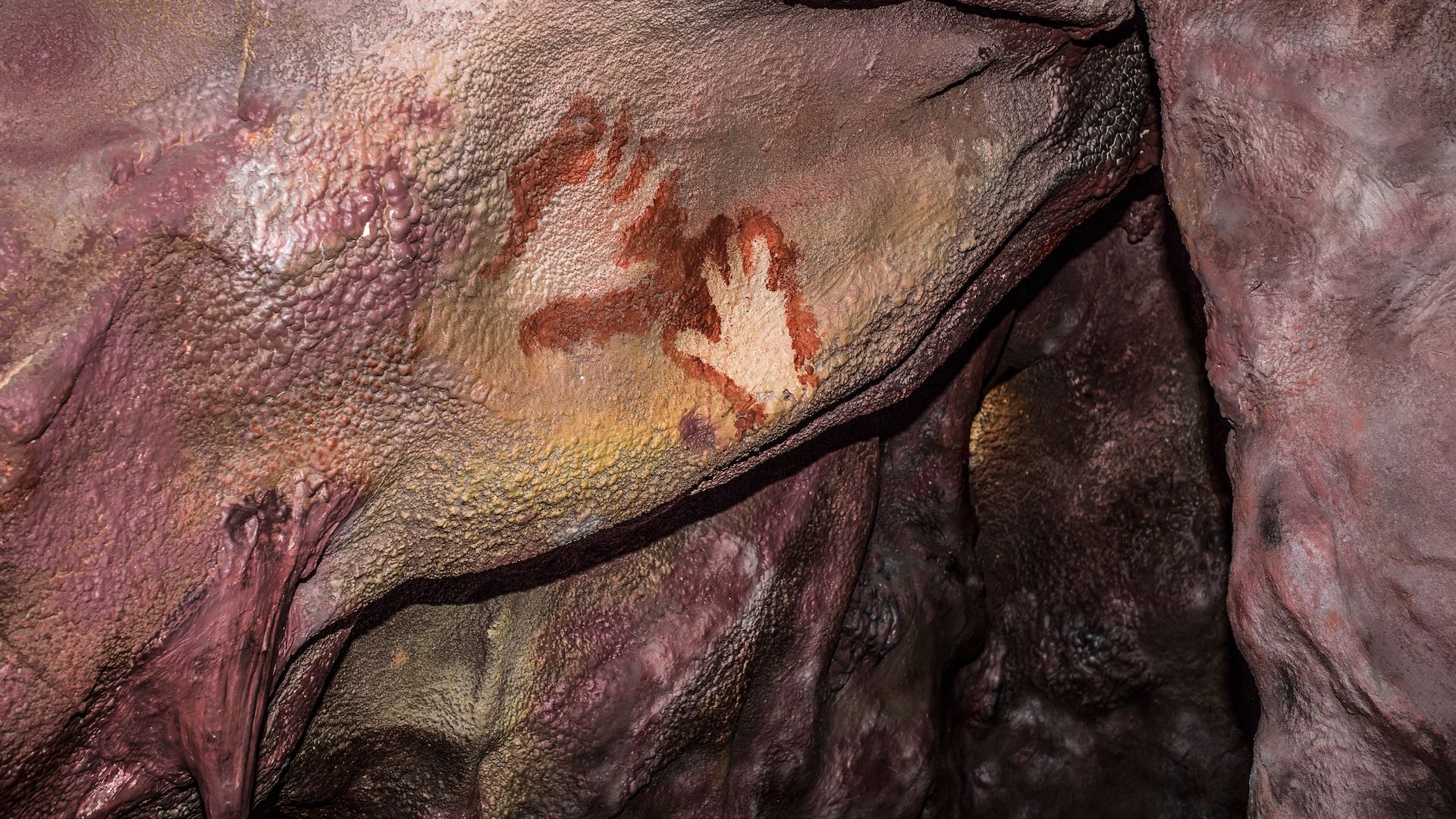
However, at this time, all evidence of Neanderthals is non-figurative, with no depictions of animals, including humans. This latter art form was probably exclusive to Homo sapiens. Instead, the Neanderthal example consists of hand stencils made by spraying pigment onto the hands, finger fluting with fingers pressed against soft surfaces, and geometric patterns.
you may like
Neanderthals lived in western Eurasia from about 400,000 years ago until they became extinct about 40,000 years ago, and are often caricatured as typical “cavemen.”
Questions about their cognitive and behavioral sophistication never fully go away, and whether they produced art is at the forefront of this question.
Despite the fact that we know that Neanderthals were able to manufacture jewelry and use colored pigments, there has been much opposition to the idea that they explored deep caves and left art on the walls.
But recent research has confirmed beyond any doubt that they did. In three caves in Spain: La Pasiega in Cantabria, Maltravieso in Extremadura, and Aldales in Malaga, Neanderthals used pigments to create linear signs, geometric shapes, hand stencils, and handprints. At La Roche Cotard, a cave in France’s Loire Valley, Neanderthals left behind various lines and shapes with finger fluting.
And deep in the Bruniquel Cave in southwestern France, they broke the stalactites into pieces of equal length, built large oval walls with them, and set fire to them. This isn’t a shelter, it’s something more bizarre, and if this were built in a modern art museum, you’d definitely think it was installation art.
Now that established examples of Neanderthal art have been found on cave walls in France and Spain, further discoveries are inevitable. However, the task is difficult because the age of Paleolithic cave paintings is difficult to establish. In fact, it is often the focus of heated debate among experts.
Relative dating methods based on the style and theme of cave paintings and comparisons of objects recovered from older archaeological levels have proven useful, but have limitations.
you may like
At least one of three conditions is required to generate an actual age. The first is the presence of charcoal pigments, which can be dated using radiocarbon methods. This will tell you exactly when the charcoal was made (and when the tree died). However, because the black pigment is often derived from a mineral (manganese), large amounts of black cave art simply cannot be dated.
A further question is whether the charcoal was produced at the same time it was used as a pigment. They were able to pick up 30,000 year old charcoal from the cave floor and write “Paul was here” on the cave wall. Radiocarbon dates do not reflect when my doodles were actually created.
The second condition is the presence of calcite flowstones (stalactites and stalagmites) formed on the art. They must be younger than that if they clearly grew up on the artwork. Using a dating method based on the decay of uranium into isotopes (specific forms) of the element thorium, it is possible to pinpoint when the flowstone was formed and determine the minimum age of the underlying art.
I was part of a team that used this method to date the flowstones on top of the red pigment art in the three aforementioned Spanish caves, demonstrating that the hand stencils, dots, and color washes must have been created more than 64,000 years ago. This is the minimum age. The actual age of the image may be even older.
But even at their youngest range, these images predate the time when modern humans (Homo sapiens) first arrived in Iberia by at least 22,000 years. Because Middle Paleolithic archeology (Neanderthals’ calling card) is common to all three caves, the simplest interpretation that fits the dating is that Neanderthals were the authors of the images.
Disputes to our results ignored the supporting information we published. Did the dated sample really cover the art? They did. Is the technology reliable? It has been going on for half a century.
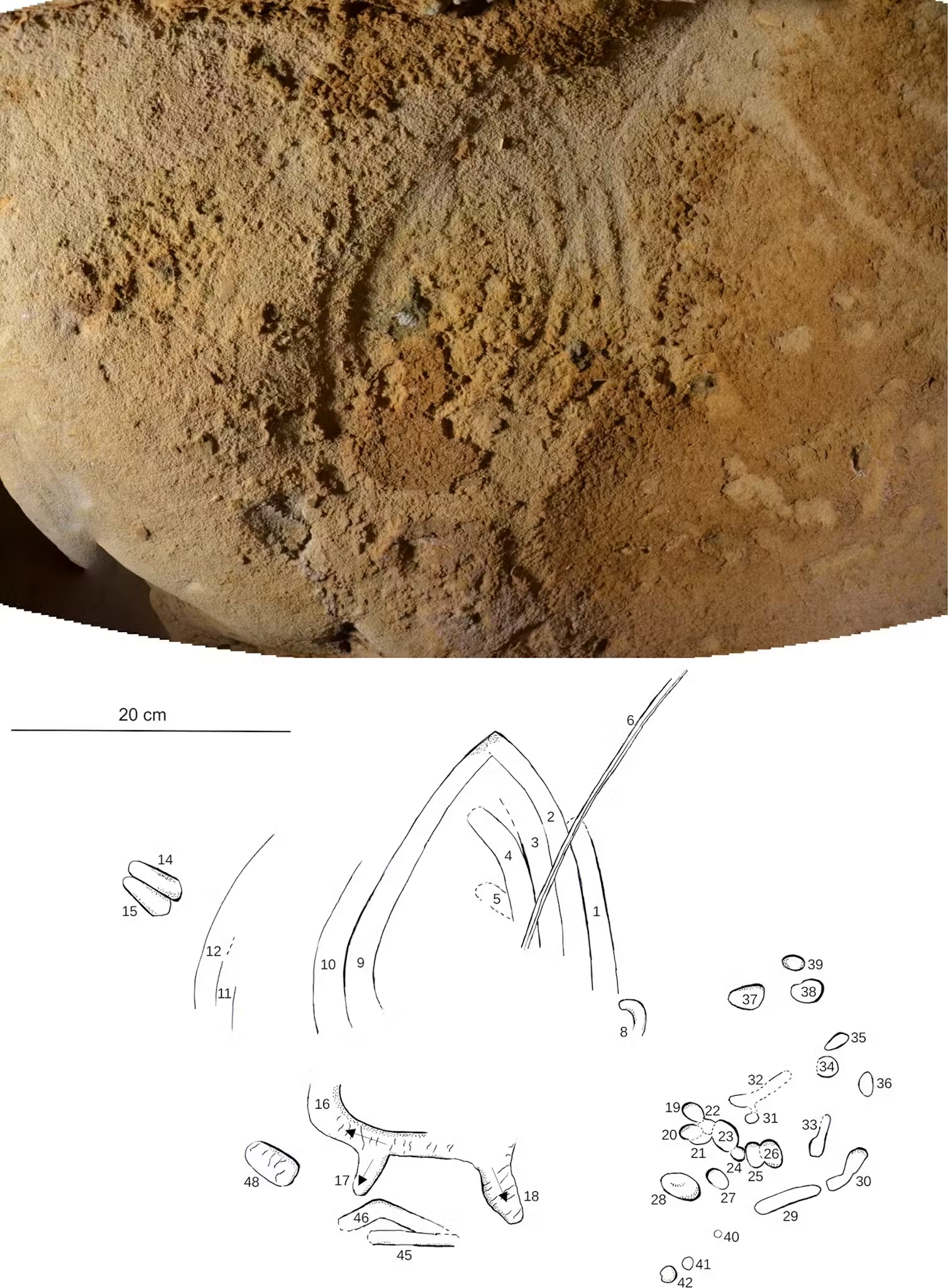
The third condition just provided further evidence of Neanderthal artistic activity. The sinuous lines traced with a finger along the soft mud of the Roche Cotard cave walls reveal another form of interaction with this mysterious subterranean realm. These markings have wavy lines, parallel lines, and curved lines arranged in an organized manner, indicating that they were created intentionally.
Dating of the deposits that formed above its entrance indicate that it was completely sealed no later than 54,000 years ago, and probably earlier. As with Spain, this was long before Homo sapiens arrived in the area, and the only remains in the caves are tools made by Neanderthals. Another art form was added to the Neanderthal repertoire.
Even the most ardent skeptics should agree that this data clearly reveals artistic activity in deep caves that was only possible by Neanderthals.
This art may represent Neanderthal people becoming more aware of their own agency in the world. It may be the first evidence of a connection to the imaginary realm. There is no doubt that more topics of discussion will emerge in the coming years.
This edited article is republished from The Conversation under a Creative Commons license. Read the original article.