

Close Menu
  • Home
  • Identity
  • Inventions
  • Future
  • Science
  • Startups
  • Spanish
What's Hot

China-linked Red Mensheng uses stealth BPF door implant to spy via communications network

First Hydrogen expands contract to advance next-generation unmanned ground vehicles

NASA outlines phased moon base strategy

Facebook X (Twitter) Instagram
  • Home
  • About Us
  • Advertise with Us
  • Contact Us
  • DMCA
  • Privacy Policy
  • Terms & Conditions
  • User-Submitted Posts
Facebook X (Twitter) Instagram
Fyself News
  • Home
  • Identity
  • Inventions
  • Future
  • Science
  • Startups
  • Spanish
Fyself News
Home » Scientists have developed the world’s first microwave brain microchip, a new type of processor that uses microwaves to perform calculations and requires very little electricity.
Science

Scientists have developed the world’s first microwave brain microchip, a new type of processor that uses microwaves to perform calculations and requires very little electricity.

By November 11, 2025No Comments4 Mins Read
Share Facebook Twitter Pinterest Telegram LinkedIn Tumblr Email Copy Link
Follow Us
Google News Flipboard
Share
Facebook Twitter LinkedIn Pinterest Email Copy Link

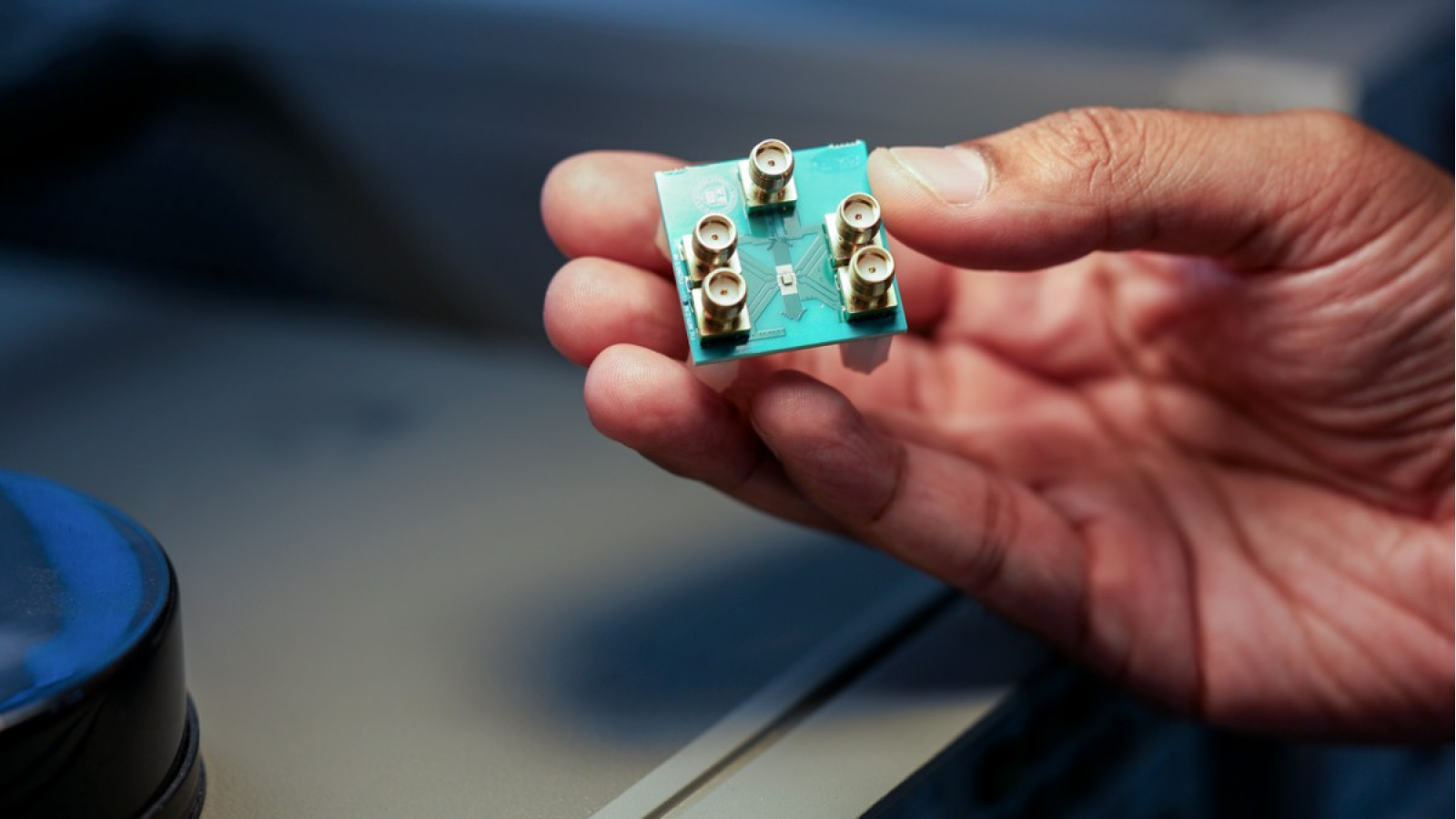
Scientists have developed a completely new type of microchip that uses microwaves instead of traditional digital circuits to perform its operations.

The processor can run faster than traditional CPUs and is the world’s first fully functional microwave neural network (MNN) that can be mounted on a chip, scientists reported in a study published Aug. 14 in the journal Nature Electronics.

High-bandwidth applications such as radar image processing require high-speed processing. Scientists are pursuing this new approach to computing because microwaves operating in the analog spectrum can meet the processing needs of these applications.

you may like

“Because it can be instantaneously distorted across a wide range of frequencies in a programmable way, it can be reused for several computing tasks,” study lead author Bal Gobind, a doctoral student at Cornell University, said in a statement. “It bypasses many of the signal processing steps that digital computers normally have to do.”

the power of microwaves

The chip uses analog waves in the microwave range of the electromagnetic spectrum within an artificial intelligence (AI) neural network to impart a comb-like pattern to the microwave waveform. The regularly spaced spectral lines in the frequency comb act like a ruler, allowing you to measure frequencies quickly and accurately.

The neural network behind the microwave chip is a collection of machine learning algorithms inspired by the structure of the human brain. Microwave brain chips use interconnected electromagnetic nodes in tunable waveguides to identify patterns in datasets and adapt to incoming information.

The microwave brain was created using an MNN, an integrated circuit that processes spectral components (individual frequencies within a signal) by capturing features of the input data over a wide bandwidth.

Get the world’s most fascinating discoveries delivered straight to your inbox.

The chip can solve simple logical operations and advanced calculations, such as recognizing binary sequences and identifying patterns in high-speed data, with 88% accuracy. In the study, the scientists said they proved this through several radio signal classification challenges.

By operating in the microwave analog range and applying a stochastic approach, the chip can process data streams on the order of tens of gigahertz (at least 20 billion operations per second). This speed exceeds that of most consumer computer processors (2.5 to 4 billion operations per second), which typically operate at 2.5 to 4 GHz.

“Bal abandoned much of traditional circuit design to accomplish this,” co-senior author Alyssa Apsell, chair of electrical and computer engineering at Cornell University, said in a statement. “Rather than trying to exactly mimic the structure of a digital neural network, he created something like a hodgepodge of controlled frequency behaviors that could ultimately lead to high-performance computation.”

you may like

Traditional digital systems require more circuitry, more power and more error correction to maintain accuracy, Govind added in a statement. However, the probabilistic approach allowed researchers to maintain high accuracy in both simple and complex calculations without increasing overhead.

The low power consumption of microwave chips is also noteworthy. It consumes less than 200 milliwatts (less than 0.2 watts), which is about the same transmit power as a mobile phone. By comparison, most CPUs require at least 65W of input power.

This low power consumption means the chip could be found in personal devices and wearable technology, the scientists said. This is a promising technology for use in edge computing because it can reduce latency by eliminating the need to connect to a central server. It also has the potential to aid in AI adoption, as it can provide a high-processing alternative with low power requirements for training AI models.

The researchers’ next step is to simplify the design by reducing the number of waveguides and making the chip smaller. More compact chips can use interconnected combs, which produce a richer output spectrum and are useful for training neural networks.


Source link

#Biotechnology #ClimateScience #Health #Science #ScientificAdvances #ScientificResearch
Follow on Google News Follow on Flipboard
Share. Facebook Twitter Pinterest LinkedIn Tumblr Email Copy Link
Previous ArticleLeonids 2025: One of the last meteor showers of the year could peak this week with a bright ‘fireball’
Next Article Protect our present, protect our future

Related Posts

Live Science Today: Meth and Google fined for causing social media addiction, and how dogs have been our friends for thousands of years

March 26, 2026

NASA announces ‘nearly impossible’ space plans, including $20 billion moon base and humanity’s first nuclear-powered interplanetary spacecraft

March 25, 2026

Is the metaverse finally dead and buried? What’s really going on with the embattled idea of living in virtual worlds.

March 25, 2026
Add A Comment
Leave A Reply Cancel Reply

Latest Posts

China-linked Red Mensheng uses stealth BPF door implant to spy via communications network

First Hydrogen expands contract to advance next-generation unmanned ground vehicles

NASA outlines phased moon base strategy

Conntour raises $7M from YC’s General Catalyst to build AI search engine for security video systems

Trending Posts

Subscribe to News

Subscribe to our newsletter and never miss our latest news

Please enable JavaScript in your browser to complete this form.
Loading

Welcome to Fyself News, your go-to platform for the latest in tech, startups, inventions, sustainability, and fintech! We are a passionate team of enthusiasts committed to bringing you timely, insightful, and accurate information on the most pressing developments across these industries. Whether you’re an entrepreneur, investor, or just someone curious about the future of technology and innovation, Fyself News has something for you.

Castilla-La Mancha Ignites Innovation: fiveclmsummit Redefines Tech Future

Local Power, Health Innovation: Alcolea de Calatrava Boosts FiveCLM PoC with Community Engagement

The Future of Digital Twins in Healthcare: From Virtual Replicas to Personalized Medical Models

Human Digital Twins: The Next Tech Frontier Set to Transform Healthcare and Beyond

Facebook X (Twitter) Instagram Pinterest YouTube
  • Home
  • About Us
  • Advertise with Us
  • Contact Us
  • DMCA
  • Privacy Policy
  • Terms & Conditions
  • User-Submitted Posts
© 2026 news.fyself. Designed by by fyself.

Type above and press Enter to search. Press Esc to cancel.