



A new paper reveals that SpaceX’s top-secret government-operated intelligence satellite StarShield intentionally transmits radio signals in the “reverse direction” outside of the frequency range designated by international authorities.
NPR recently reported that the signal was accidentally discovered by an amateur astronomer and could have a negative impact on other spacecraft in the vicinity.
you may like
SpaceX has launched dozens of Starshield batches into space so far. Although the exact number is unknown, they may total more than 200 individual satellites. The majority of the satellites are operated by the National Reconnaissance Office (NRO), while a small number are managed by the U.S. Space Command. According to the Wall Street Journal, the U.S. government paid an estimated total of $1.8 billion for the StarShield network.
On October 17, Scott Tilley, an amateur astronomer and citizen scientist who previously tracked a mysterious Chinese spaceplane and rediscovered a lost NASA satellite, published a new paper describing a series of unusual satellite signals. Tilly initially encountered these signals by mistake after switching his equipment to a frequency range rarely used by satellites, and at first he didn’t know what was causing them.

“It was just clumsy keyboard manipulation,” Tilley told NPR. “I was resetting something, and all of a sudden I was looking at the wrong antenna, the wrong band.” After comparing the signals to data collected from other amateur astronomers, he realized they were likely coming from a Starshield satellite, something he “didn’t expect at all.” (Tilley’s findings have not yet been peer-reviewed.)
The new signal has a frequency of 2,025 to 2,110 megahertz, which is typically used for “uplink” signals sent from carriers on Earth to space. But in this case, these frequencies are being used to “downlink,” or send messages from the satellite to the planet’s surface. As a result, the signal does not fall within the downlink frequencies approved by the International Telecommunication Union (ITU). ITU is the United Nations agency that coordinates the use of radio spectrum around the world and in space.
Benjamin Winkel, a radio astronomer at Germany’s Max Planck Institute for Radio Astronomy, told Live Science: “These signals appear to have been intentionally emitted by the StarShield satellites, but they are outside the permitted frequency range.” However, it is unclear why it is using uplink signals instead of standard downlink frequencies, he added.
In addition to potentially revealing the satellite’s sensitive location, Tilley warned that StarShield’s signal could confuse other spacecraft, “nearby satellites could experience radio frequency interference and possibly be unable to properly respond to commands from Earth or ignore them,” he told NPR.
But not everyone is convinced. “I think so. [the signals] Kevin Gifford, a computer science professor at the University of Colorado Boulder who specializes in radio interference from spacecraft, told NPR. However, it is too early to tell whether these signals will interfere with other spacecraft, he added, and no such incidents have been reported so far.
you may like

Tilley detected signals from 170 different StarShield satellites, suggesting that the downlink was probably used across the satellites. This further suggests that the signals are being sent intentionally, which some experts believe is not surprising.
“SpaceX is smart and knowledgeable,” Gifford said. They may have simply decided to “do it and ask for forgiveness later,” he added.
Neither SpaceX nor NRO have so far commented on the newly discovered signal.
destructive SpaceX signal
This isn’t the first time SpaceX has encountered problems with radio signals.
In 2023, a group of astronomers revealed that first-generation Starlink satellites were accidentally leaking large amounts of radio pollution into space, known as unintended electromagnetic radiation (UEMR), and that the frequencies of these signals overlapped with frequencies used by radio astronomers. A follow-up study in 2024 also revealed that 2nd generation Starlink leaked even more UEMR than 1st generation Starlink.
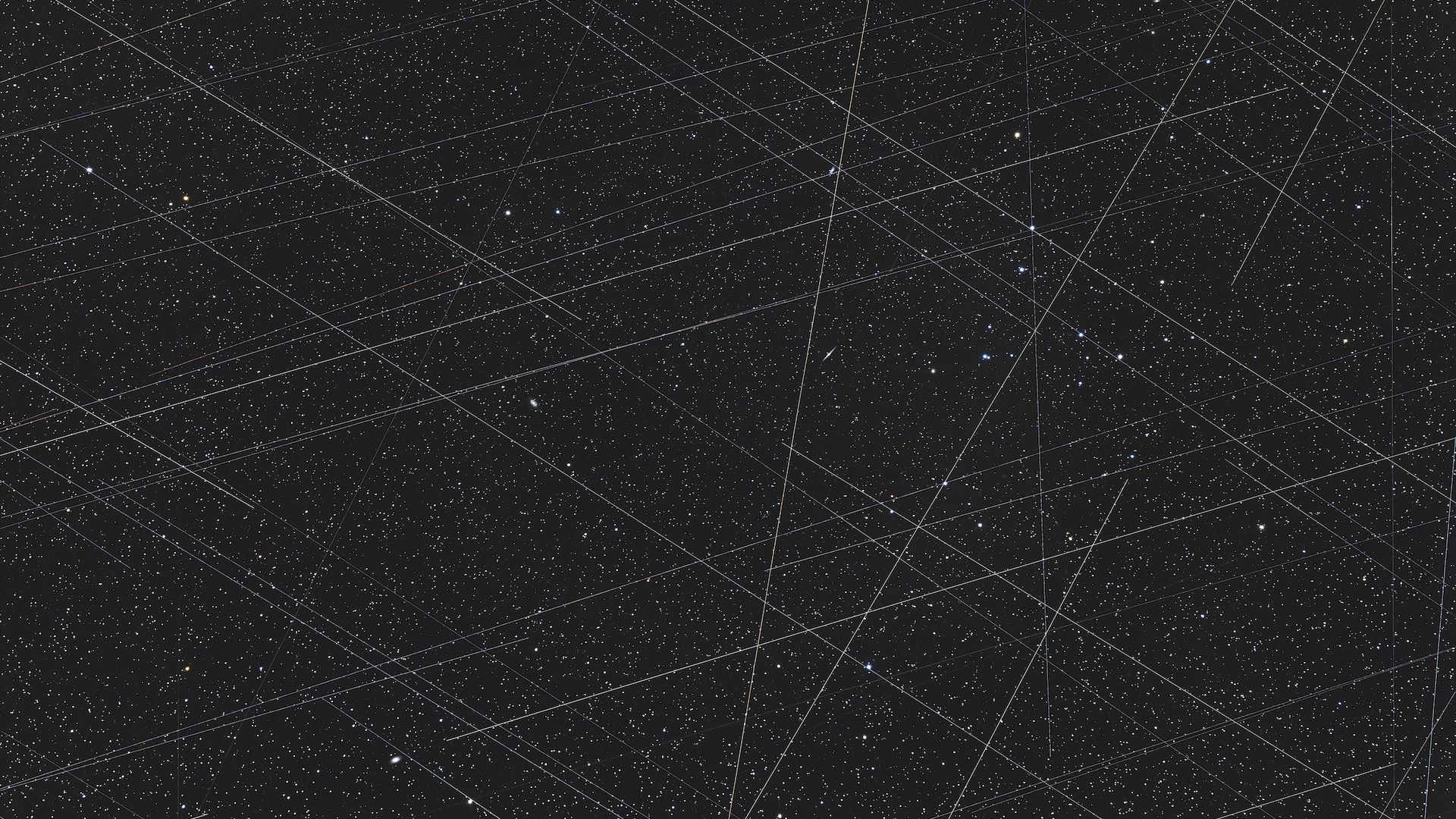
This problem is likely to worsen as the number of commercial satellites increases. For example, SpaceX recently launched its 10,000th Starlink satellite into orbit. Although not all of these satellites remain in service, they represent about 60% of the approximately 12,000 active satellites currently orbiting the Earth. Some experts predict that by 2050 there could be around 100,000 satellites.
Earlier this year, Live Science revealed that if left unchecked, UEMR from these future satellites could ultimately disrupt all forms of ground-based radio astronomy and severely hamper our ability to study the universe.
Early observations suggest the new starshield signal will not have a major impact on radio astronomy, Winkel said. However, like all other civilian satellites, they are likely to emit some form of UEMR, he added.