


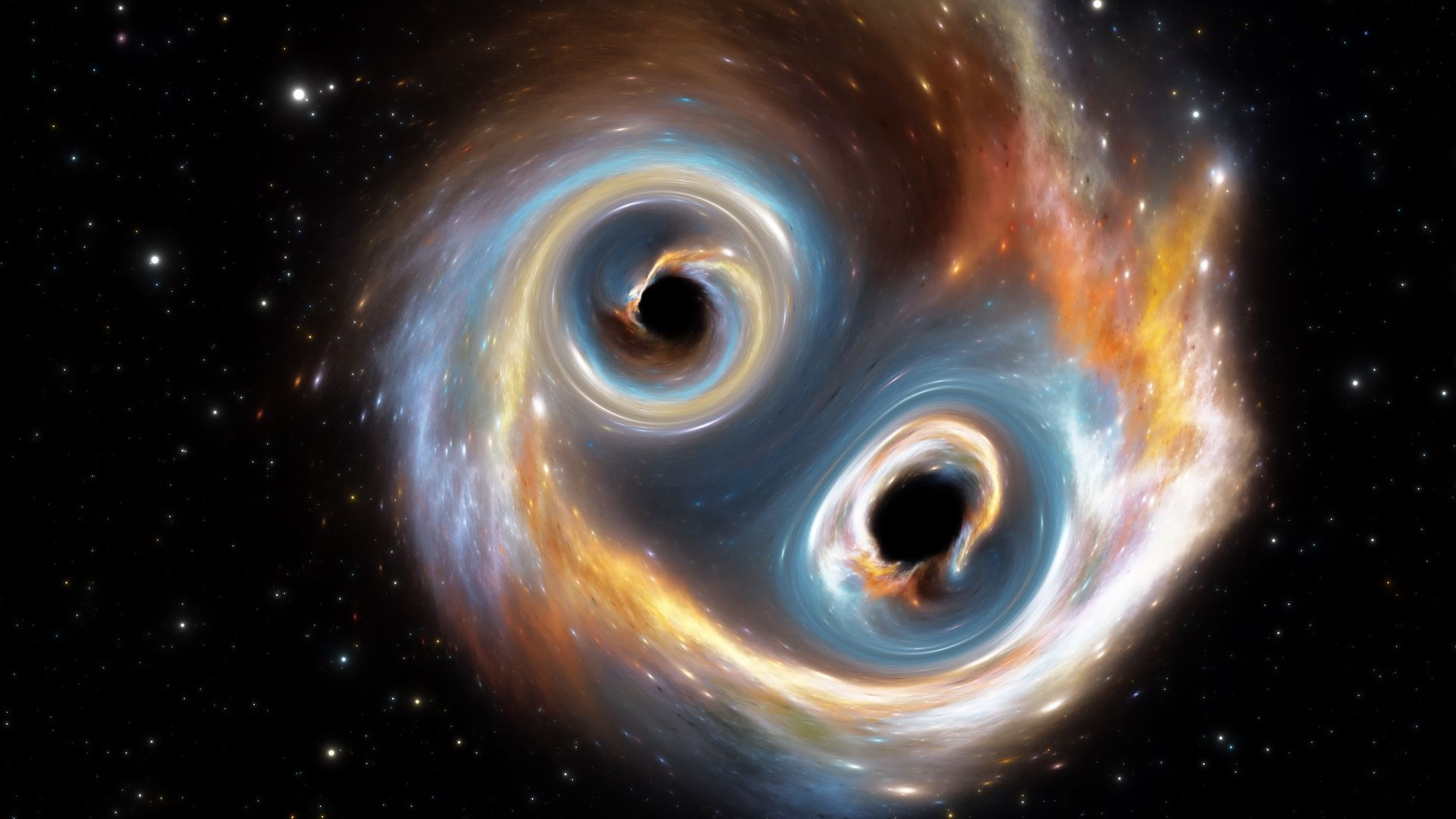
Scientists have traced the origin of the most massive black hole merger ever observed, revealing how two “impossible” giants formed despite long-held assumptions that such objects should not exist.
These black holes were considered “forbidden” because it was thought that stars of that size would blow themselves up in extremely powerful explosions, leaving no debris behind that could collapse into a black hole.
you may like
The discovery also suggests that black holes may be able to form more efficiently than scientists thought, which could change our understanding of how the universe’s first stars and black holes gave rise to today’s supermassive black holes.
Why mergers of massive black holes are important
Black hole collisions have become one of the most important tools for understanding the universe.
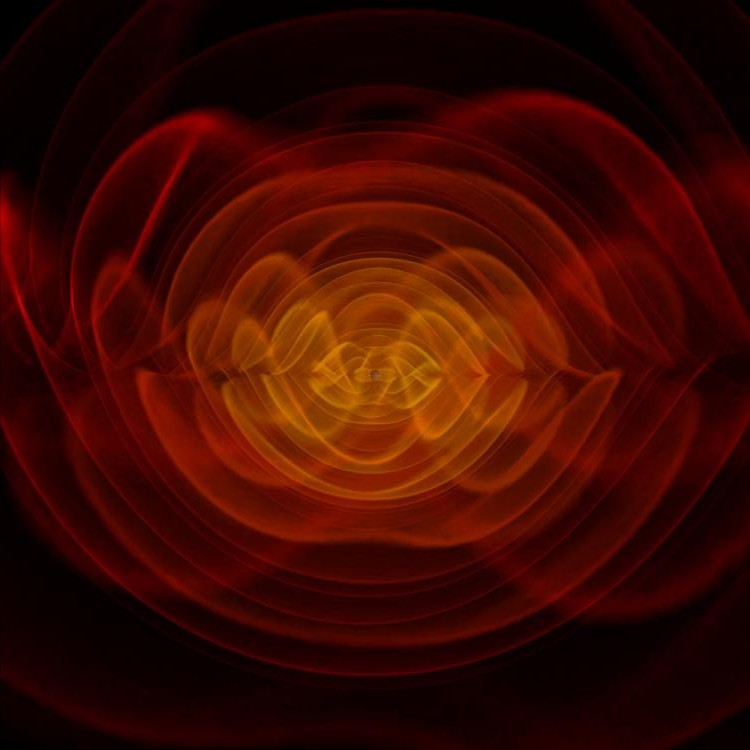
“Black hole mergers allow us to observe the universe through gravity, rather than light, through the gravitational waves produced by the distortion of space-time as black holes spiral and merge,” Professor Ole Gottlieb of the Center for Computational Astrophysics, who led the study, told Live Science in an email. Gravitational waves provide a rare glimpse into regions of space where gravity is so extreme that even light cannot escape. Just from the shape of the signal, scientists can infer the masses and spins of the merging objects and reconstruct how they formed.
These observations test the most demanding predictions of Einstein’s general theory of relativity. Because the curvature of spacetime around black hole mergers pushes the theory to its limits. Events involving the most massive black holes reveal how massive stars lived and died in cosmic time, and how early black holes grew into the monsters that sit at the centers of galaxies today.
Most massive black hole merger ever detected
When detectors recorded GW231123 in November 2023, astronomers quickly realized it was unique. Two giant objects, roughly 100 and 130 times more massive than the sun, have merged more than 2 billion light years away. What was surprising was that a black hole of this size would fall within what physicists call the “mass gap,” a range of about 70 to 140 solar masses in which black holes are expected to exist.
Stars in this range are typically torn apart by violent supernova explosions, leaving nothing behind. However, GW231123 contained not one, but two such objects, both of which showed signs of rotating at extreme speeds. The event “involved two of the fastest rotating black holes and represents a rare formation pathway for massive, rapidly rotating black holes that should not exist,” Gottlieb said.
To understand how such black holes form, the research team created detailed three-dimensional simulations, starting with the life of a very massive star. The model tracked a helium core, about 250 times the mass of the Sun, burning off its fuel, collapsing, and forming a nascent black hole. Previous theories assumed that such a star would collapse as a whole, leaving behind a black hole with the same mass as its original core. However, new research shows that this is not always the case.
you may like
solve the impossible
Gottlieb et al. found that rapid rotation changes everything.
“We showed that when a star rotates rapidly, an accretion disk forms around the newly formed black hole,” Gottlieb explained. “The strong magnetic field generated within this disk could cause a powerful outflow that dislodges some of the stellar material, preventing it from falling into the black hole.” Rather than engulfing the entire core, young black holes lose access to much of the material around them, as their magnetic force blows the material into space.
This mechanism reduces the final mass of the remnant, pushing it down into the mass gap (a region previously thought to be inaccessible). “As a result, the final black hole’s mass may be significantly reduced and fall within a mass gap that was previously thought to be inaccessible,” Gottlieb said.
The simulations also naturally produced a connection between the mass and spin of the resulting black hole. A strong magnetic field extracts angular momentum, slowing down the black hole while ejecting more mass. Weaker magnetic fields leave behind larger, faster-spinning objects. This relationship agrees well with the properties inferred for the two black holes in GW231123. One is formed in a star with an intermediate magnetic field, and the other is formed in a star with a weaker magnetic field, forming a pair with different final masses and spins. This is exactly what the gravitational wave signal suggests.
What these discoveries mean for gravity and the history of the universe
Extreme phenomena like GW231123 stretch general relativity to its breaking point.
“The extraordinary curvature of spacetime allows us to probe general relativity deep into its most extreme high-field regions and test whether Einstein’s equations remain accurate even when gravity is at its most extreme,” Gottlieb said.
If similar events happened frequently in the early universe, they would have shaped the growth of the first black holes. Such mergers “suggest that supermassive black holes may form more efficiently than current stellar models predict,” Gottlieb said. “This will impact our understanding of how the first generation of stars and black holes seeded the supermassive black holes observed in galaxies today.”
The team’s work points to new formation pathways for supermassive black holes and predicts specific patterns that astronomers can explore. “Our study opens a new window into black hole formation within mass gaps and predicts first-generation black holes (without previous mergers) at all masses,” Gottlieb said. Future gravitational wave detection will test whether the mass-spin correlation found in the simulations holds over many events.
“Once more massive black hole binaries are detected, we will be able to test the predicted correlations for this population,” Gottlieb said. These discoveries may reveal whether GW231123 is a cosmological rarity or the first clear sign of a hidden population of massive, rapidly rotating black holes.