


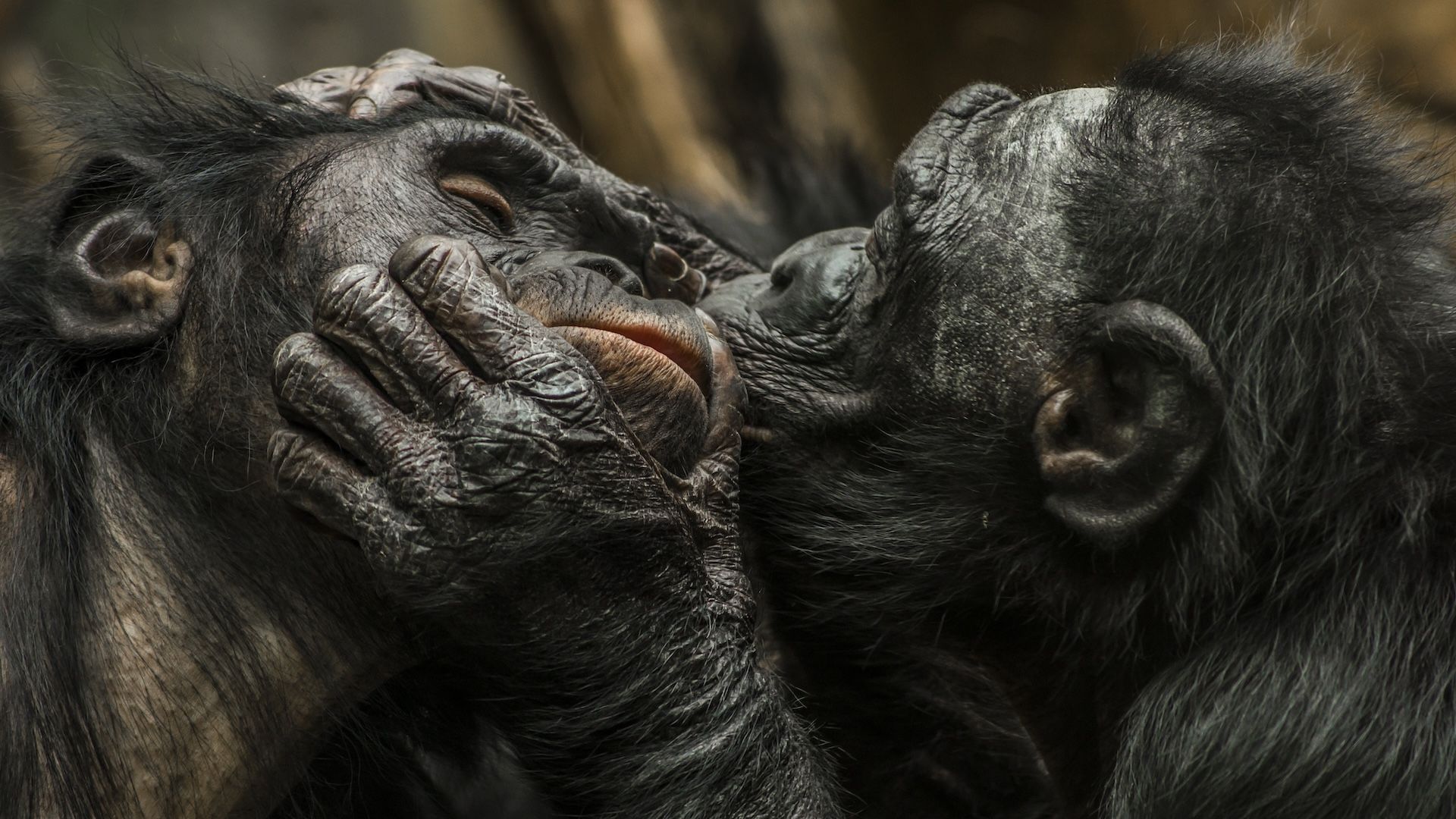
Kissing may have been around long before modern humans existed, a new modeling study suggests.
Kissing dates back some 21 million years to the common ancestor of humans and other great apes, according to a study published Wednesday (Nov. 19) in the journal Evolution and Human Behavior. Homo sapiens, on the other hand, likely appeared about 300,000 years ago.
you may like
“This is the first time that kissing has been investigated from a broader evolutionary perspective,” study lead author Matilda Brindle, an evolutionary biologist at the University of Oxford, said in a statement. “Our findings join a growing body of research highlighting the remarkable diversity in sexual behavior exhibited by our primate cousins.”
model kiss
Before dating the world’s oldest kiss, an international team of researchers defined its meaning. This was important because other mouth-to-mouth acts in nature are similar to kissing. For example, orangutan and chimpanzee mothers pass chewed food to their offspring by mouth-to-mouth, and fish engage in “kissing fights” to assert dominance or compete for territory. The researchers ultimately defined kissing as “non-aggressive mouth-to-mouth contact that does not involve the transfer of food,” they said in a statement.
Based on this definition, a variety of modern primates have been observed kissing, including bonobos, gorillas, chimpanzees, orangutans, macaques, and baboons.
The researchers then used a statistical method called Bayesian modeling to reconstruct the evolutionary history of kissing. Treating kissing as a biological trait, they tested the many ways this behavior might have evolved to find out how likely different ancestors were to have kissed as well. They ran the model 10 million times to ensure the results were strong and reliable.
The researchers concluded that kissing evolved once in the common ancestor of great apes (hominidae) between about 21.5 and 16.9 million years ago.
However, kissing was absent in the ancestral Macacina and Papionina (a group that includes macaques and baboons), suggesting that kissing evolved separately in modern species belonging to these groups. The research team determined this by retrospectively extrapolating the behavior of their common ancestors from the behavior of modern species.
Although more evidence is needed, the researchers said kissing may have evolved from the practice of transferring food from mother to infant by pre-chewing. This practical food-sharing behavior may have been recycled into what we now recognize as a kiss.
you may like
How this matches up with previous kissing research
The discovery that Neanderthals kissed not only each other but also modern humans is not new to anthropologists.
“We don’t know if this study adds anything substantively new to our knowledge of this Neanderthal behavior,” April Nowell, a paleolithic archaeologist and professor of anthropology at the University of Victoria in British Columbia who was not involved in the study, told Live Science via email.
However, the new study is consistent with previous findings. Professor Nowell said another group of researchers found “interesting evidence” in 2017 when they compared microbes stored in the dental plaque of Neanderthals who lived 48,000 years ago with microbes found in the mouths of modern humans. The researchers concluded that Neanderthals and Homo sapiens may have kissed each other, but the microbial overlap could also reflect sharing food and water, said Nowell, who was not involved in the study.
Furthermore, we already know that Homo sapiens and Neanderthals mated over a period of roughly 7,000 years, so assuming some of their ancient mating behavior was similar to today’s mating behavior, it’s possible that some kind of kissing occurred when that mating occurred.
However, it is unclear how widespread kissing was among our hominid relatives. Kissing is not a universal behavior among modern humans, with only about half of cultures kissing, so Nowell said similar variations may have existed in the past. If Neanderthals were kissing, she said, it was “an action that some Neanderthal communities did and others may not have.”
Scientists still don’t know why kissing persists in so many species, especially considering the potential downsides such as the spread of disease. There is also the idea that kissing can help increase reproductive success. For example, kissing a potential partner may help people assess a mate’s qualities through subtle chemical cues that may provide clues about a person’s overall health, genetic compatibility, immune system, and composition of the oral microbiome, researchers write in a new study. Researchers also propose that kissing may also benefit immunity by strengthening social bonds and allowing the exchange of microbes.