


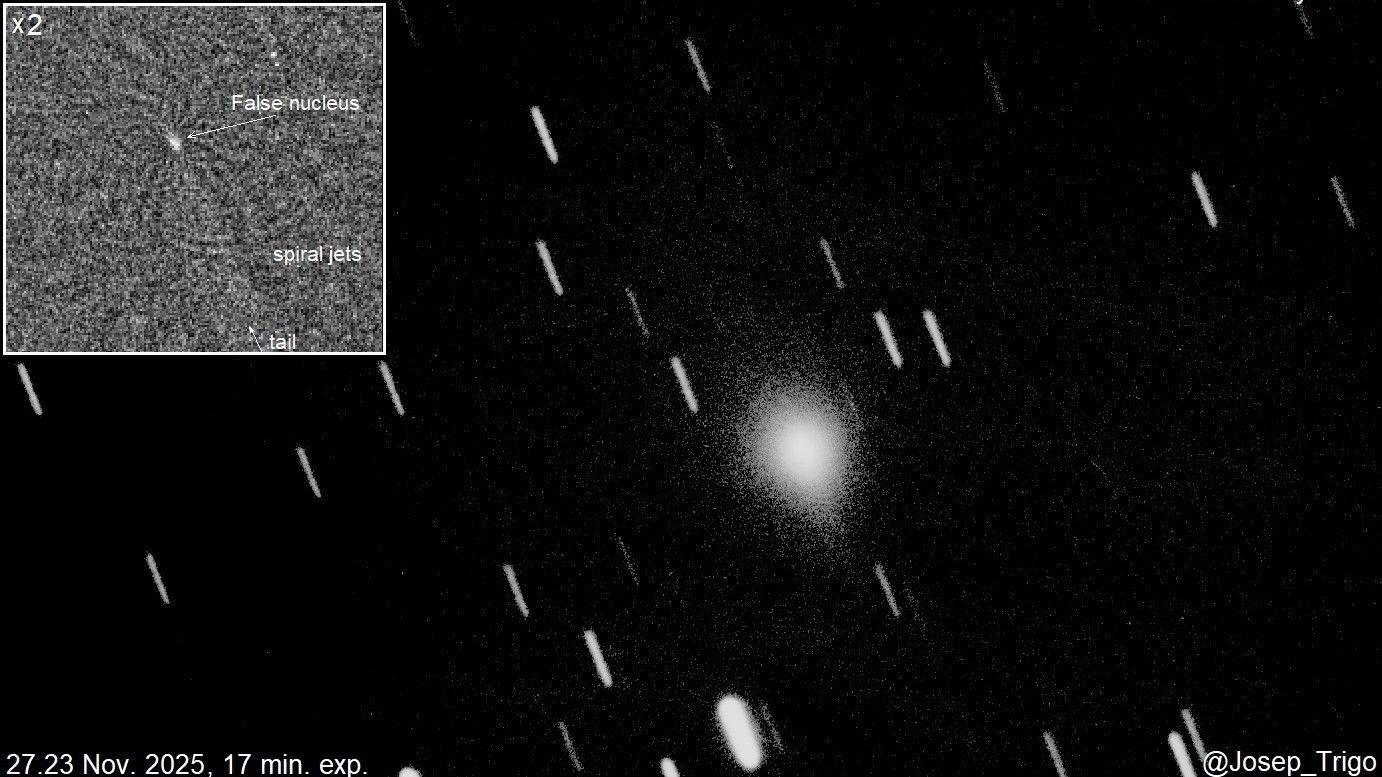
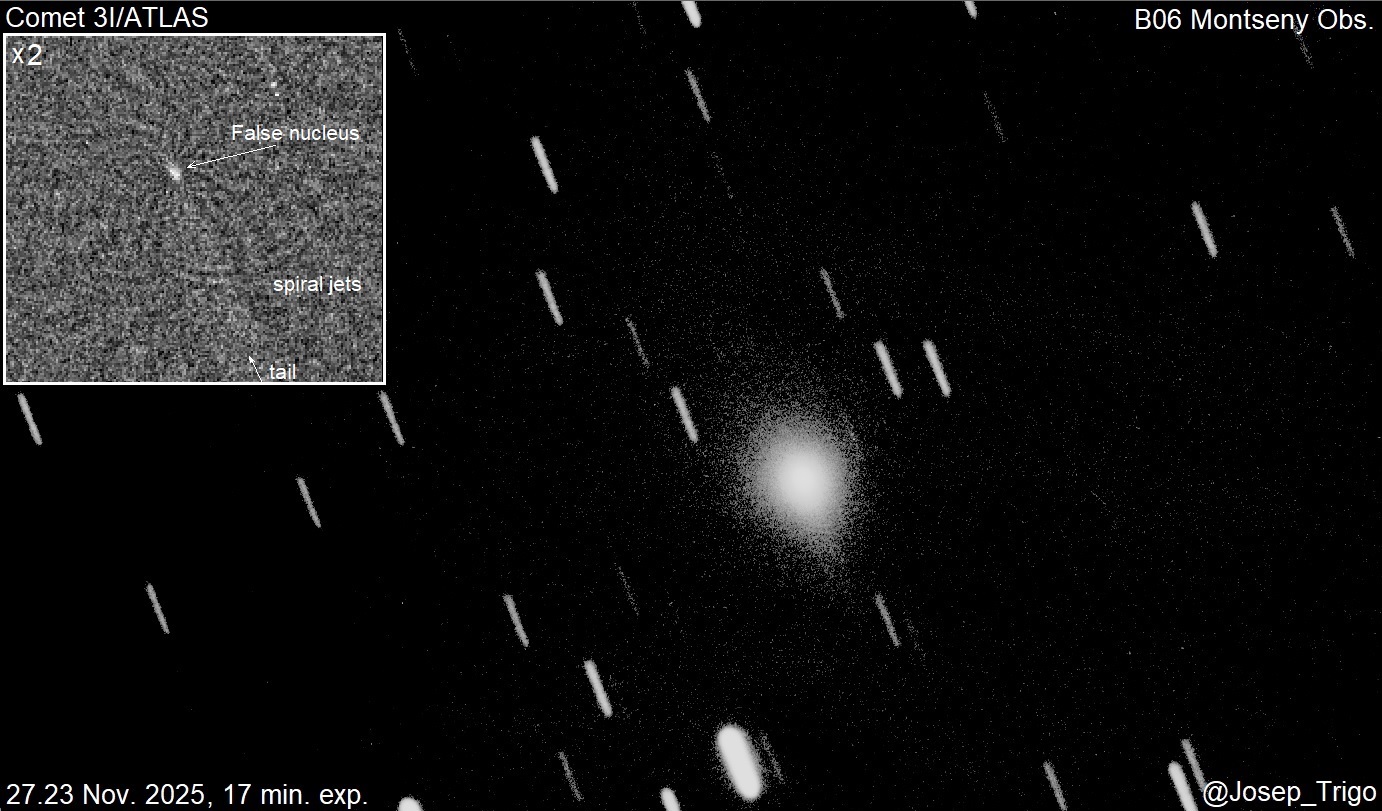
New observations suggest that the interstellar comet 3I/ATLAS may be covered in erupting “cryovolcanoes.”
The results of the study, which have not yet been peer-reviewed, suggest that Comet 3I/ATLAS is similar to an icy trans-Neptunian object (a dwarf planet or other object that orbits the Sun beyond Neptune). If confirmed, comet 3I/ATLAS would have surprising similarities with objects in our own cosmic neighborhood, even though it comes from a different solar system.
you may like
“We were all surprised,” study lead author Josep Trigo Rodríguez, a staff principal investigator at Spain’s Institute of Space Sciences (CSIC/IEEC), told Live Science. “As a comet that formed in a remote planetary system, it is noteworthy that the mixture of materials that make up the object’s surface is similar to that of trans-Neptunian objects, or objects that formed in the outer solar system. [a] Although it is far from the Sun, it is part of our planetary system. ”
Ever since astronomers first discovered comet 3I/ATLAS in July, there has been endless speculation about its origins. Much of the speculation online centers on whether this interstellar visitor could be an alien spacecraft. However, most astronomers are convinced that 3I/ATLAS is a comet from an unknown star system.
Comet 3I/ATLAS is only the third interstellar object ever recorded, giving researchers a rare opportunity to learn more about other stars’ surroundings and conditions in their distant past (3I/ATLAS may be billions of years older than our own star system). This means scientists are busy studying the object before it leaves the solar system for good next year.
For the new study, Trigo Rodríguez and his colleagues used the Joao Oro telescope at the Montsec Observatory in northeastern Spain’s Catalonia region to study the comet, combining their observations with observations from other observatories in the region. Astronomers carefully observed the comet’s closest point to the star on October 29, known as its perihelion. As the comet approaches the star, it heats up, causing surface ice to sublimate into gas that researchers can detect and study.
The researchers found that as the comet came within about 235 million miles (378 million kilometers) of the Sun, it entered a more intense phase of sublimation, at the same time rapidly brightening. They used the João Oro telescope to take the highest-resolution images to date of jets of gas and dust particles ejected from a comet. This was interpreted as a clear sign of cryovolcanic activity.
Cryovolcanoes are typically found on ice-rich planetary bodies, such as trans-Neptunian bodies. Trigo Rodriguez pointed out that the internal heat of these planets melts ice and creates cryovolcanoes, which release steam and dust into space.
#3IATLAS Pre-perihelion study of comet. including our findings regarding spectroscopic similarities with CR carbonaceous chondrites. A manuscript submitted for publication proposes a #TNO-like object currently experiencing #cryovolcanic activity at Cornell University. @arxiv repository: ➡️ arxiv.org/abs/2511.19112
— @joseptrigo.bsky.social (@joseptrigo.bsky.social.bsky.social) 2025-12-02T09:08:51.972Z
In the case of Comet 3I/ATLAS, researchers believe that cryovolcanic activity is caused by erosion of the original material trapped inside the comet. When the sun heated the comet, it broke the limit for solid carbon dioxide (dry ice) to sublimate and become a gas. This allowed oxidizing liquids to flow into the comet’s interior and react with reactive iron and nickel metal particles and sulfides.
you may like
To test their theory about the composition of comets, the researchers performed spectroscopic comparisons (analyzing how the material interacts with light) using pristine, pristine rocky meteorites called carbonaceous chondrites collected by NASA from Antarctica.
One of these Antarctic samples contained what researchers believe to be part of a trans-Neptunian object. Analysis reveals that Comet 3I/ATLAS is similar to these remnants from the early Solar System and is likely rich in natural metals.
According to London’s Natural History Museum, carbonaceous chondrites are thought to have played a role in the origin of life on Earth, providing volatile materials that helped establish the atmosphere and other conditions necessary for life.
Origin of Comet 3I/ATLAS
The exact size of 3I/ATLAS is still unknown, but Hubble Space Telescope observations suggest it is between 1,400 feet (440 meters) and 3.5 miles (5.6 kilometers) wide. Rodriguez and his colleagues calculated that if the comet were 0.6 miles (1 km) wide and had the rocky composition they deduced, its mass would be more than 660 million tons (600 million tons).
But even though 3I/ATLAS has a similar composition to carbonaceous chondrites and behaves like a transsolar object approaching the Sun, there is no doubt that it did not come from our solar system. Scientists first noticed it soaring along its hyperbolic orbit at about 137,000 miles per hour (221,000 kilometers per hour), according to NASA. This speed is too fast to be bound by the sun’s gravity.
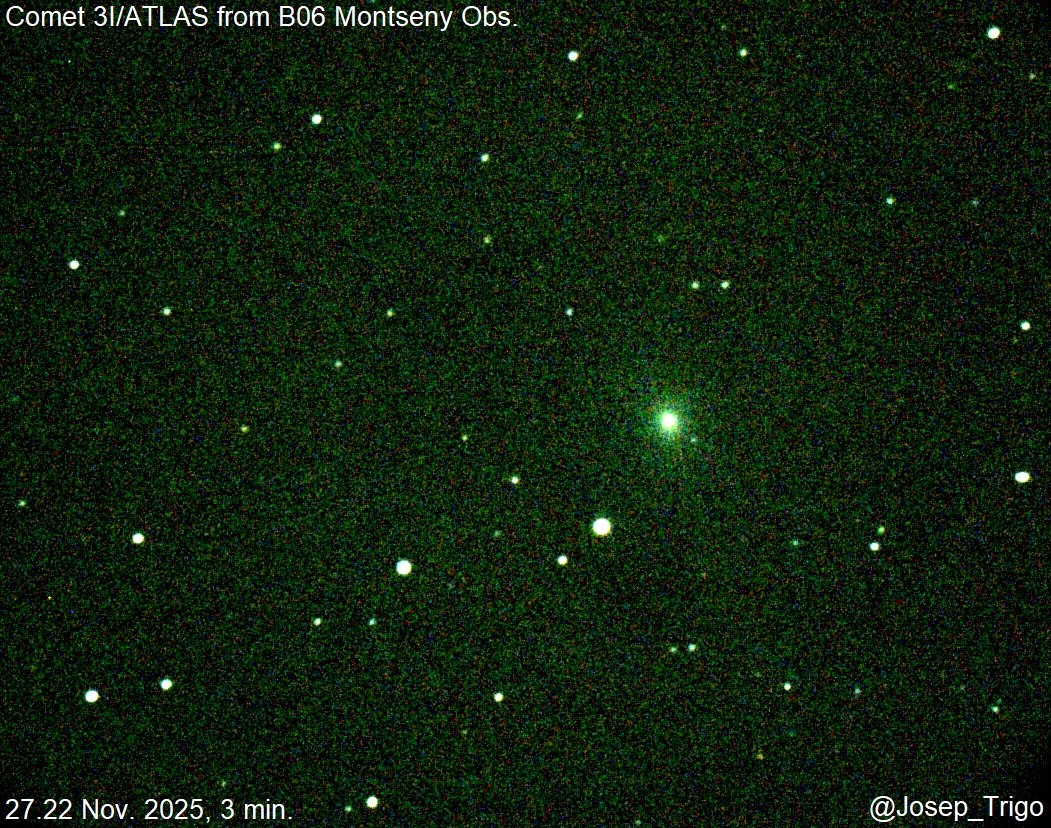
Researchers don’t know which star system comet 3I/ATLAS came from, but they do know that it has traveled a long distance. This comet is probably billions of years old, and could be more than 3 billion years older than our solar system. In fact, the comet has spent so much time in space that it may be extremely irradiated, making deciphering its origins even more difficult.
Trigo Rodriguez pointed out that it is important to study and track interstellar comets because they pose a collision risk for Earth. But he also described them as “extraordinary objects” in their own right, worthy of consideration.
They are “space capsules, containing valuable information about chemical reactions going on elsewhere in the galaxy,” Trigo Rodriguez said.