


Close Menu
  • Home
  • Identity
  • Inventions
  • Future
  • Science
  • Startups
  • Spanish
What's Hot

The Legal Revolution is Digital: Meet TwinH, Your AI Partner in the Courtroom of the Future

EU says TikTok must disable ‘addictive’ features like infinite scroll and fix recommendation engine

China-linked DKnife AitM framework, routers targeted for traffic hijacking and malware distribution

Facebook X (Twitter) Instagram
  • Home
  • About Us
  • Advertise with Us
  • Contact Us
  • DMCA
  • Privacy Policy
  • Terms & Conditions
  • User-Submitted Posts
Facebook X (Twitter) Instagram
Fyself News
  • Home
  • Identity
  • Inventions
  • Future
  • Science
  • Startups
  • Spanish
Fyself News
Home » History of Science: Computer Scientists Reveal ‘Moore’s Law’ That Guided Chip Design for Half a Century — December 2, 1964
Science

History of Science: Computer Scientists Reveal ‘Moore’s Law’ That Guided Chip Design for Half a Century — December 2, 1964

userBy userDecember 2, 2025No Comments4 Mins Read
Share Facebook Twitter Pinterest Telegram LinkedIn Tumblr Email Copy Link
Follow Us
Google News Flipboard
Share
Facebook Twitter LinkedIn Pinterest Email Copy Link

Milestone: Introducing Moore’s Law

Date: December 2, 1964

Location: San Francisco Bay Area

People: Gordon Moore

In a modest address to a local professional association in 1964, computer scientist and chemist Gordon Moore made a prediction that would define the world of technology for more than 50 years.

In an Electrochemical Society presentation titled “Evolving Technology in Semiconductor Integrated Circuits,” Moore predicted that the number of transistors on an integrated circuit will double every year.

The final version of this prediction became known as “Moore’s Law” and would drive progress in the semiconductor industry for decades.

you may like

Although they were called laws, they were predictions based on economic trends and industry trends rather than physical laws of nature.

At the time of his talk, Moore was director of research and development at Fairchild Semiconductors, and his ultimate goal was to sell more chips. Back then, computers were huge machines that took up entire rooms, and the practical use of integrated circuits known as microchips was somewhat limited.

The silicon transistor, the mainstay of computing in computers, had been invented just a decade earlier, and the integrated circuits that allowed computers to be made smaller had been patented just five years earlier. In 1961, electronics company RCA built a 16-transistor chip, and by 1964 General Microelectronics had built a 120-transistor chip.

Moore witnessed this dramatic progress and realized that mathematical laws seemed to govern it. This mathematical correlation was later given the name “Moore’s Law” by others.

Get the world’s most fascinating discoveries delivered straight to your inbox.

Moore explained this principle to the Electrochemical Society in 1964, but it received widespread attention when he was asked to write an editorial in Electronics Magazine the following April. In it, he boldly predicted that as many as 65,000 components could be packed onto a single chip. This was an unprecedented number at the time. Considering that one company announced 4 trillion transistor chips in 2024, this is now an attractive small number.
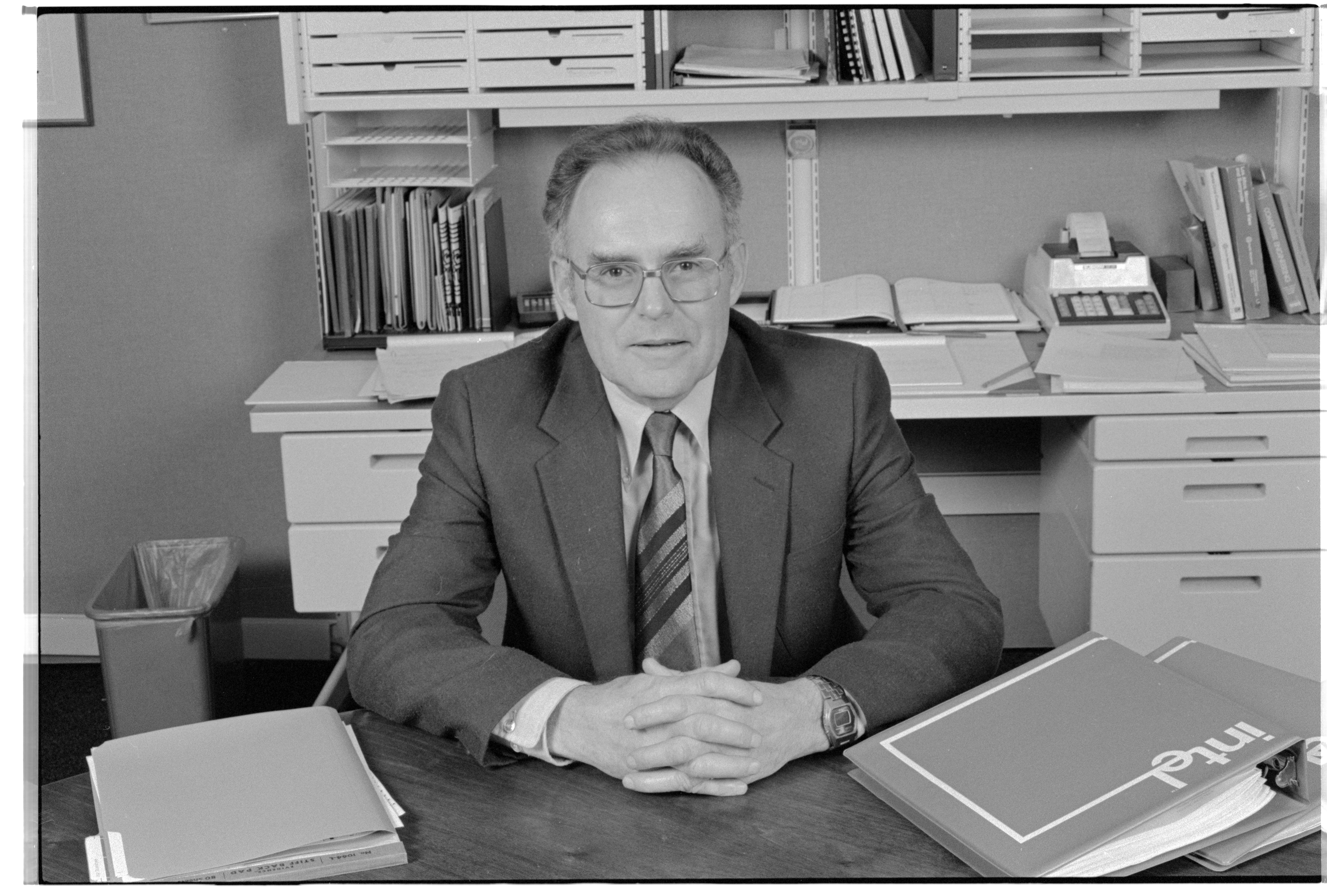
Intel CEO Gordon Moore sits behind his desk in his office.

Intel CEO Gordon Moore in his office in 1981. (Image credit: © Roger Ressmeyer/COBIS/VCG via Getty Images)

In 1968, Moore co-founded chipmaker Intel. There his rule of doubling went from casual observation to motivation for innovation.

Despite its name, Moore’s Law was never an ironclad law. In 1975, Moore reduced the rate of transistor doubling to every two years instead of every year. This more modest multiplication rate became the official Moore’s Law and would remain in place for many years to come. This constant drive toward more computing power and miniaturization has made possible virtually every modern electronic device, from personal computers to smartphones.

you may like

For years, people predicted that this law would become obsolete, but for quite some time this law has proven to be surprisingly resilient.

“The fact that I have been able to continue, [Moore’s law] “This has surprised me more than anything else in a long time,” Moore said in a 2016 Electrochemical Society interview. “There always seems to be an impenetrable barrier ahead, but as we approach it, people come up with solutions.”

But eventually that principle no longer holds true. It is not clear exactly when Moore’s law died out. In its standard form, the standard could have died in 2016, as it took Intel five years to move from 14 nanometer size technology to 10 nanometers. Moore saw this coming years before his death in 2023 at the ripe old age of 94.

In the end, Moore’s “law” had to disappear because it contradicted the actual laws of physics. As transistors became smaller and smaller, quantum mechanics, the physics that governs the very small, began to play a larger role. The world’s smallest transistors could face the problem of “quantum tunneling,” where electrons in one tiny transistor tunnel into another tiny transistor, allowing current to flow through a transistor that is supposed to be in the “off” position.

As a result, chip manufacturers are considering designing chips using new materials and new architectures. The following Moore’s law could also apply to quantum computers, which use quantum mechanics as a feature rather than a computational bug.


Source link

#Biotechnology #ClimateScience #Health #Science #ScientificAdvances #ScientificResearch
Follow on Google News Follow on Flipboard
Share. Facebook Twitter Pinterest LinkedIn Tumblr Email Copy Link
Previous ArticleWhat does it mean that Uncle Sam is one of the largest shareholders? Chip startup xLight is about to reveal it
Next Article Google patches 107 Android flaws, including two framework bugs that were exploited in the wild
user
  • Website

Related Posts

7,500-year-old deer headdress discovered in Germany shows hunter-gatherers shared sacred objects and ideas with the region’s first farmers

February 5, 2026

How well can AI and humans work together? Scientists are looking to Dungeons & Dragons to find out.

February 5, 2026

Saltwater crocodiles crossed the Indian Ocean to the Seychelles before humans arrived and made them extinct.

February 5, 2026
Add A Comment
Leave A Reply Cancel Reply

Latest Posts

The Legal Revolution is Digital: Meet TwinH, Your AI Partner in the Courtroom of the Future

EU says TikTok must disable ‘addictive’ features like infinite scroll and fix recommendation engine

China-linked DKnife AitM framework, routers targeted for traffic hijacking and malware distribution

How AI is helping solve labor issues in rare disease treatment

Trending Posts

Subscribe to News

Subscribe to our newsletter and never miss our latest news

Please enable JavaScript in your browser to complete this form.
Loading

Welcome to Fyself News, your go-to platform for the latest in tech, startups, inventions, sustainability, and fintech! We are a passionate team of enthusiasts committed to bringing you timely, insightful, and accurate information on the most pressing developments across these industries. Whether you’re an entrepreneur, investor, or just someone curious about the future of technology and innovation, Fyself News has something for you.

Castilla-La Mancha Ignites Innovation: fiveclmsummit Redefines Tech Future

Local Power, Health Innovation: Alcolea de Calatrava Boosts FiveCLM PoC with Community Engagement

The Future of Digital Twins in Healthcare: From Virtual Replicas to Personalized Medical Models

Human Digital Twins: The Next Tech Frontier Set to Transform Healthcare and Beyond

Facebook X (Twitter) Instagram Pinterest YouTube
  • Home
  • About Us
  • Advertise with Us
  • Contact Us
  • DMCA
  • Privacy Policy
  • Terms & Conditions
  • User-Submitted Posts
© 2026 news.fyself. Designed by by fyself.

Type above and press Enter to search. Press Esc to cancel.