
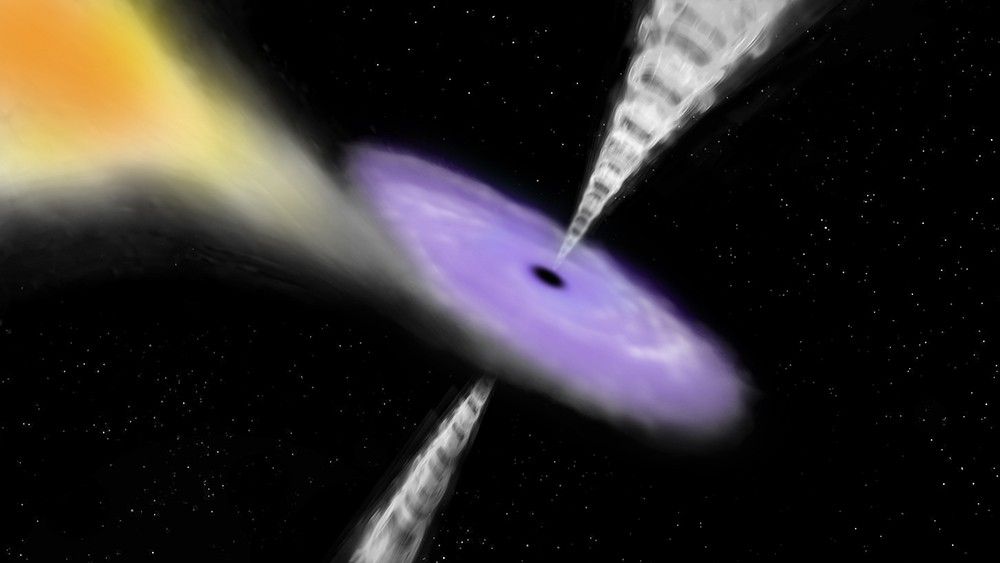
About 3 billion years ago, an unlucky star got caught in a twisted tug of war between two massive black holes. And now we are witnessing the faint screams of X-rays emanating from this violent event. If confirmed, this could be the most distant episode of two black holes attacking a star ever observed.
An international team of astronomers reported on decades of observations of the faintest variable X-ray flares known in a paper accepted for publication in the journal The Innovation in November.
you may like
make star spaghetti
A bright surge of X-rays followed by a long dimming is exactly what astronomers would expect from a violent encounter called a tidal disruption event (TDE), which occurs when a star gets too close to a supermassive black hole. The black hole’s massive gravity tears the star to shreds before it is swallowed up by the monster’s event horizon (point of no return). This process is cutely named “spaghettification,” as if the stars were being pulled into a thin piece of pasta.
This stellar material then sinks into a thin, rapidly rotating disk just outside the black hole. The energy released by this process makes the gas so hot that it emits X-ray radiation that can be seen from the far side of the universe. The matter then flows into the gaping mouth of the black hole itself, and the disk loses its brightness.
XID 925 is already notable because it was one of the most distant and faintest known TDEs ever recorded. But in 1999, everything went awry.
From January to March of that year, XID 925 unexpectedly quickly brightened by a factor of 27. After that, the X-ray brightness decayed as quickly as it appeared, and XID 925 continued to disappear from the scene.
Continuous black hole attack
Astronomers behind the new study now think there is another culprit behind this strange brightening. This is not a simple case of a TDE around a single supermassive black hole. This is the case for a TDE around two supermassive black holes.
They argue that the unlucky star was trapped within the gravity of a massive central black hole and a smaller (but still large) companion black hole. The larger black hole tore apart the star and turned it into an accretion disk. But then the second black hole swung closer to the disk and even penetrated through it, and the chaos triggered a ferocious burst of energy, scientists explained.
Like an unlucky car crashing into an accident scene, the incident caused the release of more X-rays, further confusing a chaotic situation. Once the small black hole moved, the system returned to normal.
While the astronomers cautioned that this story does not fully account for all the data, they argued that this is the most plausible scenario given what we know. If true, this would be the most distant known tidal disruption event of a binary black hole, providing us with an important and exciting window into the complex relationships between stars and black holes at the centers of young galaxies.
