


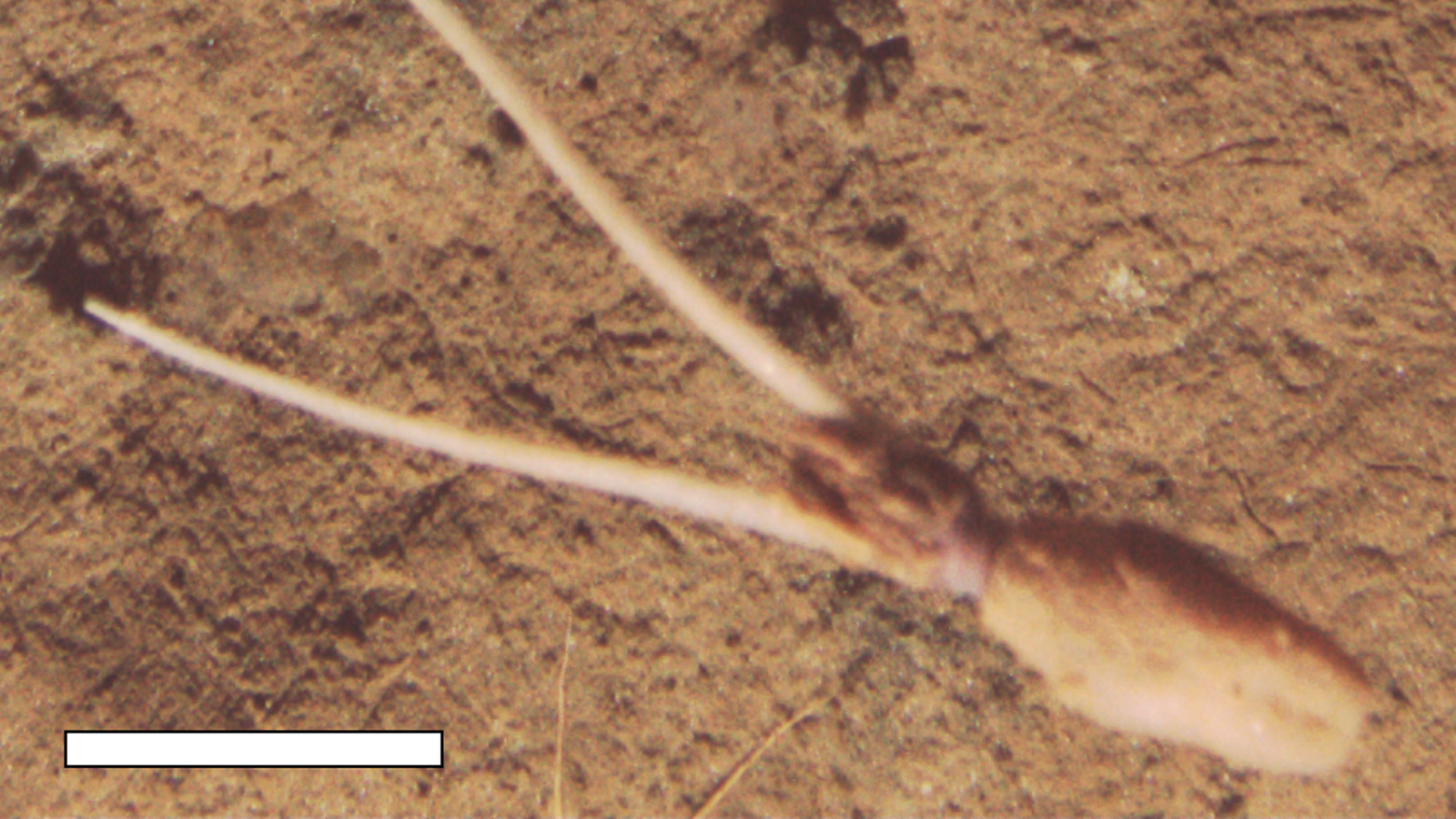
Scientists have photographed a never-before-seen deep-sea squid burying itself upside down on the ocean floor. This behavior has never been recorded in cephalopods. They captured the strange sight while surveying the depths of the Clarion-Clipperton Zone (CCZ), a deep-sea plain in the Pacific Ocean that is targeted for deep-sea mining.
“The fact that this is a squid and it’s covered in mud is novel for a squid, the fact that it’s upside down,” lead author Alejandra Mejía-Saenz, a deep-sea ecologist at the Scottish Society of Marine Science, told Live Science. “We had never seen anything like that in a cephalopod. … It was very novel and very puzzling.”
you may like
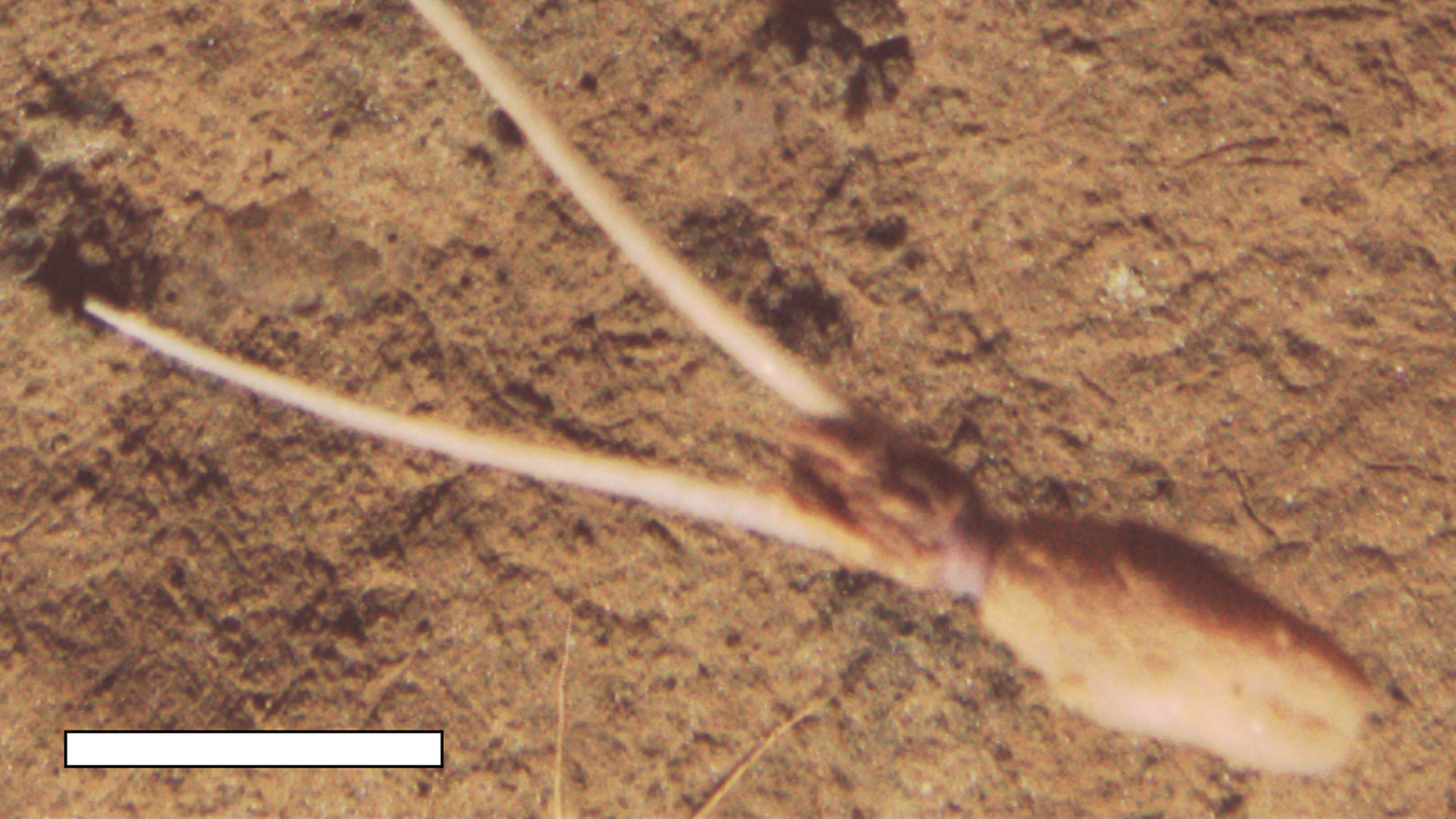
Covering or burying in mud has previously been observed in octopus, squid, and even species of squid that live in shallow waters. However, these behaviors had never been previously recorded in deep-sea squid, nor had they ever turned upside down.
“It was so exciting and unexpected to observe burying behavior in deep-sea squid that we had never seen before!” study co-author Bethany Fleming, a researcher at the University of Southampton and the UK’s National Marine Center, said in a statement emailed to Live Science.
undersea masquerade
The encounter happened during the SMARTEX project, a UK-led expedition to study how deep-sea mining affects life in the CCZ. As the team’s remotely operated vehicle (ROV) filmed a commercial exploration area, a squid appeared below, its tentacles looking like the glass sponges and large tube worms that dot the seemingly barren deep-sea wilderness.
At first, the squid under the ROV seemed unaware of its presence. At that time, researchers realized that it was a type of squid based on its movements and body characteristics. But then the squid appeared to disappear from the cameras.
“[Fleming] When I first saw this, I said, “Wait a minute, is there really a squid?” After all, there were just two white things sticking out. ” Mejia Saenz said.
The squid’s disappearance was quickly solved when researchers realized that the squid had buried itself. Based on their observations of the squid, the researchers believe that it is camouflaging itself, and that there may be two reasons why it buries itself with its tentacles sticking out. Either they were trying to avoid predators such as beaked whales, or they saw their favorite crustacean prey crawling around glass sponges in the area and used their tentacles to imitate the sponges to attract a snack. “We thought, ‘Well, if sponges attract crustaceans and squid imitate sponges and eat crustaceans, that would make sense,'” Mejia-Saenz said.
If that’s true, squid may be using a strategy biologists call “masquerade” – making objects appear inedible and being ignored by predators – in conjunction with booby traps to target prey. In the depths, where food is scarce, this type of ambush can be a smart energy trade-off. This is because animals waste less energy waiting for food than chasing it, and at the same time remain unaware of nearby threats.
you may like
Jim Barry, chief scientist at California’s Monterey Bay Aquarium Research Institute (MBARI), who was not involved in the study, agreed that squid appear to mimic the glass sponges found in the CCZ. “When the squid exhibits a display behavior, it is similar to some marine invertebrates (sponges, soft corals, polychaetes) that live in this region,” he told LiveScience in an email.
Why deep squid are rarely seen
Deep plains like the CCZ cover vast areas of the ocean floor, but they remain some of the least explored habitats on Earth. “The ocean is vast,” Mejia-Saenz said, adding that abyssal plains are “one of the least explored parts of the ocean.”
Even in this relatively well-studied zone, the team’s extensive survey found only 33 cephalopod encounters over the approximately 3,100 miles (5,000 kilometers) of the ROV’s trail. This small tally helps explain why acts like mud-covered masquerades are only coming to light now.
“Given the very limited observations that have been made in the deep ocean, it may not be surprising to discover new species,” Barry said. “Abyss squid are extremely rare, and squid with mimicry behavior are even less known to science.…Here are the main reasons we know so little about deep-sea cephalopods. [the] The effort put into exploring the deep sea is very limited. ”
Mining into the unknown
What’s particularly interesting about this one squid is where it was spotted. The CCZ is a prime target for deep-sea mining plans for nickel, cobalt, manganese and other metals used in batteries.
“The reason we know so much about CCZ is because there are commercial interests there,” Mejia-Saenz said. To recover valuable minerals, mining vehicles kick up sediment plumes that blanket nearby life. “Disturbance of the seafloor will probably have negative effects on these animals,” she says. “We don’t know yet what the impact will be.”
Barry said we are becoming increasingly reliant on deep sea resources. He said there are “many dangers at stake in potential mining areas, and it is essential that we at least understand what kind of life inhabits these sites and how vulnerable these communities are to human activities.”
MBARI scientist Bruce Robison, who was not involved in the study, said discoveries like this muddy squid highlight the limits of our knowledge.
“Deep-sea squid are fast, agile, and alert, so they only show us when they want to or when they simply don’t care,” he told LiveScience in an email. “What we observed must only be a small part of their behavior. It’s always a surprise to learn what new (to us) tactics the squid have in their bag of tricks.”