


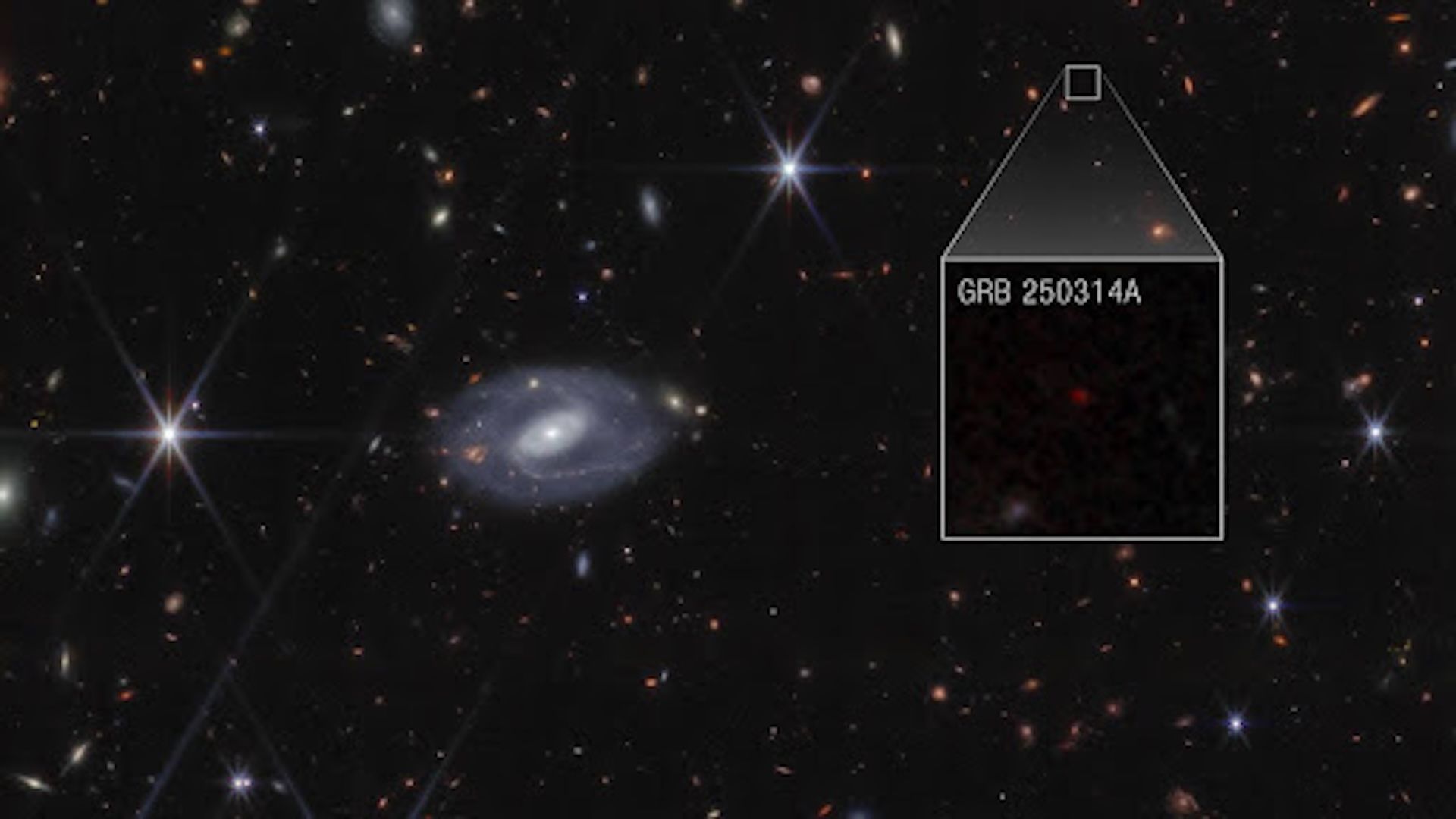
Astronomers using the James Webb Space Telescope (JWST) may have discovered the most distant supernova in the universe. This stellar explosion was caused by a very faint galaxy and occurred when the universe was only 730 million years old.
In addition to potentially adding another record to JWST’s already impressive list, this detection provides insight into the origin of the ultra-bright gamma-ray burst observed in March. These sudden, brief bursts of gamma rays are among the most powerful explosions in the universe.
you may like
Many of these high-energy phenomena were not discovered within the first billion years of the universe’s existence, so this was a rare opportunity for astronomers to understand how stars and galaxies in the early universe evolved.
When two research teams examined the properties of this gamma-ray burst, they found evidence that it could have been produced by an exploding star at the edge of the universe, confirming one of the teams’ predictions.
“We were surprised that our predictions worked so well and that we were able to demonstrate that JWST was able to see individual exploding stars at such extreme distances,” AJ Levan, lead author of one of the two papers and a professor at Radboud University in the Netherlands and the University of Warwick in the UK, told Live Science by email.
Both new studies were published in the journal Astronomy & Astrophysics on December 9th.
look for clues
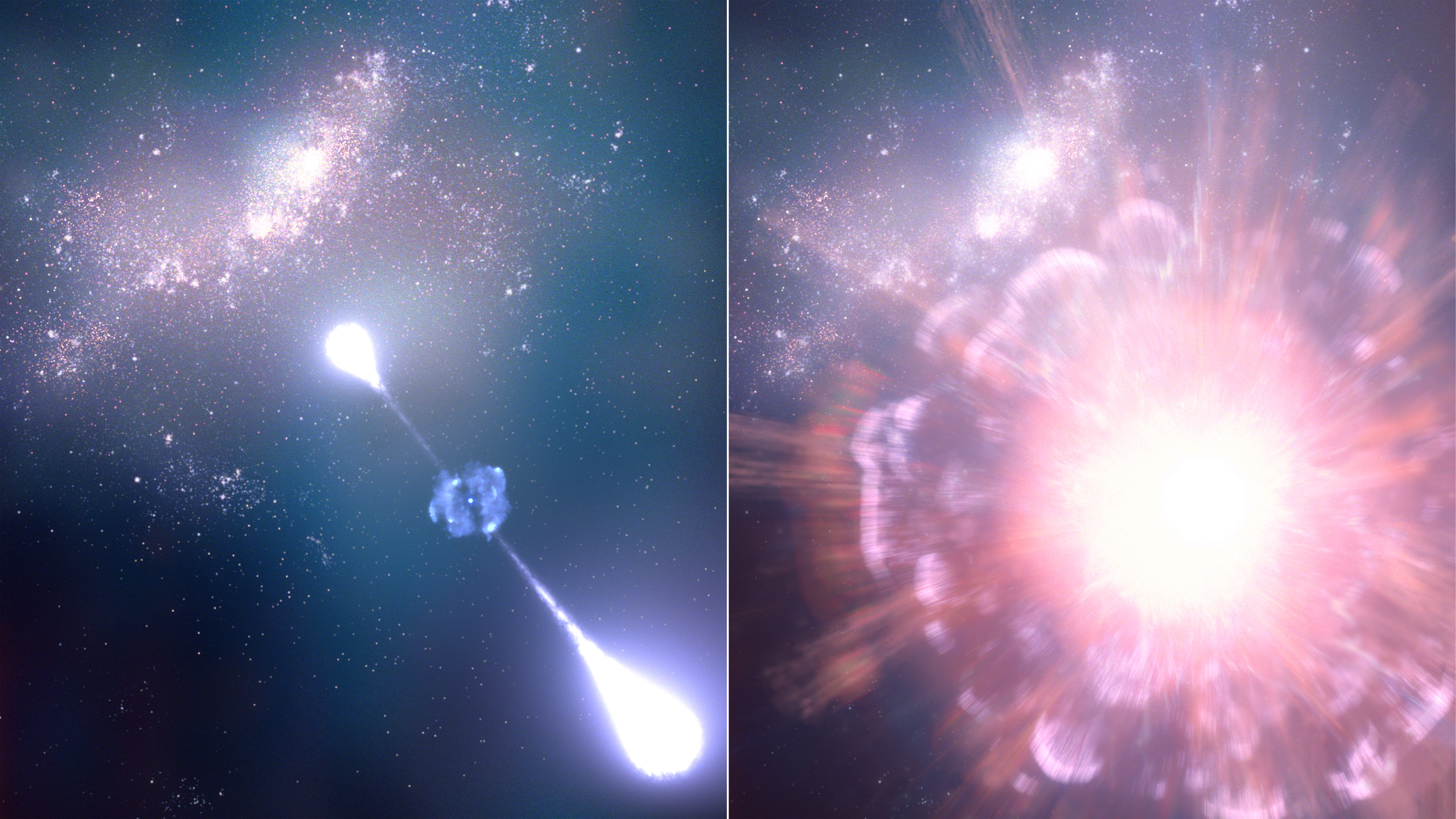
Short gamma-ray bursts, lasting less than two seconds, are thought to result from the merger of neutron stars, the ultra-dense remains of dead stars. In contrast, long gamma-ray bursts occur when massive stars collapse to form neutron stars or black holes.
The first burst of GRB 250314A lasts about 10 seconds, making it one of the long-lasting bursts. Therefore, researchers wanted to know whether the gamma-ray bursts were caused by supernovae, the catastrophic death of a massive star.
Gamma-ray bursts last only seconds to minutes, but they leave behind a smoothly fading afterglow of light that is lower in energy than gamma rays (X-rays, light, radio waves, and infrared radiation) and can last for several days. Because gamma-ray bursts are so short-lived, most of the information about them is revealed by their longer-lasting afterglow.
you may like
To confirm their predictions, the researchers needed to separate the light from afterglows, supernovae, and host galaxies. GRB 250314A produced detectable infrared and X-ray afterglows, but fortunately, by the time JWST observed the site several months later, the afterglows had disappeared. Therefore, this glow is expected to be too weak to explain the observed light, indicating that another light source is contributing to this glow.
“Now we are [light from the] “Galaxies and supernovae,” Levan said. If most of the light was produced by the host galaxy, it would have been very compact and unusually old, with stars that formed nearly 200 million years after the Big Bang.
“This would be an interesting result in itself, since galaxies like this are not often seen, and especially this is not the type of galaxy where you would expect to find gamma-ray bursts,” he added.
Therefore, the researchers concluded that the nature of the gamma-ray bursts could only be explained by supernovae.
twins far apart
The brightness of a supernova is determined by the amount of radioactive material released during the explosion. This is determined by the mass of the star’s core when it explodes.
For several reasons, astronomers believe that stars in the early universe may have had larger cores than the stars we see today. Therefore, the supernova associated with GRB 250314A provided a rare opportunity to study the properties of stars in the early Universe. GRB 250314A may be the earliest supernova ever observed, so researchers compared it to supernovae seen in nearby space. Surprisingly, it turned out to be very similar to modern star explosions.
“This could be an opportunity. After all, it’s just one object,” Levan said. “But it could also suggest that the star is exploding.” [in the early universe] — and therefore also the entire population of stars — are not as different as we think…”
To confirm that it’s a supernova, researchers need to re-estimate how much of the observed light comes from the supernova itself, and how much comes from the afterglow or host galaxy. They plan to conduct follow-up observations next year after the supernova has faded, which will make it much easier to distinguish contributions from these different sources.