
Transforming PFAS treatment capabilities

Wastewater treatment facilities in the United States have implemented PerfluorAd™ for PFAS removal.
Per- and polyfluoroalkyl substances (PFAS) remain among the most problematic water contaminants in the United States. While regulatory standards continue to tighten, with national maximum contaminant levels (MCLs) recently set at 4 ppt for PFOA and PFOS, industrial and municipal treatment facilities are faced with increasing amounts of wastewater containing PFAS, often exceeding tens of thousands of ppt. For waste disposal companies, these pressures create operational bottlenecks, slowdowns and high disposal costs.
Waste treatment facilities in the Great Lakes region of the United States faced exactly these constraints. The plant regularly received high-margin industrial wastewater containing 10,000 to 50,000 ppt of total PFAS, including PFOA, PFOS, PFNA, PFHxS, and short-chain fluorinated compounds. The facility operated a foam fractionation system (SAFF®), but increased PFAS loading regularly overloaded the system, forcing throughput to decrease and limiting revenue opportunities.
To meet this challenge, the facility integrated PerfluorAd™, a plant-based PFAS flocculation and precipitation technology developed by Cornelsen. PerfluorAd is selective for PFAS and is particularly effective at long-chain C8 chemistry, forming microflocs that are easily separated using existing processing equipment. This technology has already been documented to achieve removal efficiencies of 80-98% in high-strength PFAS waste streams and up to 99% removal in some water matrices, as demonstrated in full-scale applications in multiple countries.
Simple enhancements that deliver impactful results
One of the advantages of PerfluorAd is its ease of implementation. The Great Lakes facility seamlessly integrated PerfluorAd into its existing pretreatment process, requiring only minor changes in dosing and mixing. As demonstrated in Cornelsen’s technical literature, the technology’s chemistry is resistant to complex backgrounds such as high DOC, high salinity, and fluctuating pH, making it suitable for the site’s diverse industrial waste inputs.
When PerfluorAd was added upstream of the foam fractionation system, several performance benefits immediately emerged.
Consistent throughput: PerfluorAd reduces the concentration of PFAS entering the foam fraction and prevents system overload. Factories no longer have to slow down operations on days with high PFAS waste. Improved PFAS treatment efficiency: Once the influent is stabilized, the foam separation system operates within its optimal design range, improving overall PFAS removal consistency. Increased revenue capacity: By preventing bottlenecks, the plant can now accept and process more profitable wastewater. This was previously limited by fluctuations in PFAS loads.
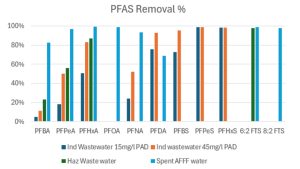
The factory owner summed up the impact succinctly: “PerfluorAd works very well. There are no problems. We are working to expand capacity to other facilities to accept more high-margin waste.”
Economic and environmental benefits
Traditional PFAS treatment methods (granular activated carbon (GAC), ion exchange, membranes, thermal destruction) often involve significant consumables and waste disposal burdens. PerfluorAd offers a contrasting model.
Generates less waste because the PFAS is concentrated into a minimal amount of sludge or solids. Biodegradable chemistry that breaks down into harmless compounds. Compatibility with existing isolated assets avoids large capital investments. Passive flocculation and easy mixing result in low energy demands.
The facility also reduced operational wear and tear and extended system availability by reducing the load on downstream SAFF® equipment.
PerfluorAd’s low volume sludge is particularly advantageous compared to alternatives. For example, at airports transitioning from aqueous film-forming foam (AFFF) systems, traditional triple-wash methods can generate large amounts of contaminated water, whereas PerfluorAd often consolidates PFAS into a single waste drum.
A replicable model for PFAS management in the United States
This Great Lakes facility demonstrates how a simple upstream PFAS separation step can transform operational capabilities. As PFAS regulations tighten across the United States and several states introduce their own aggressive MCLs, the need for scalable and cost-effective solutions increases.
PerfluorAd provides wastewater treatment plants, industrial processors, and remediation companies with an approachable, modular way to reduce PFAS loads while leveraging existing equipment. The facility plans to expand to additional locations, and its successful experience provides a promising pathway for national PFAS management.
“At Cornelsen, we are building a PFAS treatment train that delivers practical, proven results for communities across the United States,” said Pamela Lynch, president of Cornelsen. “While our work in the United States is in its early stages as Cornelsen scaled up in 2025 to meet global demand, our commitment to advancing safe and reliable water solutions is already taking shape. We are building on decades of full-scale implementation in Europe and the United Kingdom.”
This article will be published in an upcoming PFAS Special Focus Publication in January.
Source link

