
Why we need global measures against space debris
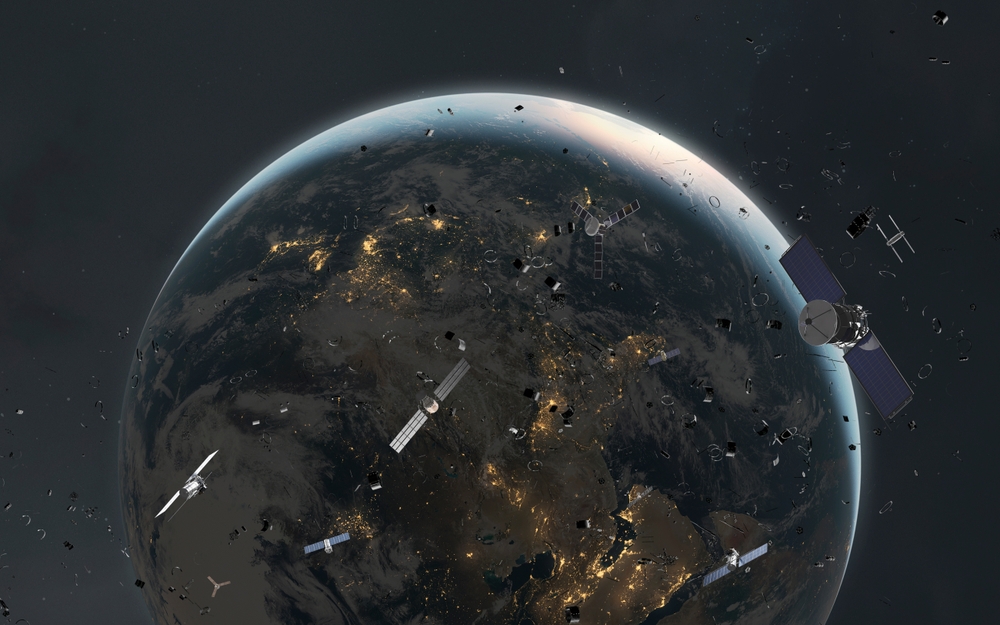
Earth’s orbit is crowded and dangerous. Over the past few decades, thousands of satellites, spent rocket stages, debris from explosions and collisions, and even tiny paint shavings have accumulated around Earth.
According to the space agency, there are well over 1 million pieces of debris larger than 1 cm in orbit that can damage or destroy a functioning spacecraft if they collide at orbital speeds of up to 28,000 km/h.
Without action, this buildup risks triggering a cascading collision known as Kessler syndrome, which could make critical orbital regions increasingly unusable for communications, Earth observation, scientific research, and human spaceflight.
International frameworks: guidelines, agreements and harmonized policies
The space debris problem is global and transnational in nature, and debris generated by one country can endanger satellites operated by another.
Correspondingly, an international framework of guidelines and cooperating bodies has grown over the past 30 years.
The Interagency Space Debris Coordination Committee (IADC), comprised of 13 space agencies and their associate members, has developed widely recognized mitigation standards that recommend debris reduction practices throughout the lifecycle of spacecraft and rocket stages.
Additionally, the United Nations Guidelines for the Long-Term Sustainability of Space Activities (LTS), while voluntary, unify spacefaring nations around core principles such as avoiding the release of mission-related objects and planning for the disposal of used satellites. These soft law norms help shape national regulations and industry practices.
The European Space Agency’s (ESA) Zero Debris Charter, signed by more than 40 organizations, further expands this cooperation and encourages a common commitment to reducing debris generation and pursuing sustainable operations.
Pioneering space debris removal mission
International and commercial efforts are finally moving beyond mitigation to active debris removal (ADR), the technology needed to physically remove objects from orbit.
One of the most high-profile efforts is ClearSpace-1, an ESA mission scheduled to launch later this year. It uses a servicer spacecraft equipped with a robotic arm to rendezvous with a defunct payload adapter and remove it from orbit, demonstrating rendezvous, acquisition, and deorbit techniques.
Alongside ClearSpace-1, technology demonstrators such as RemoveDEBRIS, a joint project between the University of Surrey and the European Commission, are advancing important ADR technology by successfully testing nets, harpoons and deployable drag sails to capture and deorbit test targets.
Commercial business is also progressing. For example, Astroscale’s ADRAS-J mission, part of Japan’s commercial debris removal demonstration, is poised to get up close and inspect the upper stage rocket body in orbit, paving the way for future capture and deorbit services.
National Strategy and Space Agency Roadmap
Countries and space agencies are strengthening their strategic frameworks to address debris risks.
NASA has long championed space debris mitigation and research, regularly updating its debris environment models and proposing new remediation paths, including nudging large objects to reduce collision risk and removing small debris with lasers. ESA aims to limit future debris generation and integrate debris management into mission design by 2030, pursuing bold zero-debris approaches, including reducing acceptable lifetime orbit time and supporting active removal demonstrations. Showing both technical and diplomatic leadership, Japan is exploring a regulatory framework and building a coalition of nations to shape international debris removal rules, with concrete proposals expected to be made soon in global forums.
National space agencies are also increasing investment in space situational awareness (SSA), or tracking and predicting the movement of space debris, which is essential for collision avoidance and safe satellite operations.
Cutting-edge technology: robotics, lasers and new removal concepts
Ambitious techniques are being studied to expand space debris removal beyond current missions.
Robotic rendezvous and capture systems, whether nets, claws, magnets, or autonomous servicers, are being improved to increase reliability in the harsh orbital environment.
Laser technology is being investigated as a way to slowly “push” small debris into decaying trajectories without physical contact, potentially reducing the risk of fragments too small for traditional capture.
On the design front, the agency is pushing for “design for the end” spacecraft that more fully disintegrate upon re-entry, reducing the risk of surviving debris reaching the surface.
Public-private partnerships and the commercial clean economy
Dealing with space debris is not just a public mission. The private sector is stepping up the development of solutions that achieve both sustainability and economic goals.
Companies like Astroscale and ClearSpace are moving into commercial ADR services that satellite operators can purchase, creating a nascent industry around in-orbit services and sustainability.
Governments foster this ecosystem with funding initiatives and partnerships that de-risk early technology development, while competitions and challenges (such as NASA’s Detect, Track, and Repair Competition) foster innovation in tracking and repair technologies.
Future challenges
Despite progress, major challenges remain. In-orbit operations are regulated by treaties that do not explicitly specify ownership of space debris or consent for its removal, creating legal ambiguity for ADR missions involving objects launched by other countries.
Additionally, tracking the full extent of debris (particularly objects smaller than 1 cm) remains technically difficult, but essential for safety.
Stronger international standards and enforcement mechanisms are needed to coordinate the launch of thousands of new satellites (including mega-constellations) with strong mitigation practices.
And while ADR demonstrations are promising, scaling up removal to the amount needed to stabilize the orbital environment will require sustained investment, innovative propulsion and rendezvous technologies, and global coordination.
A common commitment to a sustainable trajectory future
Space has become an integral part of modern life, powering communication, navigation, weather forecasting, scientific discovery, and more.
Protecting this shared environment from the growing threat of debris requires a multifaceted global response.
Through international cooperation, national strategies, emerging technologies, and partnerships between governments and industry, the world is moving toward a future where space is used responsibly and sustainably, and Earth’s orbit remains safe and accessible for generations to come.
Source link

