


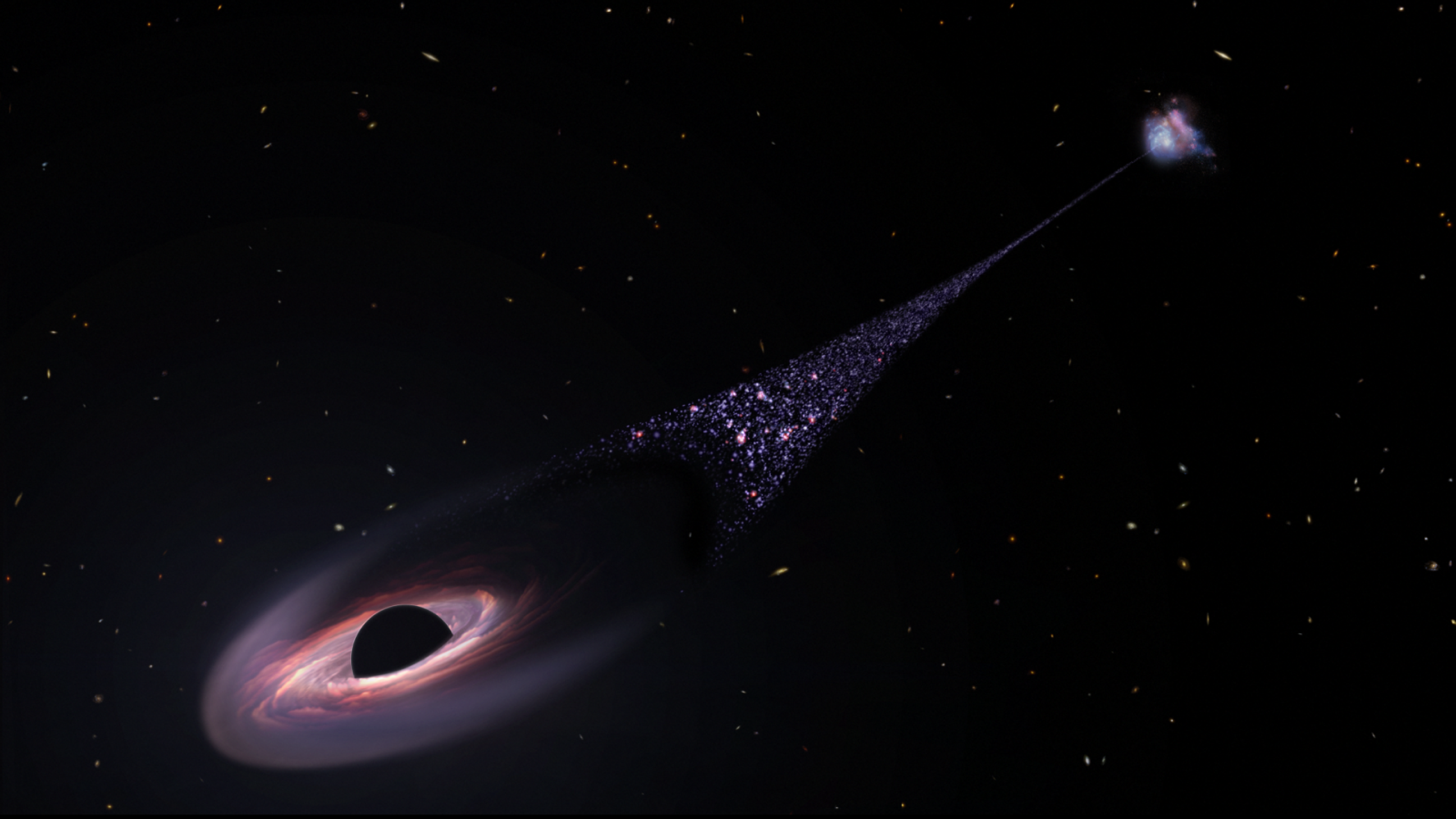
A shock wave in the far reaches of space could be a precursor to the first known runaway supermassive black hole to escape from its host galaxy at 2.2 million miles per hour (3.6 million kilometers per hour).
The possible confirmation from the James Webb Space Telescope (JWST), published on the preprint server Arxiv on December 3, has not yet been peer-reviewed. However, the paper was published in the Astrophysical Journal Letters, and the study’s lead author, Peter van Dokkum, a professor of astronomy and physics at Yale University, has published several peer-reviewed papers on supermassive black hole candidates in recent years.
you may like
Following the flow of stars
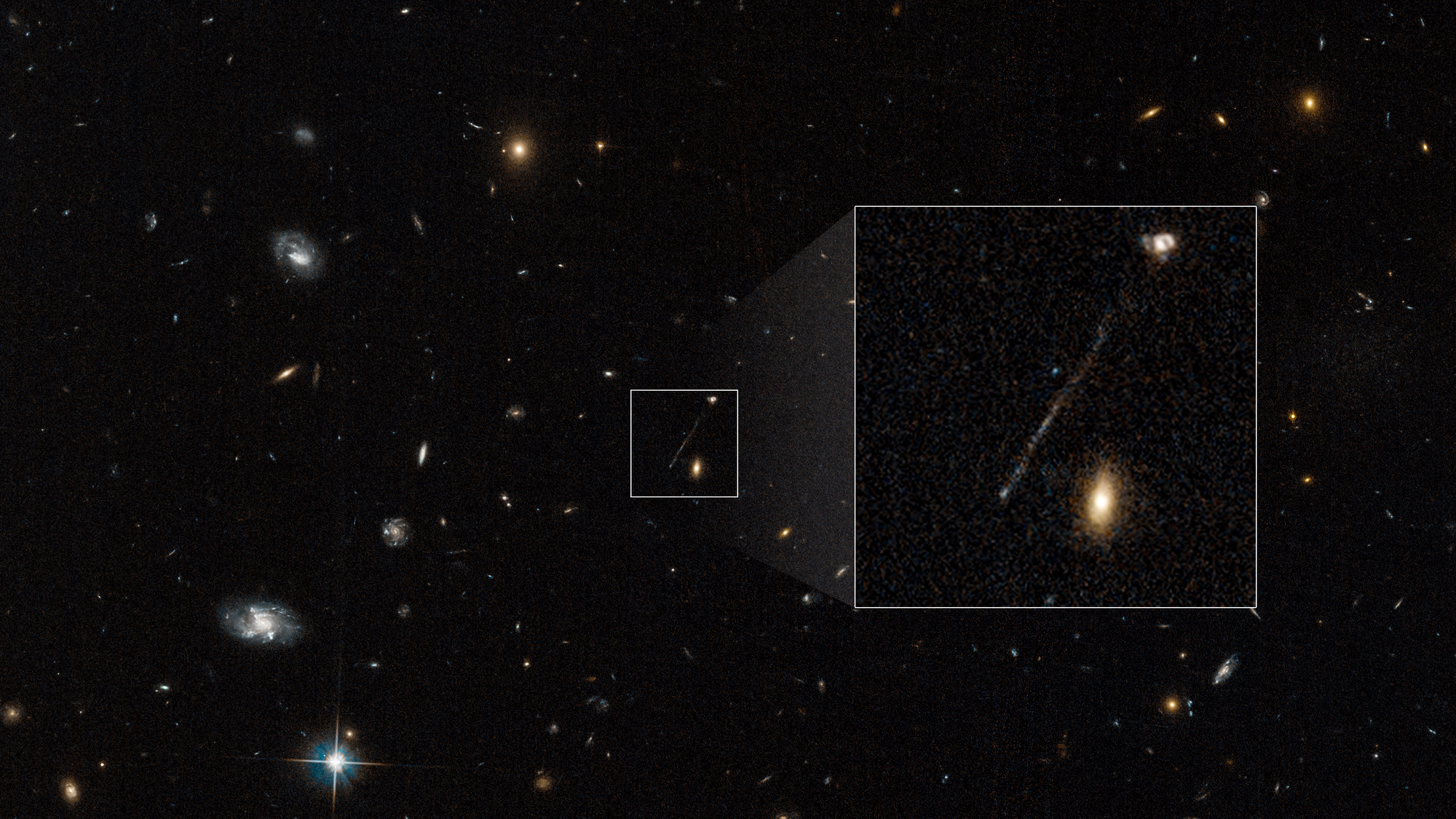
The black hole candidate was first discovered by Van Dokkum’s team in 2023, when a faint line was visible in archive images from the Hubble Space Telescope. The scene was so strange that the researchers conducted new observations at the Keck Observatory in Hawaii.
Observations at the time showed that the black hole had the mass of 20 million suns, and that the strange line was the “wake” of a young star stretching 200,000 light-years across space (twice the diameter of the entire Milky Way). The Hubble image captures the moment the universe was about half way through its current age of 13.8 billion years.
“We suspected that this strange object was a runaway supermassive black hole, but we didn’t have ‘conclusive proof’,” Van Dokkum said. So for new research, the team turned to JWST, a deep space observatory unique in its “sensitivity and sharpness,” to “observe bow shocks caused by speeding black holes,” van Dokkum said.
The resulting images surprised the team.
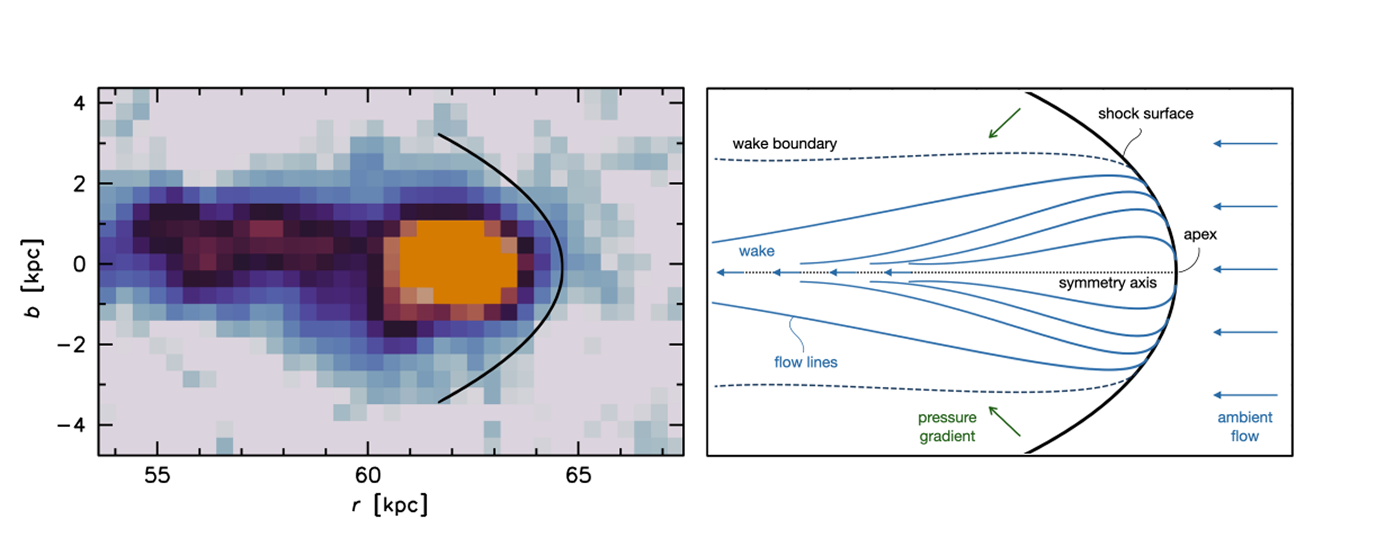
JWST’s mid-infrared instrument has produced unprecedented clarity of the shock wave, or bow shock, at the tip of a black hole candidate’s escape. “It’s a bit like the waves created by a ship,” Van Dokkum said. “In this case, the ship is very difficult to see in the black hole, but we can see the ‘water’, in fact the gases of hydrogen and oxygen. [the black hole] Push forward. ”
Van Dokkum was surprised. “Everything about this object told us it was something really special, but it was incredibly satisfying to see this distinct feature in the data,” he added.
Apart from JWST’s sheer resolution, van Dokkum said his study showed that the observations are consistent with Hubble and Keck data at different wavelengths of light. The data “all provide different pieces of the puzzle, and they fit together beautifully, just as predicted by the theoretical models,” he said.
you may like
super huge mystery
By studying runaway black holes like this candidate, van Dokkum said, scientists can learn more about how galaxies and black holes evolved. Most large galaxies, including our own Milky Way, have supermassive black holes embedded at their centers. Whether they can escape the galaxy’s tight bonds remains a long-standing mystery.
Van Dokkum says the only way a supermassive black hole could be stripped from a galaxy is if at least two of these holes come unusually close to each other and the intense gravitational interaction “kick” one out of place.
New research suggests that the candidate runaway was created after at least two, and possibly up to three, black holes all interacted. With each having the mass of at least 10 million suns, the violence of the encounter must have been “considerable,” van Dokkum said.
As for where to look next for runaway supermassive black holes, the paper says there are “several promising candidates,” but these systems are difficult to interpret. One example is an obscure object known as a “space owl” about 11 billion light-years from Earth.
According to a new paper, the Cosmic Owl contains two galactic nuclei, each with an active supermassive black hole at the center of the galaxy, and, curiously, a third supermassive black hole “embedded within a cloud of gas” between the two galaxies.
How the third black hole ended up inside the gas cloud is a matter of debate. Some researchers have argued that the black hole could be a runaway that escaped from one of its host galaxies, but van Dokkum’s group’s JWST observations challenge that interpretation. Their observations suggest that the out-of-place black hole “likely formed in situ by the direct collapse” of gas produced by a shock wave after two galaxies nearly collided with each other.
Further research is needed on this object and other objects that may be host to runaway black holes. Van Dokkum cited the current Euclid Space Telescope and the upcoming Nancy Grace Roman Space Telescope as promising research instruments. Unlike JWST, these telescopes are designed to see the entire sky. “That tells us how often something like this happens. That’s something we’d love to know.”