
3km X-ray laser measures the hottest solid material on Earth
The world’s longest thermometer measures the temperature of extreme substances.
We use thermometers to measure body temperature in daily life. When scientists need to bring materials to extreme temperatures—for example, to recreate the conditions inside planets, fusion capsules, or laser-stressed metals—they use something much larger: a 3-kilometer X-ray laser.
At SLAC National Accelerator Laboratory in California, the Linac Coherent Light Source (LCLS) produces ultra-bright, ultra-fast X-ray flashes that can directly track the movement of atoms. In this sense, it acts as the world’s longest thermometer, an X-ray beam that records measurements at the instant when a short-lived, highly excited state of matter is created.
These experiments occur on time scales that are difficult to grasp. A process that would be blurry at normal speeds is resolved here using X-ray pulses of trillionths of a second, on the order of picoseconds. Since no physical probe can be inserted into such short events, the light itself can act as a thermometer, effectively turning the LCLS into a kind of atomic radar gun.
How do we measure the temperature of a trillionth of a second event?
The basic idea is easy to explain, even if it is technically difficult to implement. First, a femtosecond laser sends controlled pulses of energy into a thin metal foil, causing its atoms to move rapidly. Precisely timed pulses of X-rays then scatter off these atoms and return with a small Doppler spread, a small change in energy (or “color”) caused by the movement of the atoms. By measuring its spread, we infer the speed of the atoms, and from that speed we determine the temperature. This allows direct in-situ measurements at the moment when extreme conditions exist. At the same time, the diffraction pattern can be recorded to ensure that the crystal lattice remains intact and the extracted temperature can be assigned to the solid at that moment.
Two aspects are important. The first is timing. Because the heating pulse and the X-ray probe are separated by only a few trillionths of a second, they observe the system while it is still hot, before it has cooled or the structure has relaxed. The second is accuracy. The X-ray energy is measured with such high resolution that even small Doppler spreads can be resolved. The motion of the atoms is directly encoded in the scattered light, eliminating the need to rely on indirect assumptions about what is happening inside the material.
In plain English, it’s “the longest thermometer”
Simply put, this depends on the Doppler effect. As the siren moves toward you, its pitch increases. The sound gets lower as you move away. X-rays scattered from vibrating atoms behave similarly, with small changes in frequency (or energy) rather than large changes in pitch. Hotter ions move faster and produce a broader spectrum, so the width of the blur is a direct measure of their temperature. This is exactly what happens in the experiment. The hotter the ion, the more blurred the measured spectrum becomes.
Surprise: A solid that remains solid even at ~19,000 K
Using this light-as-thermometer method, the researchers pushed the gold crystal into a region previously thought to be unlikely: around 19,000 Kelvin, about 14 times gold’s equilibrium melting temperature, while leaving the crystal lattice intact¹.
For decades, prevailing models suggested that solids could not maintain stability well above about three times their melting temperature until they encountered an “entropic catastrophe” in which vibrations disrupted the lattice and rapidly lost crystalline order. The new results show that if heating is fast enough, the material can temporarily avoid this collapse during short intervals probed by X-ray pulses.
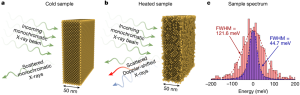
An important factor is the rate of energy storage. The crystals heat up so quickly that they don’t have time to expand, flow, or structurally break down. Crystalline order persists for very short periods of time under conditions that are ruled out by simple equilibrium theory, providing new insight into how melting begins when materials are far from equilibrium.
The superheated solid exists only temporarily, but that’s enough. This measurement provides a well-defined snapshot of the system at extreme temperatures and confirms that temperature can be directly measured in the still solid state for this short period of time.
why is this important
High energy density (HED) materials exist between the familiar solids and fully ionized plasmas. Examples include the core of a planet, shock-compressed metal, and fusion fuel in the process of igniting. Although pressure and density are reasonably limited in many of these systems, it has historically been much more difficult to directly measure temperature.
The measured spread of scattered X-rays allows temperature diagnosis directly from the atomic motion. This reduces reliance on indirect models and allows for more rigorous tests of how heat flows, how electrons and ions exchange energy, and how crystals approach melting under extreme drives.

The “world’s longest thermometer” was used in these experiments. Credit: U.S. Geological Survey/Department of the Interior/USGS
Using high-repetition X-ray lasers, the same approach can be used to map temperatures during shock compression or in fusion experiments where ion temperature is a key parameter. The resulting data can be used to obtain quantitative measurements that benchmark and refine our understanding of matter at high energy densities. Together, these features turn short-lived HED states into quantitative testbeds for far-from-equilibrium matter theories.
Milestones and starting lines
This research resulted in two simultaneous milestones. One, it’s the first time we’ve directly measured the atomic temperatures of these extreme solids in situ, and two, to our knowledge, they’re the hottest crystalline materials ever recorded. They also challenged long-held expectations about how far overheating can occur before a crystal loses order.
More importantly, a new set of questions has arisen that can be addressed through direct measurements.
How do crystals actually fail under this kind of drive? Do defects dissolve or collapse more uniformly? How fast does heat transfer between electrons and ions when they are far from equilibrium? Which materials remain ordered the longest under ultra-high speed drives? Can we take advantage of their resilience in our applications?

This method itself is widely applicable. It relies on powerful, well-characterized X-ray pulses and high-resolution spectrometers, ingredients available in several X-ray free electron lasers around the world. As a result, the same temperature diagnostics can be applied to many experiments investigating melting, heat transport, and material stability under extreme conditions.
High energy density science, more generally, is about creating, controlling, and diagnosing states of matter that are difficult or impossible to access in normal environments. Giant lasers create shocks similar to astrophysical explosions, diamond anvils compress matter to planetary pressures, and X-ray lasers allow the movement of atoms to be tracked in real time. This work adds a quantitative thermometer to that toolkit. This shows that it is possible to confirm the structure of ultrafast solids that are far from equilibrium and at the same time directly measure the temperature.
Along the way, the team also set a practical benchmark for how high temperatures a crystalline solid can be driven while maintaining order. This record itself is secondary, but it shows what is currently possible. Materials can now be moved to conditions that were once thought to be out of reach, and their responses can be precisely measured. In this way, the field advances by turning increasingly extreme regimes into carefully characterized experiments.
References
G. White et al., “Superheating of gold beyond the predicted entropic catastrophe threshold,” Nature 643, 950–954 (2025)
This article will also be published in the quarterly magazine issue 25.
Source link

