
Close Menu
  • Home
  • Identity
  • Inventions
  • Future
  • Science
  • Startups
  • Spanish
What's Hot

AWS CodeBuild misconfiguration exposed GitHub repository to potential supply chain attacks

Higgsfield, the AI ​​video startup founded by former Snap executives, is valued at $1.3 billion

Iran’s internet shutdown becomes longest in history as protests continue

Facebook X (Twitter) Instagram
  • Home
  • About Us
  • Advertise with Us
  • Contact Us
  • DMCA
  • Privacy Policy
  • Terms & Conditions
  • User-Submitted Posts
Facebook X (Twitter) Instagram
Fyself News
  • Home
  • Identity
  • Inventions
  • Future
  • Science
  • Startups
  • Spanish
Fyself News
Home » Black hole butterfly? The James Webb Telescope discovered dozens of black hole “cocoons” in the early universe.
Science

Black hole butterfly? The James Webb Telescope discovered dozens of black hole “cocoons” in the early universe.

userBy userJanuary 14, 2026No Comments3 Mins Read
Share Facebook Twitter Pinterest Telegram LinkedIn Tumblr Email Copy Link
Follow Us
Google News Flipboard
Share
Facebook Twitter LinkedIn Pinterest Email Copy Link

Scientists may have finally determined the nature of some of the most mysterious objects in the night sky.

In a new study, researchers investigated what the “little red dots” are. These mysterious objects from the early Universe have characteristics of both galaxies and supermassive black holes, but they don’t quite fit either description.

A new study has found that these mysterious dots may be, after all, young supermassive black holes trapped in dense clouds of gas that obscure any obvious signs of their true nature. The researchers published their findings in the academic journal Nature on Wednesday (January 14).

you may like

The tiny red dot was first observed by the James Webb Space Telescope (JWST) shortly after the spacecraft began collecting data in 2022. These were originally thought to be compact galaxies packed with stars, but they existed too early in the universe for so many stars to form, at least under our current understanding of galaxy evolution.

Instead, other researchers suggested that this unusual object could be an early supermassive black hole. The light emitted by the energetic hydrogen atoms surrounding the dots suggests that the gas is moving at thousands of miles per second, pulled by the gravity of the central object.

“Such extreme velocities are the hallmark of an active galactic nucleus,” said Rodrigo Nemen, an astrophysicist at the University of São Paulo in Brazil, in an accompanying paper published in the journal Nature. This means that the hungry supermassive black hole at the center of the galaxy is drawing in matter.

But unlike supermassive black holes, tiny red dots that emit X-rays or radio waves have not been observed. And whether the points are black holes or early galaxies, they appear to have too much mass to have formed so early in the universe.
Get the world’s most fascinating discoveries delivered straight to your inbox.

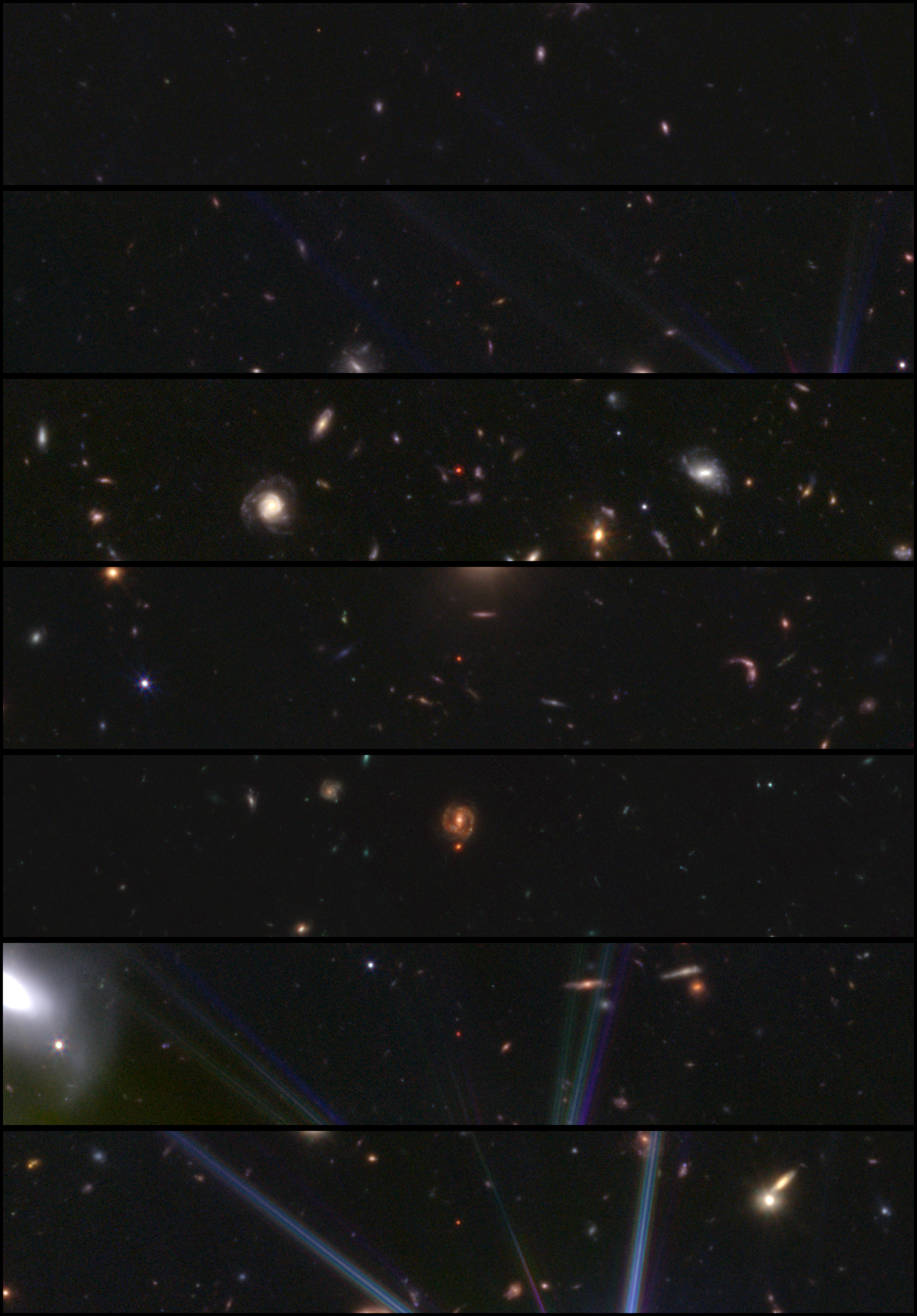
Image composed of various things "small red dot" Discovered by JWST during deep space exploration

A composite image of various “small red dots” discovered by JWST during deep space research. (Image credit: Darach Watson/JWST)

In a new study, researchers took a closer look at the light emitted by these objects to better understand their properties. The scientists studied spectra from 30 tiny red dots, each collected by JWST’s infrared instruments.

The light emitted by the tiny red dot closely matches the light the researchers predicted would come from a supermassive black hole surrounded by a dense cloud of gas. The gaseous cocoon may have captured X-ray and radio emissions from the growing black hole, preventing them from reaching JWST.

When the researchers recalculated the mass of the little red dot based on their new interpretation, they found that it was about 100 times less massive than previously thought. Together, this evidence suggests that the tiny red dot is growing a supermassive black hole that is accreting surrounding gas.

“These are the lowest-mass black holes at high redshift to our knowledge, suggesting the presence of a young population. [supermassive black holes](Redshift describes how light stretches toward the redder end of the electromagnetic spectrum as it traverses the expanding universe; higher redshifts mean more distant objects).

“With the revised mass estimate, [little red dots] Confirming this finding will include studying more of the tiny red dots to investigate whether this “cocoon” stage is common and determine what role it plays in black hole growth, Nemen wrote.


Source link

#Biotechnology #ClimateScience #Health #Science #ScientificAdvances #ScientificResearch
Follow on Google News Follow on Flipboard
Share. Facebook Twitter Pinterest LinkedIn Tumblr Email Copy Link
Previous ArticleWoolly rhinoceros meat pulled from ancient wolf stomach provides clues to Ice Age giant extinction
Next Article Bandcamp takes action against AI music, bans it from platform
user
  • Website

Related Posts

NASA astronauts return to Earth after unprecedented medical emergency on ISS

January 15, 2026

China unveils world’s first lunar clock, solving strange time dilation predicted by Einstein

January 15, 2026

Woolly rhinoceros meat pulled from ancient wolf stomach provides clues to Ice Age giant extinction

January 14, 2026
Add A Comment
Leave A Reply Cancel Reply

Latest Posts

AWS CodeBuild misconfiguration exposed GitHub repository to potential supply chain attacks

Higgsfield, the AI ​​video startup founded by former Snap executives, is valued at $1.3 billion

Iran’s internet shutdown becomes longest in history as protests continue

OpenAI invests in Sam Altman’s brain-computer interface startup Merge Labs

Trending Posts

Subscribe to News

Subscribe to our newsletter and never miss our latest news

Please enable JavaScript in your browser to complete this form.
Loading

Welcome to Fyself News, your go-to platform for the latest in tech, startups, inventions, sustainability, and fintech! We are a passionate team of enthusiasts committed to bringing you timely, insightful, and accurate information on the most pressing developments across these industries. Whether you’re an entrepreneur, investor, or just someone curious about the future of technology and innovation, Fyself News has something for you.

Castilla-La Mancha Ignites Innovation: fiveclmsummit Redefines Tech Future

Local Power, Health Innovation: Alcolea de Calatrava Boosts FiveCLM PoC with Community Engagement

The Future of Digital Twins in Healthcare: From Virtual Replicas to Personalized Medical Models

Human Digital Twins: The Next Tech Frontier Set to Transform Healthcare and Beyond

Facebook X (Twitter) Instagram Pinterest YouTube
  • Home
  • About Us
  • Advertise with Us
  • Contact Us
  • DMCA
  • Privacy Policy
  • Terms & Conditions
  • User-Submitted Posts
© 2026 news.fyself. Designed by by fyself.

Type above and press Enter to search. Press Esc to cancel.