
2025 was the third hottest year on record, Copernicus data warns
According to the Copernicus Climate Change Service (C3S), run by the European Center for Medium-Range Weather Forecasts (ECMWF), global temperatures in 2025 will be just 0.01°C lower than in 2023 and 0.13°C lower than in 2024, still holding the title of the hottest year on record.
The release of this data was coordinated with other major climate monitoring organizations, including NASA, NOAA, the Met Office, Berkeley Earth Station, and the World Meteorological Organization (WMO), and highlighted the broad scientific consensus on the scale and pace of global warming.
Underscoring the bleak climate picture painted by the analysis, C3S Director Carlo Buontempo said: “The fact that the past 11 years have been the warmest on record provides further evidence of an undeniable trend towards a hotter climate.
“The world is rapidly approaching the long-term temperature limits set by the Paris Agreement, which we will pass without fail. Our choice now is how to best manage the inevitable overshoot and its impact on societies and natural systems.”

Crossing a major climate milestone
One of the most important findings relates to worrying trends over time, not just the hottest year. Over the three-year period 2023-2025, global warming averaged more than 1.5°C above pre-industrial (1850-1900) levels.
This is the first time in a three-year span that the 1.5°C limit under the Paris Agreement, a standard that targets long-term global warming rather than short-term fluctuations, has been exceeded.
Based on multiple analytical methods, scientists currently estimate that long-term global warming has reached around 1.4°C, with the 1.5°C threshold expected to be reached by the end of this decade. This is more than 10 years earlier than expected at the time the agreement was signed.
Exactly how warm was it in 2025?
Using the ERA5 reanalysis dataset, Copernicus reports that global surface temperatures in 2025 were 1.47 degrees Celsius above pre-industrial levels, following the hottest year ever at 1.60 degrees Celsius in 2024.
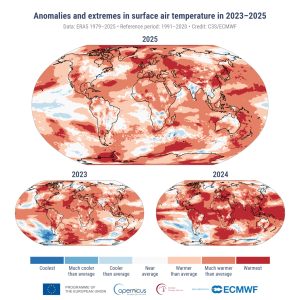
Although 2025 was slightly colder than the previous two years, it still brought exceptional warmth to much of the planet.
Temperatures on land on Earth were the second highest on record, with the polar regions once again standing out for their extremes.
The polar regions offset the cooler tropics
In contrast to 2023 and 2024, temperatures across the tropics were slightly cooler in 2025, but remained well above average in many regions.
Scientists believe this is partly due to ENSO’s neutral or weak La Niña conditions in the equatorial Pacific, which tend to suppress global temperatures compared to El Niño years.
That cooling effect was offset by dramatic warming in the polar regions. The Antarctic recorded its highest annual temperature on record, while the North Pole experienced its second-warmest year on record.
Warmer temperatures were also observed in parts of the Northeast Atlantic, Pacific Ocean, Europe, and Central Asia.
Why has it been so hot these past three years?
Researchers point out that there are two main factors behind the exceptional warmth of 2023-2025. The first is the continued accumulation of greenhouse gases caused by human emissions and the declining capacity of natural systems to absorb carbon dioxide.
The second is the role of the sea. Sea surface temperatures have reached unusually high levels globally, driven by El Niño events earlier in the period and further amplified by long-term climate change.
Additional influences include changes in aerosols, low cloud cover, and atmospheric circulation patterns.
Heat stress, wildfires, and human health
In 2025, approximately half of the world’s land area will be exposed to more days than average of intense heat stress, defined as “sensible temperatures of 32 °C or higher.”
The World Health Organization (WHO) has identified heat stress as the leading cause of weather-related deaths worldwide.
Hot, dry, and windy conditions also caused severe wildfires, particularly in parts of Europe and North America.
Data from the Copernicus Atmospheric Monitoring Service (CAMS) shows Europe has recorded its highest annual wildfire emissions ever, with smoke and pollutants worsening air quality across large areas.
Extreme events increase data urgency
Although the report does not directly attribute individual disasters to climate change, 2025 was marked by record heat waves, powerful storms, and massive wildfires across Europe, Asia, and North America, including events in Spain, Canada, and Southern California.
These extreme results provide real-world context to the statistics and help explain why public and political attention continues to grow over which year will be the next hottest.
monitor the path ahead
Scientists stress that rising greenhouse gas concentrations, primarily the result of human activity, remain the main cause of long-term warming.
Laurence Rouille, Director of ECMWF’s Copernicus Atmospheric Monitoring Service, explained: “Atmospheric data for 2025 paint a clear picture. Human activity remains the main driver of the extreme temperatures we are observing. Greenhouse gases in the atmosphere have steadily increased over the past decade.”
“We will continue to track greenhouse gases, aerosols and other atmospheric indicators to help decision makers understand and respond effectively to the risks of continued emissions, and to strengthen synergies between air quality and climate policy. The atmosphere is sending us a message, and we must listen.”
As the race for the title of hottest year continues, the larger message from the data is clear. Record-breaking warmth is no longer the exception, but is becoming the norm.
Source link

