
World-class rare earth magnet recycling facility begins operations in the UK

The University of Birmingham has launched a new facility for the recycling of rare earth magnets, which will help reduce the UK’s dependence on imports of rare earth metals, alloys and magnets.
Rare earth magnets are one of the important “critical minerals” that are essential to modern life. They form the core building blocks of technologies such as wind turbines, electric vehicles, medical devices, pumps, robotics, and electronics.
Therefore, as the adoption of low-carbon technologies accelerates, the demand for these minerals will only increase.
Professor Rachel O’Reilly MBE FRS, Vice-Chancellor (Research) at the University of Birmingham, explained: “The University of Birmingham is playing a key role in helping the UK become a technological leader in this field by developing fully circular solutions for supplying critical minerals such as those found in rare earth magnets.”
“The opening of the Birmingham Magnet Recycling Facility highlights the important role that university-led research and development plays in providing industrial capacity and addressing the national resilience and sustainability goals identified within the UK Government’s strategic and social priorities.”
Supporting the UK’s focus on strategically important minerals
In 2021, the Birmingham Center for Strategic Elements and Critical Materials (BCSECM) worked with a number of partners to produce a policy committee report entitled ‘Securing technology in the UK – Critical Metals’.
The report warned that the UK faces major industrial changes as it moves from fossil fuels to electrification, increasing its reliance on technology-critical metals (TCMs) such as lithium, cobalt and rare earths.
The report recommends developing strategies for recycling, primary production, processing and international partnerships, which will be key to securing the materials needed for the UK’s low-carbon and competitive industrial future.
The new processing facility will reintroduce the production of sintered rare earth magnets to the UK for the first time in 25 years, and can be used in the primary production of magnets as well as recycled feed.
Innovative rare earth recycling process
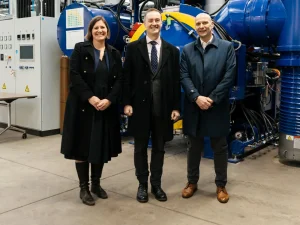
The rare earth magnet recycling facility, opened by Chris McDonald MP, Minister for Industry at the Department of Energy Security and Net Zero and the Department of Commerce, uses a breakthrough hydrogen-based process developed by researchers.
Hydrogen processing of magnet scrap (HPMS) technology is a highly efficient method to extract rare earth magnets from used products without completely decomposing the product. Convert waste into a sustainable source of rare earths that can be used to make new metals, alloys and magnets, while reducing environmental impact, cost and supply chain risk.
The Tysley Energy Park facility in Birmingham will scale up the process to commercial production levels. While the previous proof-of-concept facility processed batches of 50 to 100 kg, the new scaled-up facility can recover more than 400 kg of rare earth alloys per batch and produce 100 tons of new sintered magnets per year in one shift and more than 300 tons in multiple shifts.
By recycling products such as hard drives, electric motors, wind turbines, robotic actuators, pumps, filters, and electronics, we can save around 90% CO2 compared to manufacturing magnets from minerals extracted from the ground.
Extensive circular solutions for critical minerals
Rare earth recycling is within the University of Birmingham’s extensive research strengths, including battery recycling, robotic disassembly, chemical recovery and energy storage.
The recycling facility has received £4.5m of funding from Innovate UK’s Driving the Electric Industrialization Centers (DER-IC), with support grants from the Innovate Climates Programme, EPSRC, Advanced Propulsion Center and EU Horizon grants.
The investment will support the UK’s drive towards a net-zero carbon economy and contribute to the development of clean technology supply chains.
“This is a great example of knowledge transfer from research to industry and has the potential to reduce the risk of supplying rare earth permanent magnets to UK manufacturing and make these critical components more sustainable,” said Bruce Adderley of Innovate UK.
Professor Alan Walton, Principal Scientist and Head of the Magnetic Materials Group (MMG) at the Birmingham Center for Strategic Elements and Critical Materials, added: “The University of Birmingham’s recycling facility will provide recycled feedstock for multiple parts of the UK’s rare earths value chain, driving job creation, workforce skills development and long-term economic growth in the UK.”
Source link

