
Spin size rewrites the Kondo effect

Quantum effects in Kondo lattices determine whether a system behaves magnetically or non-magnetically, opening new avenues for designing future quantum materials and technologies.
The Kondo effect, the interaction between localized spins and conduction electrons, plays a central role in many quantum phenomena.
However, the presence of additional charge and orbital degrees of freedom in real materials makes it difficult to isolate the important quantum mechanisms behind the Kondo effect. In these materials, electrons not only have spin; They may also move around and occupy different orbits.
All of these extra motions mixed together make it difficult to focus solely on the spin interactions that cause the Kondo effect.
A research team led by Associate Professor Hironori Yamaguchi of the Graduate School of Science at Osaka Metropolitan University attempted to overcome this barrier.
Kondo necklace model and the possibility of breaking new ground
The Kondo necklace model, proposed by Sebastian Doniach in 1977, simplifies the Kondo lattice by focusing only on the spin degrees of freedom.
This model has long been considered a promising conceptual platform for exploring new quantum states. However, its experimental realization has remained an unresolved problem for nearly half a century.
One important question is whether the Kondo effect and the resulting behavior fundamentally depend on the size of the local spins.
Understanding this property is of universal importance in quantum materials research.
Kondo effect changes depending on spin
The research team succeeded in creating a new type of Kondo necklace using a precisely designed organic-inorganic hybrid material consisting of organic radicals and nickel ions.
This achievement was made possible by RaX-D, an advanced molecular design framework that allows precise control over the molecular alignment and resulting magnetic interactions within the crystal.
Based on an earlier realization of the Kondo necklace with spin 1/2, the researchers demonstrated that the behavior of the Kondo effect changes qualitatively when the localized spin (decorated spin) increases from 1/2 to 1. Thermodynamic measurements revealed a clear phase transition to a magnetically ordered state.
Through quantum analysis, the research team revealed that Kondo coupling mediates an effective magnetic interaction between spin moments, thereby stabilizing long-range magnetic order.
overturning conventional wisdom
This result overturns the conventional view that the Kondo effect primarily suppresses magnetism by coupling free spins into singlets, i.e., maximally entangled states with zero total spin.
Instead, this study shows that when the localized spin is larger than 1/2, the same Kondo interaction works in the opposite direction to promote magnetic order.
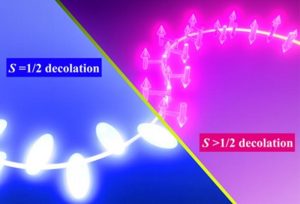
By comparing spin 1/2 and spin 1 realizations side by side on a clean spin-only platform, the researchers identified a new quantum boundary. The Kondo effect inevitably forms local singlets at spin 1/2 moments, but stabilizes the magnetic order at spin 1 and above.
This finding provides the first direct experimental evidence that the function of the Kondo effect is fundamentally dependent on spin size.
Innovation in new quantum materials
The discovery that the Kondo effect behaves in fundamentally different ways depending on the size of the spins provides a new perspective on the understanding of quantum materials and establishes a new conceptual basis for the engineering of spin-based quantum devices.
Professor Yamaguchi explained: “The discovery of the spin size-dependent quantum principle in the Kondo effect opens up a completely new area of research in quantum materials.
“The ability to switch quantum states between non-magnetic and magnetic states by controlling spin size represents a powerful design strategy for next-generation quantum materials.”
next step
Controlling whether Kondo lattices become magnetic or nonmagnetic is highly relevant for future quantum technologies, as it allows manipulation of key behaviors such as entanglement, magnetic noise, and quantum criticality.
The researchers hope their findings could help innovate new quantum materials and ultimately contribute to the development of emerging quantum technologies such as quantum information devices and quantum computing.
Source link

