



Cybersecurity teams want to go further than just considering threats and vulnerabilities in isolation. It’s not just about what could go wrong (vulnerabilities) and who could attack (threats), but also where they might intersect in a real-world environment to expose you to real exploitable risks.
Which exposures really matter? Can attackers exploit them? Are our defenses effective?
Continuous Threat Exposure Management (CTEM) can provide a useful approach for cybersecurity teams aiming for integrated threat/vulnerability or exposure management.
The true meaning of CTEM
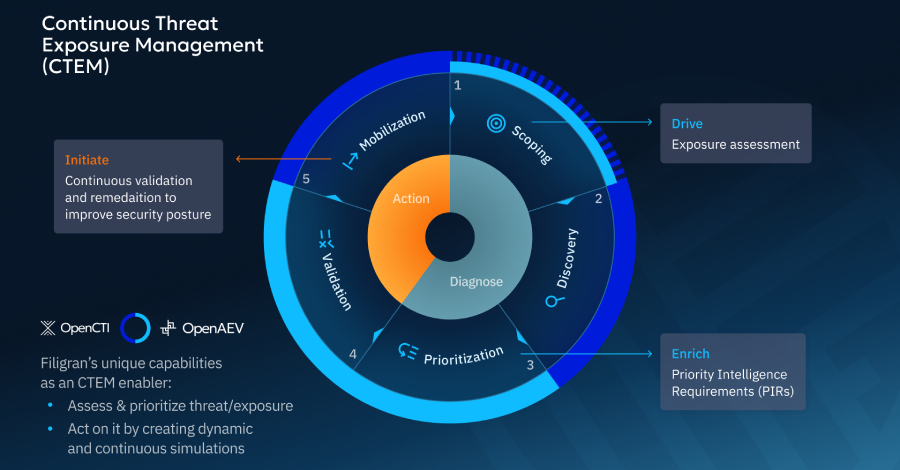
CTEM, as defined by Gartner, emphasizes a “continuous” cycle of identifying, prioritizing, and remediating exploitable exposures across the attack surface, resulting in an improved overall security posture. This is not a one-time scan and results are provided through the tool. This is an operating model built on five steps:
Scoping – Assess threats and vulnerabilities to identify the most important assets, processes, adversaries, etc. Discovery – Map exposures and attack vectors across your environment to predict adversary behavior. Prioritize – Focus on what attackers can actually exploit and what needs to be fixed. Validation – Test your assumptions using secure and controlled attack simulations. Mobilize – Drive evidence-based remediation and process improvement
What are the real benefits of CTEM?
CTEM shifts the focus to risk-based exposure management and integrates many sub-processes and tools such as vulnerability assessment, vulnerability management, attack surface management, testing, and simulation. CTEM integrates exposure assessment and exposure validation with the ultimate goal of enabling security teams to record and report potential impact on cyber risk reduction. Technology and tools have never been an issue. In fact, there are many problems in the cybersecurity field. At the same time, by using more tools, we have created more silos. This is exactly what CTEM is trying to challenge. Can we unify our view of threats/vulnerabilities/attack surfaces and take action on truly exploitable exposures to reduce overall cyber risk?
The role of threat intelligence in CTEM
Thousands of vulnerabilities are reported every year (more than 40,000 in 2024), but less than 10% are actually exploited. Threat intelligence can greatly help focus on issues that matter to your organization by tying vulnerabilities to attacker tactics, techniques, and procedures (TTPs) observed in active campaigns. Threat intelligence is no longer a “nice to have” but a “must have.” This helps specify the Priority Intelligence Requirements (PIR), which is the most important context, threat landscape, in your environment. This prioritized threat intelligence tells you which flaws are weaponized against which targets and under what conditions, allowing you to focus remediation on what is exploitable in your environment, rather than what is theoretically possible.
The question you should ask your threat intelligence team is, “Are we optimizing the value of the threat data we’re currently collecting?” This is the first area of improvement/change.
Verification-driven risk reduction
Prioritized threat intelligence should be followed by testing and validation to see how security controls perform against the most likely exploitable files and attack paths and what impact it could have on the organization. The key element here is that your security validation program must go beyond technology. Processes and people should also be included. A perfectly tuned EDR, SIEM, or WAF will only provide limited protection when the incident workflow is unclear, the playbook is outdated, or the escalation path breaks due to pressure. This is where we expect to see the integration of breach and attack simulations, tabletop exercises, and automated penetration testing for Adversarial Exposure Validation (AEV).
avoid buzzwords
CTEM is not a product. This is a strategic approach that uses results-driven metrics to manage exposures. Its implementation also cannot be left to a single security team/department. This must be driven from the top, breaking down silos and improving security workflows across teams. Start with the “scoping” stage to determine what to include in your exposure control program and where to focus first.
What are the biggest business risks that cybersecurity can directly impact? Which environments (on-premises, cloud, IT/OT, subsidiaries, etc.) and asset types (crown jewels, endpoints, identity systems, data stores, etc.) are in scope? Do we accurately capture this inventory? Which adversaries and attack methods are most relevant to our industry and technology stack? How do we incorporate existing threat intelligence and incident data to narrow the scope? How do you define “at significant risk” (based on exploitability, business impact, data sensitivity, blast radius, etc.)? Can we validate our tools, people, processes, tools today? What is our initial ability to remediate the issue within this scope (people, tools, SLA)?
Although this is not a complete list, these questions will help you define a realistic, risk-aligned CTEM scope that can be implemented and measured, rather than an effort that is too broad and unmanageable.
Conclusion:
CTEM works when you answer important questions with evidence.
What could harm us? How can this happen? Can I stop?
For more resources on exposure management, threat intelligence, and verification practices, visit Filigran.