
Close Menu
  • Home
  • Identity
  • Inventions
  • Future
  • Science
  • Startups
  • Spanish
What's Hot

Tinder looks to AI to fight ‘swipe fatigue’ and dating app burnout

Hackers release personal information stolen during Harvard, University of Pennsylvania data breaches

Microsoft develops scanner to detect backdoors in open weight large-scale language models

Facebook X (Twitter) Instagram
  • Home
  • About Us
  • Advertise with Us
  • Contact Us
  • DMCA
  • Privacy Policy
  • Terms & Conditions
  • User-Submitted Posts
Facebook X (Twitter) Instagram
Fyself News
  • Home
  • Identity
  • Inventions
  • Future
  • Science
  • Startups
  • Spanish
Fyself News
Home » Italian rock climber accidentally discovers evidence of sea turtle colony 80 million years ago
Science

Italian rock climber accidentally discovers evidence of sea turtle colony 80 million years ago

userBy userJanuary 27, 2026No Comments4 Mins Read
Share Facebook Twitter Pinterest Telegram LinkedIn Tumblr Email Copy Link
Follow Us
Google News Flipboard
Share
Facebook Twitter LinkedIn Pinterest Email Copy Link

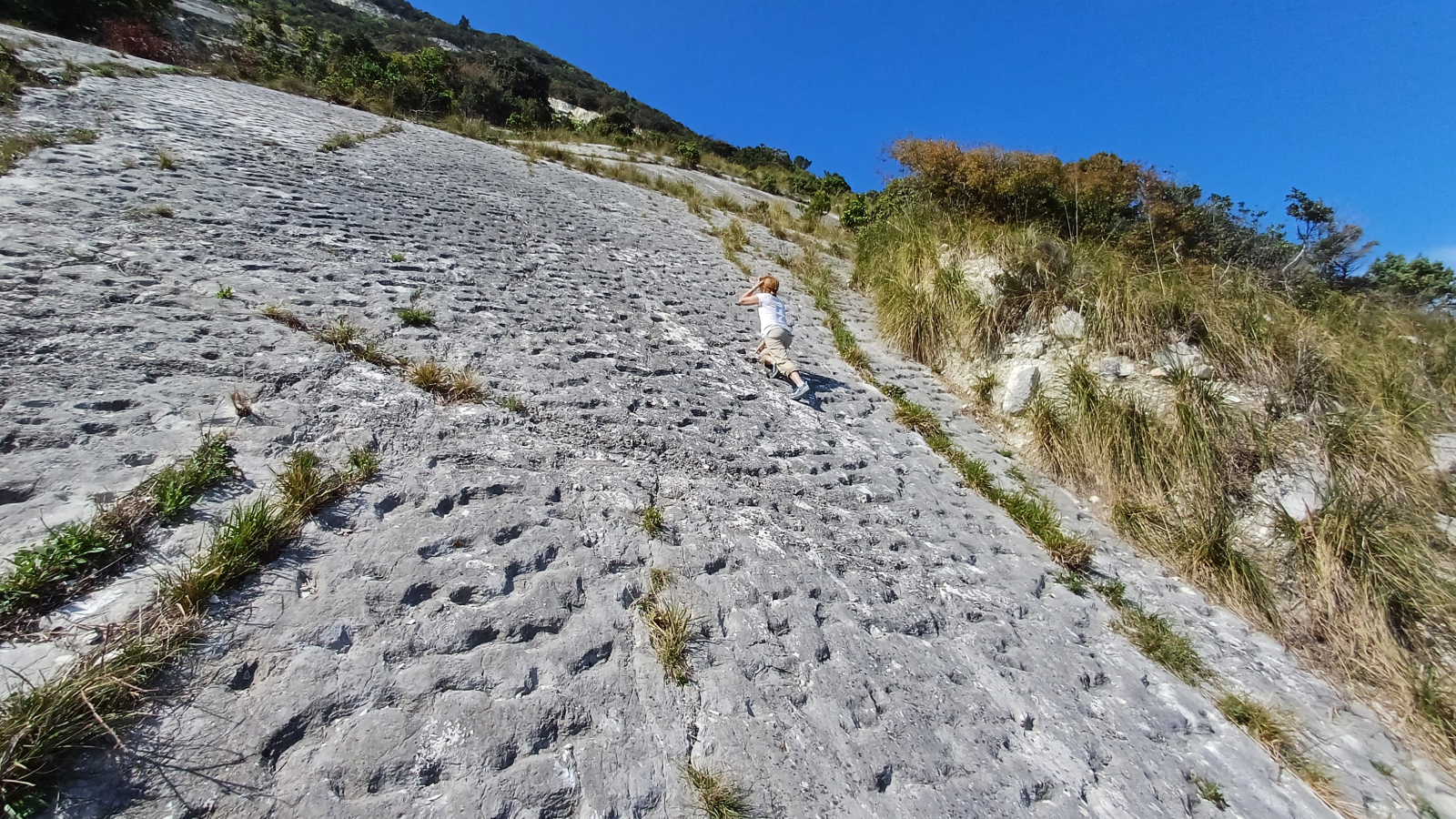
Rock climbers in Italy have stumbled upon evidence of what appears to be a sea turtle colony that occurred some 80 million years ago. Now, new research suggests that these ancient marine reptiles were fleeing earthquakes.

Climbers recognized the significance of their discovery because the grooves in Monte Conero’s rock face overlooking the Adriatic reminded them of other climbers who made headlines earlier that year. These grooves, found elsewhere in the same regional park, were thought to have been created by Cretaceous marine reptiles pressing their paddles into the ocean floor. They consulted geologist Paolo Sandroni, a fellow climber, and contacted Alessandro Montanari, director of the Cordigioco Geological Observatory (OGC).

After investigating what these grooves are, the researchers revealed their findings in a study published in the journal Cretaceous Research on November 19th.

you may like

Sandroni and another member of the team returned to the area to collect rock samples and document the site using a drone.

Hundreds of these footprints are located in the Scalia Rossa limestone formation in Conero Regional Park, a formation that has been extensively studied for decades and preserves millions of years of deep-sea sediments, study co-author Montanari told Live Science.

What is now part of the mountain was once the deep ocean floor folded up and pushed up by tectonic movements millions of years ago. Rock samples taken just above the track and analyzed by the team revealed important clues about the track’s location and the story behind it. For example, they suggest that sea turtles lived during the Late Cretaceous Period, about 79 million years ago, and suggest that the limestone was part of underwater mud avalanches triggered by earthquakes.

The abundance of seismic activity in this formation is also supported by decades of collective research. Thin-section slides of rock samples reveal microfossils of organisms that live along the ocean floor, suggesting an underwater environment hundreds of meters deep.
Get the world’s most fascinating discoveries delivered straight to your inbox.

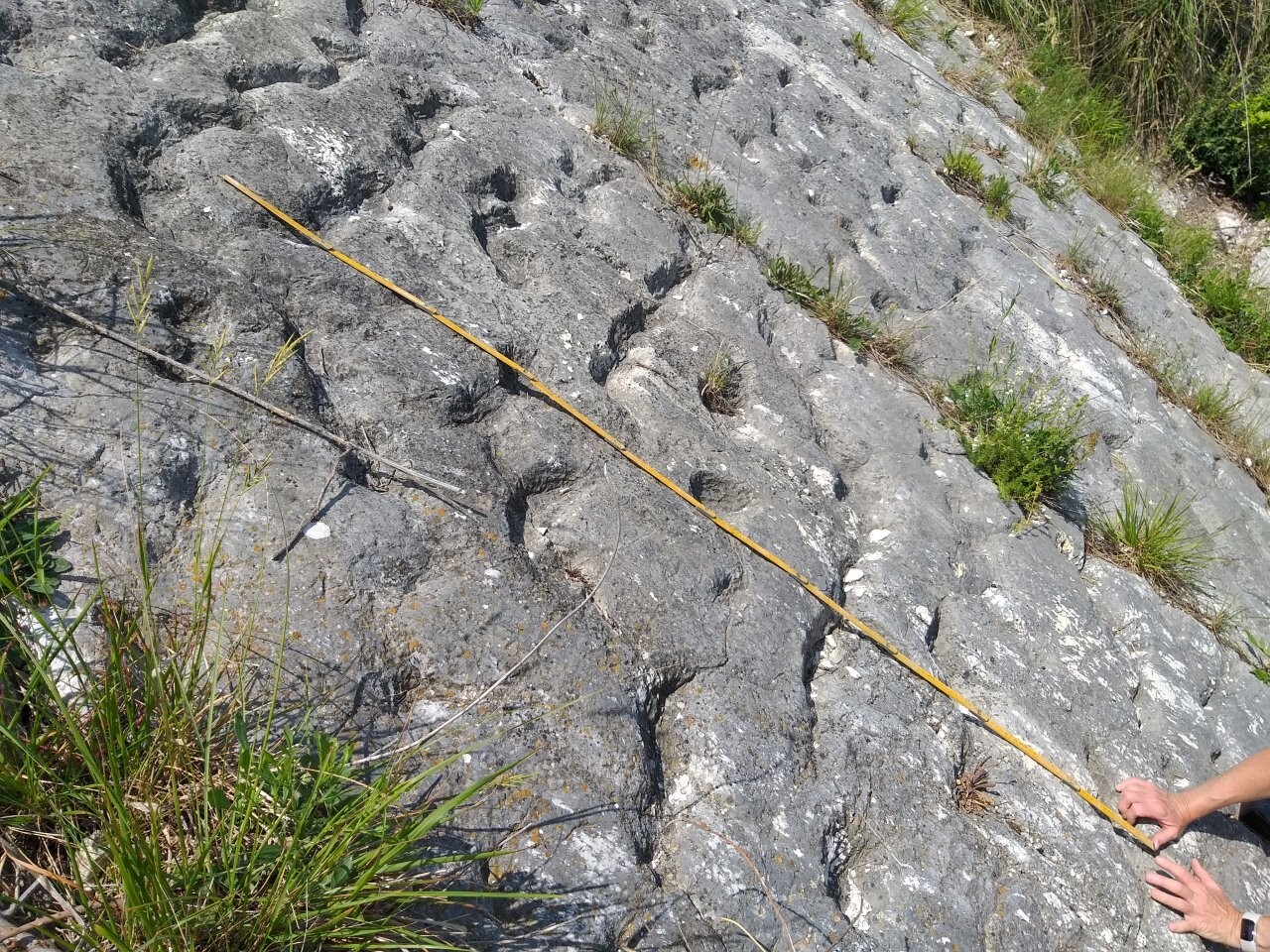
Someone is holding a tape measure next to an indentation in the floor that has been identified as footprints left by an ancient herd of sea turtles.

Researchers say the ditch appears to be the result of turtles escaping from an earthquake that triggered an underwater avalanche. (Image credit: Paolo Sandroni)

Usually, the traces left by animals are erased by ocean floor currents and become “earthworms, clams, shellfish,” etc. [other] “They’re basically gardening the ocean floor,” Montanari said. But within minutes of the footprints being made, an earthquake triggered an underwater avalanche that preserved them, he said.

The only vertebrates large enough to leave such footprints during the Late Cretaceous were marine reptiles such as sea turtles, plesiosaurs, and mosasaurs. The latter two are thought to have been primarily solitary creatures, but if the behavior of ancient sea turtles mirrors that of some sea turtles today, they may have been foraging close to shore or emerging from the water to lay their eggs, the researchers said. Whatever brought the turtles together, the researchers suggested that the earthquake caused them all to flee at once, with some swimming above toward the open ocean and others scrambling toward the deeper ocean floor. An impending underwater avalanche pushed them further away.

Michael Benton, a professor of vertebrate paleontology at the University of Bristol in the UK, who was not involved in the study, said the study provided a clear geological context but questioned which animal made the footprints.

“This footprint is unusual. It appears that the two forelimbs enter the sediment together, indicating underwater punting, where the animal propels itself forward,” he told LiveScience. Most vertebrates tend to “walk or swim by moving their limbs out of sequence” rather than lowering two limbs at the same time, he said. “Sea turtles typically have a very efficient swimming mode,” he said, “a bit like underwater flight, with a flailing paddle in front of them,” similar to a figure-eight pattern, which doesn’t seem to match the footprints found. He also wonders why they don’t try to escape by simply “swimming off the ocean floor.”

Montanari said the print would benefit from further study, but it was geologically clear that there was an underwater avalanche triggered by an earthquake. He said he hopes their research will encourage further research by fossil experts.


Source link

#Biotechnology #ClimateScience #Health #Science #ScientificAdvances #ScientificResearch
Follow on Google News Follow on Flipboard
Share. Facebook Twitter Pinterest LinkedIn Tumblr Email Copy Link
Previous ArticleNeuromorphic computers promise to reduce energy consumption for AI
Next Article A simple blood test could change the diagnosis of Alzheimer’s disease
user
  • Website

Related Posts

A deer carrying the rotting head of a vanquished enemy and a playful lynx shortlisted for the Nuveen People’s Choice Award for Wildlife Photographer of the Year.

February 4, 2026

Terrifying photo of polar bear mother and cub resting in the mud in the summer heat

February 4, 2026

Scientists map thousands of ways ‘city-killer’ asteroid 2024 YR4 could hit the moon, resulting in an explosion as bright as Venus

February 3, 2026
Add A Comment
Leave A Reply Cancel Reply

Latest Posts

Tinder looks to AI to fight ‘swipe fatigue’ and dating app burnout

Hackers release personal information stolen during Harvard, University of Pennsylvania data breaches

Microsoft develops scanner to detect backdoors in open weight large-scale language models

DEAD#VAX malware campaign deploys AsyncRAT via VHD phishing files hosted on IPFS

Trending Posts

Subscribe to News

Subscribe to our newsletter and never miss our latest news

Please enable JavaScript in your browser to complete this form.
Loading

Welcome to Fyself News, your go-to platform for the latest in tech, startups, inventions, sustainability, and fintech! We are a passionate team of enthusiasts committed to bringing you timely, insightful, and accurate information on the most pressing developments across these industries. Whether you’re an entrepreneur, investor, or just someone curious about the future of technology and innovation, Fyself News has something for you.

Castilla-La Mancha Ignites Innovation: fiveclmsummit Redefines Tech Future

Local Power, Health Innovation: Alcolea de Calatrava Boosts FiveCLM PoC with Community Engagement

The Future of Digital Twins in Healthcare: From Virtual Replicas to Personalized Medical Models

Human Digital Twins: The Next Tech Frontier Set to Transform Healthcare and Beyond

Facebook X (Twitter) Instagram Pinterest YouTube
  • Home
  • About Us
  • Advertise with Us
  • Contact Us
  • DMCA
  • Privacy Policy
  • Terms & Conditions
  • User-Submitted Posts
© 2026 news.fyself. Designed by by fyself.

Type above and press Enter to search. Press Esc to cancel.