
Close Menu
  • Home
  • Identity
  • Inventions
  • Future
  • Science
  • Startups
  • Spanish
What's Hot

Iran-linked RedKitten cyber campaign targets human rights NGOs and activists

This week’s science news: ‘Cloud People’ grave discovered in Mexico, pancreatic cancer epidemic, AI swarms ready to take over social media

Mandiant discovers ShinyHunters-style Vishing attack that steals MFA and compromises SaaS platforms

Facebook X (Twitter) Instagram
  • Home
  • About Us
  • Advertise with Us
  • Contact Us
  • DMCA
  • Privacy Policy
  • Terms & Conditions
  • User-Submitted Posts
Facebook X (Twitter) Instagram
Fyself News
  • Home
  • Identity
  • Inventions
  • Future
  • Science
  • Startups
  • Spanish
Fyself News
Home » Halley was not the first to discover the existence of this famous comet. According to new research, monks in the 11th century were the first to do it.
Science

Halley was not the first to discover the existence of this famous comet. According to new research, monks in the 11th century were the first to do it.

userBy userJanuary 29, 2026No Comments4 Mins Read
Share Facebook Twitter Pinterest Telegram LinkedIn Tumblr Email Copy Link
Follow Us
Google News Flipboard
Share
Facebook Twitter LinkedIn Pinterest Email Copy Link

Halley’s Comet is named after the famous astronomer who was the first to describe its movement through space, but new research suggests he wasn’t the first to discover its periodic orbit past Earth.

Halley’s Comet is named after the British astronomer Edmund Halley, who in 1705 pieced together the space rock’s orbit using a combination of his own observations and historical records from other observers. However, recent research suggests that Halley’s comet was not the first to discover the approximately 75-year cycle of his namesake comet. Instead, the English monk Aylmer of Malmesbury (also known as Ethelmer) may have linked the two observations of the comet more than 600 years ago.

Mr Aylmer is perhaps best known as Britain’s first person to try aviation. Aylmer, who grew up reading Greek mythology, was fascinated by the story of Daedalus, whose son Icarus flew too close to the sun. In the late 990s or early 1000s, Aylmer reportedly created a pair of wings, attached them to his hands, and jumped off a tower. According to the 12th century historian William of Malmesbury, the monk glided for about 200 meters before a gust of wind interrupted his descent and he plummeted to the ground, breaking both of his legs.

you may like

In addition to his interest in flight, Aylmer also had a strong interest in astrology and astronomy. As a boy in 989, William of Malmesbury writes, he saw a comet hurtling over his home in England. Decades later, in 1066, he saw the comet again and linked the two events, argues Simon Portegis-Zwart, an astronomer at Leiden University in the Netherlands, in a new book.

Porgy’s Zwart, according to William of Malmesbury’s account, says that when Aylmer saw the comet in 1066, he exclaimed, “It’s come, hasn’t it?… It’s been a long time since I’ve seen you, but now I see you…” is even more frightening, because I see you brandishing the downfall of my country.” At the time, England was in the midst of a succession crisis, with no clear heir to the throne following the death of Edward the Confessor. If William’s records are accurate, Aylmer realized that the two “shining stars” he had seen were indeed the same. In any case, it is clear that William himself was aware of the connection.

Halley’s Comet was the first comet recognized by astronomers to appear periodically or repeatedly. It orbits the sun in a highly elliptical orbit. This elongated orbit causes it to pass close to Earth every 72 to 80 years, leaving a bright dust trail in its wake.

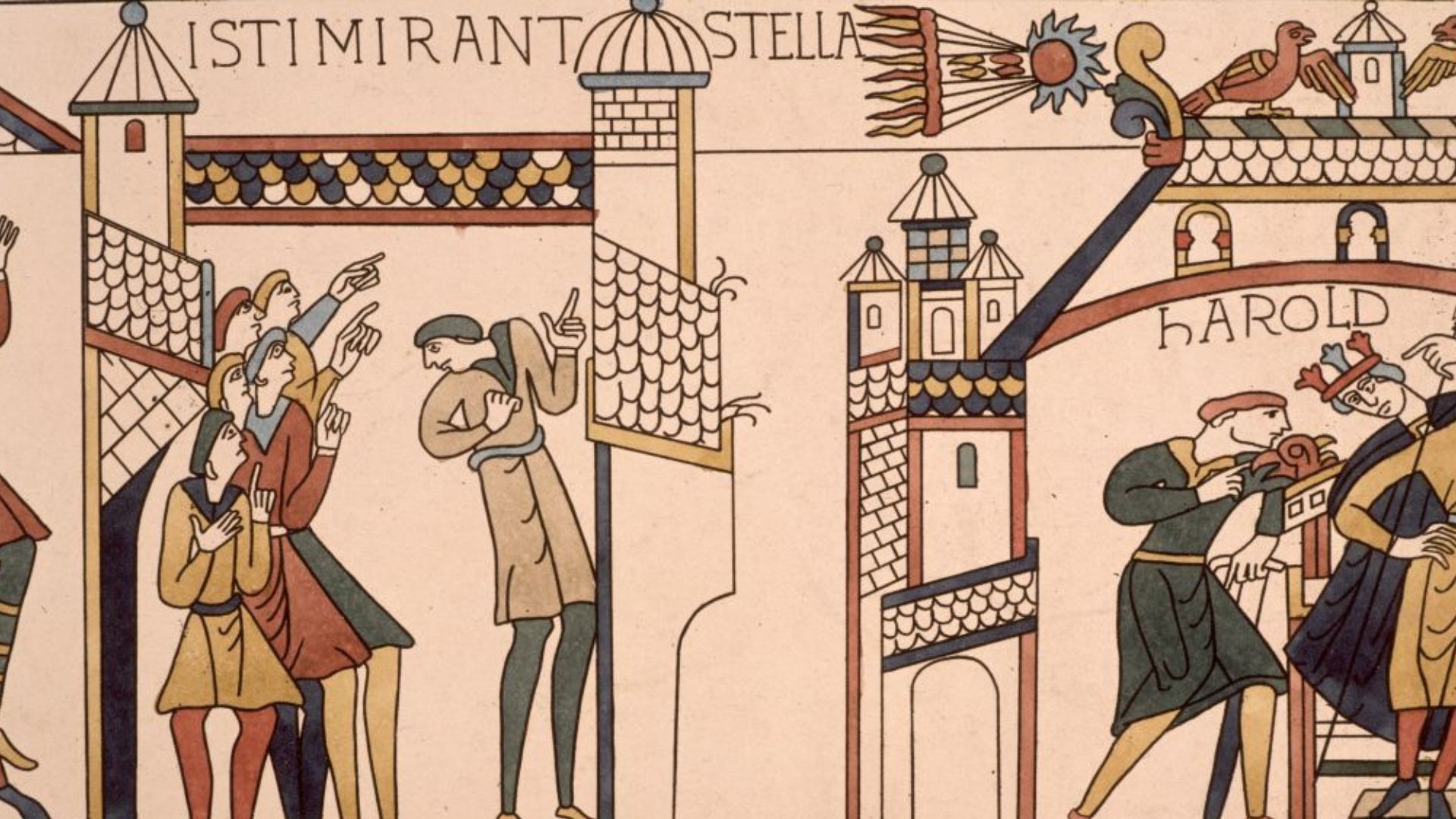
The earliest possible record of Halley’s Comet is in a Chinese chronicle from 239 BC. Since then, it has been recorded dozens of times by astronomers around the world, often interpreted as a kind of omen. For example, the Roman-Jewish historian Flavius ​​Josephus believed that the sighting of a comet in 66 AD portended the fall of Jerusalem. The comet’s passage was sewn into the Bayeux Tapestry, which recorded William the Conqueror’s invasion of England in 1066, after it was seen flying over Brittany and the British Isles in April of the same year.

Get the world’s most fascinating discoveries delivered straight to your inbox.

Astronomer Halley connected the comet’s appearances in 1531, 1607, and 1682. Halley went on to predict the comet’s return in 1758. Halley died in 1742 before seeing his prediction come true, but after his death, Halley was proven correct when the comet actually returned as predicted.

While Halley’s calculations were impressive, Porteghese-Zwart argues that Aylmer should be given credit for piecing together the appearance of comets centuries ago. He and Michael Lewis of the British Museum published a chapter discussing this point in their book Dorestad and Everything After: Ports, Townscapes and Travelers in Europe, 800-1100 (Sidestone Press, 2025).

The next pass in late July 2061 will allow you to catch Comet Halley (or Comet Aylmer). Mark your calendars now.


Source link

#Biotechnology #ClimateScience #Health #Science #ScientificAdvances #ScientificResearch
Follow on Google News Follow on Flipboard
Share. Facebook Twitter Pinterest LinkedIn Tumblr Email Copy Link
Previous ArticleEven after Microsoft launches its own AI chips, Nadella says it won’t stop buying AI chips from Nvidia and AMD.
Next Article Medium gives employees Friday off to join national strike to protest ICE
user
  • Website

Related Posts

This week’s science news: ‘Cloud People’ grave discovered in Mexico, pancreatic cancer epidemic, AI swarms ready to take over social media

January 31, 2026

Snow moon will ‘engulf’ one of the brightest stars in the sky this weekend: where and when to see it

January 30, 2026

South Carolina measles outbreak is the largest since the U.S. eradicated measles

January 29, 2026
Add A Comment
Leave A Reply Cancel Reply

Latest Posts

Iran-linked RedKitten cyber campaign targets human rights NGOs and activists

This week’s science news: ‘Cloud People’ grave discovered in Mexico, pancreatic cancer epidemic, AI swarms ready to take over social media

Mandiant discovers ShinyHunters-style Vishing attack that steals MFA and compromises SaaS platforms

CERT Polska details coordinated cyberattacks on over 30 wind and solar farms

Trending Posts

Subscribe to News

Subscribe to our newsletter and never miss our latest news

Please enable JavaScript in your browser to complete this form.
Loading

Welcome to Fyself News, your go-to platform for the latest in tech, startups, inventions, sustainability, and fintech! We are a passionate team of enthusiasts committed to bringing you timely, insightful, and accurate information on the most pressing developments across these industries. Whether you’re an entrepreneur, investor, or just someone curious about the future of technology and innovation, Fyself News has something for you.

Castilla-La Mancha Ignites Innovation: fiveclmsummit Redefines Tech Future

Local Power, Health Innovation: Alcolea de Calatrava Boosts FiveCLM PoC with Community Engagement

The Future of Digital Twins in Healthcare: From Virtual Replicas to Personalized Medical Models

Human Digital Twins: The Next Tech Frontier Set to Transform Healthcare and Beyond

Facebook X (Twitter) Instagram Pinterest YouTube
  • Home
  • About Us
  • Advertise with Us
  • Contact Us
  • DMCA
  • Privacy Policy
  • Terms & Conditions
  • User-Submitted Posts
© 2026 news.fyself. Designed by by fyself.

Type above and press Enter to search. Press Esc to cancel.