

Close Menu
  • Home
  • Identity
  • Inventions
  • Future
  • Science
  • Startups
  • Spanish
What's Hot

OpenAI launches a way for enterprises to build and manage AI agents

AISURU/Kimwolf botnet launches record 31.4 Tbps DDoS attack

Data breach at government tech giant Conduent balloon affects millions more Americans

Facebook X (Twitter) Instagram
  • Home
  • About Us
  • Advertise with Us
  • Contact Us
  • DMCA
  • Privacy Policy
  • Terms & Conditions
  • User-Submitted Posts
Facebook X (Twitter) Instagram
Fyself News
  • Home
  • Identity
  • Inventions
  • Future
  • Science
  • Startups
  • Spanish
Fyself News
Home » ‘Behemoth Star’, previously thought to be dying, is ‘rising from the ashes’ like a phoenix
Science

‘Behemoth Star’, previously thought to be dying, is ‘rising from the ashes’ like a phoenix

userBy userFebruary 4, 2026No Comments3 Mins Read
Share Facebook Twitter Pinterest Telegram LinkedIn Tumblr Email Copy Link
Follow Us
Google News Flipboard
Share
Facebook Twitter LinkedIn Pinterest Email Copy Link

One of the largest stars in the universe, previously predicted to be on the brink of a violent supernova explosion, may not explode anytime soon after all, a new study suggests. The surprising discovery also suggests that this star’s “behemoth” is slowly being cannibalized by a smaller, hidden partner.

WOH G64, also known as the “giant star,” is a red supergiant star located approximately 163,000 light-years from Earth in the Large Magellanic Cloud, a dwarf galaxy that orbits the Milky Way. This giant is about 1,500 times wider than the Sun, making it one of the largest stars ever discovered. It also shines up to 282,000 times brighter than our home star.

In recent years, WOH G64 has become significantly fainter, suggesting that the giant star is transitioning into a smaller, hotter, yellow supergiant star by shedding its outermost layers of gas. When this happens in a red supergiant star, it’s usually a sign that the star is about to go supernova. This seemed likely, given that the star is about 5 million years old, close to the lifespan of red supergiants, which burn through fuel much faster than stars like the Sun.

you may like

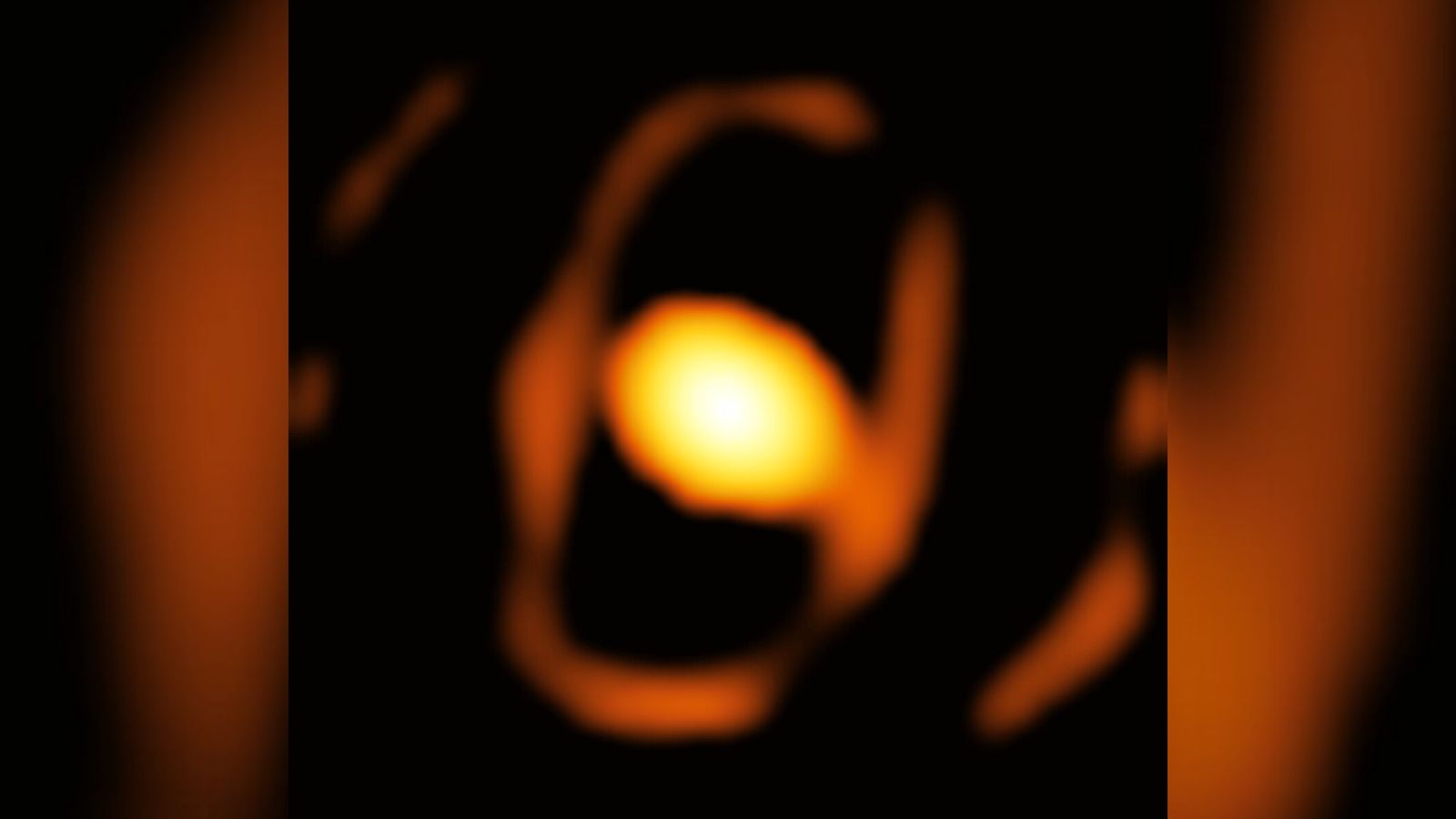
Further evidence that an explosion was imminent came in November 2024. Researchers used the Very Large Telescope in Chile to take highly detailed pictures of WOH G64, the first of their kind for an extragalactic object, and detected an “egg-shaped cocoon” of gas and dust surrounding the star. Experts speculated that this was evidence that the star had shed its outer layers and became a yellow supergiant star.

But in a new study published in Monthly Notices, a journal of the Royal Astronomical Society, on January 7, researchers used the South African Large Telescope (SALT) to re-examine WOH G64 and found a “smoking gun” that casts doubt on the widely accepted supernova hypothesis.
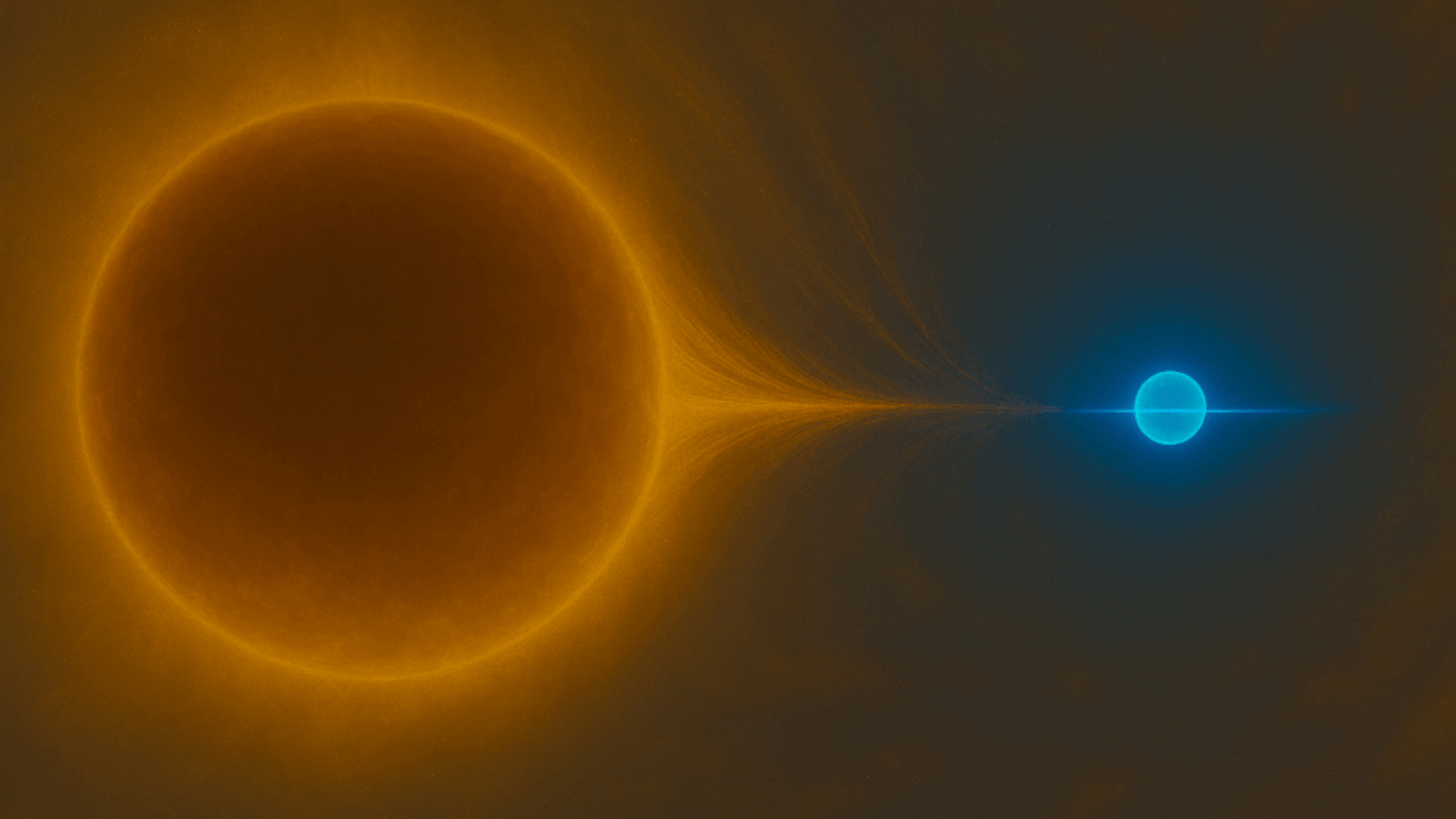
AI-generated image showing small blue stars stealing gas from red supergiants like WOH G64

This AI-generated image shared by researchers shows WOH G64 losing gas to its cannibalistic siblings, which may explain its recent strangeness. (Image credit: Created by Jacco van Loon using Copilot)

The research team’s data, collected by SALT’s powerful spectrometer between November 2024 and December 2025, revealed titanium oxide (usually found only in red supergiant stars) in WOH G64’s atmosphere.

“This suggests that WOH G64 is now a red supergiant star and may not have stopped being a red supergiant star,” study co-lead author Jaco van Loon, an astrophysicist at Keele University in the UK, said in a statement. “We are essentially witnessing a ‘phoenix’ rising from the ashes,” he added.

Get the world’s most fascinating discoveries delivered straight to your inbox.

But if WOH G64 hasn’t turned into a yellow supergiant, why does it behave so strangely?
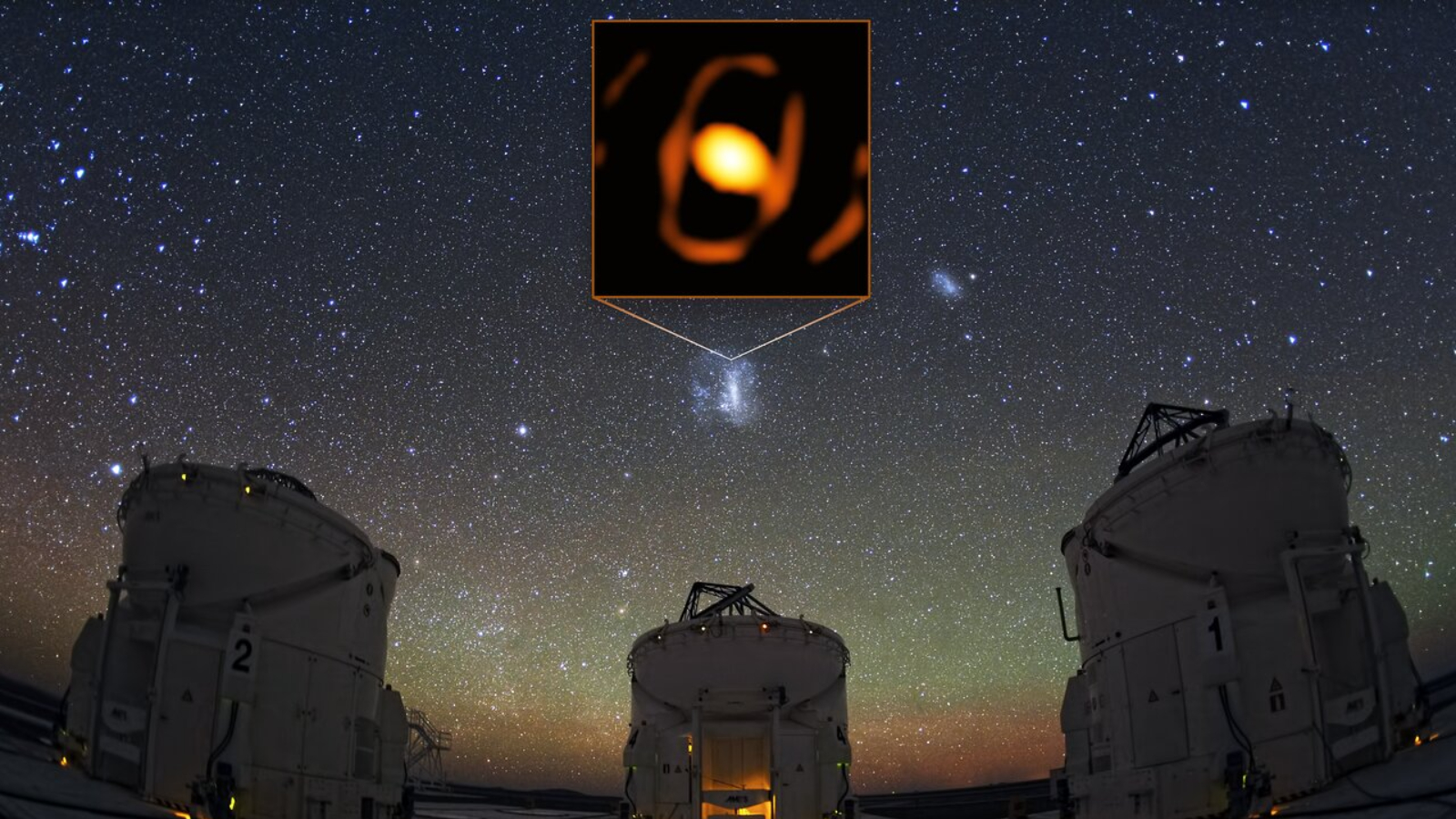
A photo of a telescope with a starry sky in the background and a new photo superimposed on top of it

A high-resolution photo of WOH G64’s egg-like cocoon was taken by the Very Large Telescope in Chile in November 2024. (Image credit: ESO/K. Ohnaka et al./Y. Beletsky (LCO))

The researchers suspect that the giant star is part of a binary system that includes smaller stars. In this case, its small blue-glowing partner is probably pulling WOH G64’s outer layer into the circumstellar disk.

“The red supergiant’s atmosphere has been stretched by the companion star’s approach, but it has not been completely stripped away,” Van Loon said. “It continues.”

This theory was also proposed when the star’s dusty cocoon was photographed in 2024, but it failed to gain traction.

All eyes are now on WOH G64 for further clues as to when this stellar behemoth will finally blow its top.

Van Loon, J. T., and Ohnaka, K. (2026). A phoenix rises from the ashes: WOH G64 is still a red supergiant star. Monthly Notices of the Royal Astronomical Society, 546(2). https://doi.org/10.1093/mnras/stag012


Source link

#Biotechnology #ClimateScience #Health #Science #ScientificAdvances #ScientificResearch
Follow on Google News Follow on Flipboard
Share. Facebook Twitter Pinterest LinkedIn Tumblr Email Copy Link
Previous ArticleEleven Labs raises $500 million from Sequoia at $11 billion valuation
Next Article DEAD#VAX malware campaign deploys AsyncRAT via VHD phishing files hosted on IPFS
user
  • Website

Related Posts

Total lunar eclipse on March 3rd: When and where can you see the “blood moon” from the United States?

February 5, 2026

Genetically unique group from southern Greece can trace paternal ancestry to the Bronze Age

February 4, 2026

Galileo images suggest life-friendly molecules are leaking from Jupiter’s giant moon Europa

February 4, 2026
Add A Comment
Leave A Reply Cancel Reply

Latest Posts

OpenAI launches a way for enterprises to build and manage AI agents

AISURU/Kimwolf botnet launches record 31.4 Tbps DDoS attack

Data breach at government tech giant Conduent balloon affects millions more Americans

Fundamental raises $255 million in Series A for new big data analytics initiative

Trending Posts

Subscribe to News

Subscribe to our newsletter and never miss our latest news

Please enable JavaScript in your browser to complete this form.
Loading

Welcome to Fyself News, your go-to platform for the latest in tech, startups, inventions, sustainability, and fintech! We are a passionate team of enthusiasts committed to bringing you timely, insightful, and accurate information on the most pressing developments across these industries. Whether you’re an entrepreneur, investor, or just someone curious about the future of technology and innovation, Fyself News has something for you.

Castilla-La Mancha Ignites Innovation: fiveclmsummit Redefines Tech Future

Local Power, Health Innovation: Alcolea de Calatrava Boosts FiveCLM PoC with Community Engagement

The Future of Digital Twins in Healthcare: From Virtual Replicas to Personalized Medical Models

Human Digital Twins: The Next Tech Frontier Set to Transform Healthcare and Beyond

Facebook X (Twitter) Instagram Pinterest YouTube
  • Home
  • About Us
  • Advertise with Us
  • Contact Us
  • DMCA
  • Privacy Policy
  • Terms & Conditions
  • User-Submitted Posts
© 2026 news.fyself. Designed by by fyself.

Type above and press Enter to search. Press Esc to cancel.