
Turning lignocellulosic biomass into sustainable fuel for transportation

ABATE demonstrates the integration of thermochemical and biochemical processes to convert biomass residues into advanced biobased refining intermediates for sustainable transportation fuels.
Achieving a climate-neutral energy system requires finding cleaner ways to power sectors that are difficult to electrify, especially long-haul transport and aviation. Sustainable fuels from renewable sources are an important part of the solution. However, currently commercially available technologies often face barriers due to increased process costs and energy requirements, or raw material limitations.
ABATE (Advanced Bio-based Refinary Intermediates) is an ambitious Horizon Europe project to address these challenges by developing new processes to enhance the value of residual biomass into cost-competitive, carbon-neutral advanced bio-based intermediates. These intermediates can directly replace fossil fuels in traditional refineries and help reduce emissions without major changes to current infrastructure. Based on current assessments, ABATE technology has the potential to meet more than 55% of the EU’s renewable marine fuel needs and around 5% of its aviation fuel needs by 2035.
The project will provide robust policy-relevant evidence supporting the EU Green Deal, Fit for 55 and bioeconomy strategies by demonstrating sustainable bio-based carbon capture, utilization and storage solutions that link industrial decarbonization and circular bioeconomy innovations.
From biomass to sustainable fuel
ABATE focuses on residual lignocellulosic biomass such as forest residue and agricultural waste. These materials are widely available and do not conflict with food production. The project aims to produce economically viable and climate-friendly fuels by combining innovative thermochemical and biochemical processes.
This approach is based on research conducted in the Horizon 2020 BioMates project, which successfully validated a two-step evaluation process for lignocellulosic biomass at pilot scale (Technology Readiness Level 5). ABATE is currently working on the next steps by scaling up and enhancing the technology to achieve industrial relevance. The technology is expected to deliver GHG emissions reductions of 90% to 120% at full scale, in accordance with the Revised Renewable Energy Directive (REDIII) methodology, through process optimization and the use of renewable energy sources within the process.
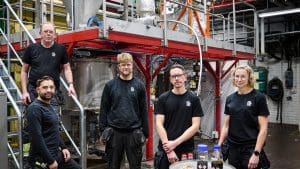
A major milestone for ABATE will be achieved in 2026. The existing demonstration plant has been successfully scaled up to TRL 6 at the RISE facility in Sweden. In parallel, a new hydroprocessing plant for bio-oil upgrading is being built at the CERTH facility in Greece, further increasing industrial relevance and process efficiency. Overall, ABATE is introducing five key innovations to produce advanced bio-based intermediates that are carbon-neutral and cost-competitive.
A new era of sustainable fuels: Advances in fast pyrolysis technology and hydroprocessing
One of ABATE’s core innovations is an improvement in fast pyrolysis, a process that converts biomass into liquid bio-oil, biochar, and gas. A long-standing challenge is the limited range of available feedstocks and variable quality of bio-oils, which complicate large-scale implementation. ABATE addresses these issues by enabling the use of low-value biomass feedstocks such as forest residue and straw through a new high-temperature gas filtration system.
The project will also improve the fast pyrolysis oil upgrade stage by optimizing the catalyst system. The bio-oil will be upgraded in stages using modern catalysts and can be easily converted into fuels such as diesel and jet fuel using existing refining equipment. The design and construction of a new large-scale plant at the CERTH facility will enable improved product recycling and heat integration, increasing overall efficiency.
Importantly, ABATE uses an innovative absorption system to integrate carbon capture and utilization (CCU) directly into the fast pyrolysis process. Combined with the use of green hydrogen, fossil energy demand will be significantly reduced, making the technology compatible with the EU’s climate change and decarbonization goals.
Strategies to achieve full circularity
Circularity is a central goal of the ABATE project. To maximize resource efficiency, the CO₂ emitted during process gas combustion is captured, purified, and compressed. This captured CO₂ will be used to demonstrate the potential of technologies to further reduce carbon emissions, including conversion to methanol.
Additionally, the ABATE project aims to treat the entire residual hydrogen stream and convert at least 90% of the CO2 into methane in a bioreactor. The operation of this bioreactor is demonstrated at TRL 6 within the ABATE project, indicating its readiness for industrial applications.
ABATE is also exploring benefits beyond fuel production. After thermal stabilization, the biochar produced during the fast pyrolysis process will be tested to ensure compliance with EU fertilizer product regulations and evaluated for use as a soil conditioner. This can highlight the potential dual role of stabilized biochar as a soil conditioner and a powerful carbon sink, supporting climate mitigation strategies and sustainable agriculture.
Reducing industrial and environmental impact: increasing renewable energy in hard-to-electrify sectors
ABATE is expected to offer significant industrial and environmental benefits. The innovation is expected to lead to the production of cost-competitive biofuels by using cheap and available forest and agricultural residues as feedstock.
A major industrial outcome of ABATE is the ability to co-process biobased intermediates in existing refineries. This is an important step towards unlocking Annex IX (Part A) feedstocks such as forestry and agricultural residues under RED III. As a result, refineries will be able to significantly increase renewable content in hard-to-electrify areas while continuing to rely on existing infrastructure and expertise to meet the growing requirements of RED III, ReFuelEU Aviation, and FuelEU Maritime. At the same time, the integration of carbon capture, renewable energy and resource circularity will facilitate efficient carbon management and directly contribute to the EU’s net-zero climate and energy targets.
Please note: This is a commercial profile
This article will also be published in the quarterly magazine issue 25.
Source link

