
Aiming for minimally invasive stimulation for brain disorders
Michaela Nesvarova discusses the effects of brain disorders and how we can provide less invasive methods to monitor them.
Living with a brain injury often means relying on medications and sometimes surgery that don’t work for everyone. EU-funded researchers are currently studying whether nanotechnology could one day provide a safer, less invasive alternative.
For decades, treating serious brain disorders often meant difficult trade-offs. Symptoms may be alleviated, but this usually comes at the expense of invasive surgery and implanted electrodes that remain in the body for life.
“Having wires inside your body is not ideal,” says neuroscientist Mavi Sánchez Vives, head of the systems neuroscience group at the IDIBAPS Institute in Barcelona, Spain. “But for many patients, it was the only option.”
That paradigm may now be starting to change. Sánchez Vives is leading the EU-funded META-BRAIN research initiative, which will run for three years until December 2026. The team is exploring new ways to interact with the brain by combining nanotechnology, ultrasound, and advanced brain monitoring.
The META-BRAIN team brings together scientists and clinicians from leading research institutions across Europe, including Austria, Cyprus, Italy, Spain, and Switzerland, to develop wireless, minimally invasive methods to restore brain activity. They are using nanotechnology to interact with neurons remotely without permanent implants or open brain surgery.
Increased neurological burden
Neurological diseases are one of the greatest health challenges of our time and a leading cause of disease and disability worldwide. In Europe alone, 165 million people suffer from brain diseases such as Parkinson’s disease, stroke, epilepsy, depression, anxiety and traumatic brain injury.
“These disorders are based on neuropathology and are often associated with changes in brain rhythms and activity patterns,” explained Dr. Sánchez-Vives.
Available treatments remain limited. Medications are not effective for all patients and can cause serious side effects. Surgical approaches such as deep brain stimulation require implanting electrodes deep into the brain to block or modulate erroneous signals.
“Some patients live with these implants for decades,” says Sánchez-Vives. “But they come with risks and complexities. We need better options.”
Wireless interaction with the brain
To address this need, the META-BRAIN research team is exploring minimally invasive ways to remotely and precisely control neural activity.
“The main goal is to investigate new forms of wireless interaction with the brain,” she said. “I want to achieve high-precision control using nanotechnology as an interface.”
Non-invasive brain stimulation methods already exist, but they have important limitations. Some lack the ability to precisely target specific areas of the brain, while others are unable to reach deeper structures.
“That’s why we need a non-invasive approach that can target all parts of the brain,” Sánchez-Vives said.
To do this, researchers are exploring two different but complementary ideas. Carefully focused ultrasound waves are used to stimulate the brain from outside the body. The other relies on nanoparticles, called magnetoelectric nanoparticles, that can be guided and activated using magnetic fields.
Small particles that act as wireless electrodes
Marta Palazzini, director of research at Italy’s National Research Council (CNR) Institute of Electronics, Information Engineering and Telecommunications in Milan, said magnetoelectric nanoparticles are emerging as a particularly promising avenue.
Simply put, magnetoelectric nanoparticles, many times smaller than the width of a human hair, convert magnetic signals into electrical signals. This is the same type of signal that neurons use to communicate. When exposed to an external magnetic field, it generates a localized electric field, effectively acting like a wireless electrode.
“It can be injected without surgery and can be controlled remotely using a magnetic field,” Palazzini said. “Because it’s so small, it can be applied with great precision.”
Laboratory experiments have already shown that external magnetic fields can be used to activate these nanoparticles in a controlled manner. Importantly, they can both stimulate and suppress neural activity.
“This gives us many treatment possibilities,” Palazzini said. “This allows us to fine-tune the stimulation of the brain, rather than simply turning neurons on and off.”
Treat the brain without surgery
In the long term, researchers envision applications that could fundamentally change the way neurological injuries and disorders are treated.
For example, after a serious accident, a patient with a traumatic brain injury may be taken to the hospital and undergo detailed brain imaging tests. Based on this scan, clinicians can inject magnetoelectric nanoparticles directly into the affected area in a dose tailored to each individual patient.
“These decisions could be guided by personalized computational models of the brain,” Palazzini said.
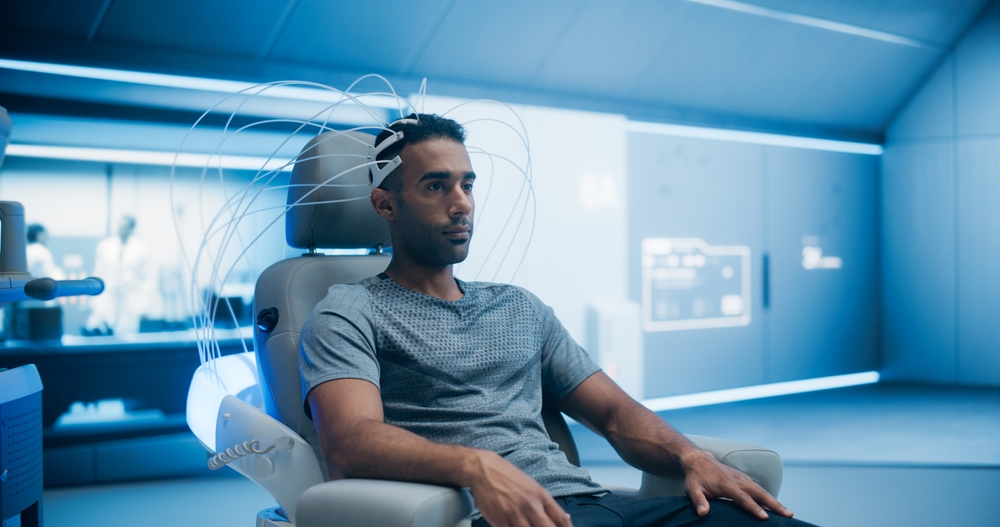
Once in place, the nanoparticles can be activated externally, for example using a helmet-like device, to restore healthy activity patterns and return damaged tissue to normal physiological function.
“The idea is to intervene immediately without opening the skull or implanting any hardware,” Palazzini said.
“We could treat injuries right away, and in some cases even avoid surgery. This method would be much safer, faster and less invasive. That would be the dream.”
From the lab to life-changing applications
So far, the META-BRAIN team has performed extensive experiments on brain tissue and is currently working on in vivo studies in rodents. Although no human trials will be conducted within the scope of this project, the researchers will run computational simulations using a human brain phantom, a highly detailed 3D model of the brain.
If successful, this technology could ultimately lead to more effective treatments for a wide range of neurological and neuropsychiatric conditions. Patients with Parkinson’s disease may regain smoother movement, epilepsy patients may achieve better seizure control, and people with complex mental disorders may benefit from more targeted treatments.
Beyond therapy, this technology could help restore or replace lost sensation. When sensory pathways are damaged, magneto-electrical interfaces could one day help replace or bypass broken connections, potentially offering new options for certain forms of blindness and other sensory losses.
unknown territory
Despite the promises, the researchers want to emphasize that the study is still in its early stages.
“It will be a long process before this technology reaches patients,” Sánchez-Vives said. “We first need to thoroughly understand how these particles behave in the brain and how to control them safely and effectively.”
Still, the possibility cannot be denied.
“It’s interesting that such a small particle can have such a large effect on neurons,” she said. “We are pioneering entirely new territory, which could ultimately change the way we treat brain diseases.”
The research for this article was funded by the European Innovation Council (EIC). The views of the interviewees do not necessarily reflect the views of the European Commission.
This article was originally published in Horizon, EU Research and Innovation Magazine.
Detailed information
Source link

