


Close Menu
  • Home
  • Identity
  • Inventions
  • Future
  • Science
  • Startups
  • Spanish
What's Hot

New Chrome vulnerability allows malicious extension to escalate privileges via Gemini panel

Google develops Merkle tree certificate to enable quantum-proof HTTPS in Chrome

Hacktivists claim to have hacked the Department of Homeland Security and released ICE contract data

Facebook X (Twitter) Instagram
  • Home
  • About Us
  • Advertise with Us
  • Contact Us
  • DMCA
  • Privacy Policy
  • Terms & Conditions
  • User-Submitted Posts
Facebook X (Twitter) Instagram
Fyself News
  • Home
  • Identity
  • Inventions
  • Future
  • Science
  • Startups
  • Spanish
Fyself News
Home » Paleolithic humans invented ‘early predecessors of writing’ at least 40,000 years ago, engraved sign suggests
Science

Paleolithic humans invented ‘early predecessors of writing’ at least 40,000 years ago, engraved sign suggests

userBy userFebruary 28, 2026No Comments4 Mins Read
Share Facebook Twitter Pinterest Telegram LinkedIn Tumblr Email Copy Link
Follow Us
Google News Flipboard
Share
Facebook Twitter LinkedIn Pinterest Email Copy Link

Humans first developed complex, information-rich writing around 3000 BC, when the Sumerians of southern Mesopotamia (present-day Iraq) invented cuneiform. But new research suggests that precursors to writing can be found tens of thousands of years ago in carvings and tools made by Paleolithic hunter-gatherers in central Europe.

When modern humans (Homo sapiens) first arrived in Europe about 55,000 years ago, they brought with them a culture of sophisticated tools such as projectile points and drilling tools. Humans began decorating cave walls with geometric shapes, hand stencils, and animal representations, and adorned their tools and carvings with geometric symbols, the meanings of which have puzzled archaeologists for decades.

In a study published February 23 in the journal PNAS, linguist Christian Benz of Germany’s Saarland University and archaeologist Ewa Dutkiewicz of the Museum of Prehistory and Early History in Berlin statistically analyzed more than 3,000 mysterious marks on 260 ancient objects and determined that they constituted “symbolic sequences” that encoded the thinking of Paleolithic people.

you may like

“Our research helps reveal the unique statistical properties, or statistical fingerprints, of these symbol systems, which are the earliest predecessors of writing,” Benz said in a statement.

The researchers cataloged intentional symbols such as lines, dots, crosses, stars, grids and zigzags carved into various tools and figurines, most of which had been discovered during previous archaeological excavations at cave sites in the Swabian Jura mountains of southern Germany. They then used computational techniques to examine the statistical properties of the symbols and found that the Paleolithic arrangement was comparable to protocuneiform in its potential to encode information.

Benz’s research deals with measurable aspects of frequency trends and symptoms. (In linguistics, a symbol is a physical representation of a concept or meaning.) Benz compared symbol systems and discovered similarities and differences by statistically examining two sets of symbols, in this case the Paleolithic system and Protocuneiform.

“Our analysis shows that these symbol arrangements have nothing to do with today’s writing systems,” Benz said. “Symbols in archaeological artifacts are frequently repeated: cross, cross, cross, line, line, line. This kind of repetition is a feature not found in spoken language.”

Get the world’s most fascinating discoveries delivered straight to your inbox.

Paleolithic hunter-gatherers instead developed a symbol system comparable to early proto-cuneiform, created tens of thousands of years later. “In terms of complexity, the code arrays are comparable,” Benz says.

But while cuneiform evolved rapidly over 1,000 years in Mesopotamia, the Paleolithic symbol system researchers discovered remained consistent for nearly 10,000 years.
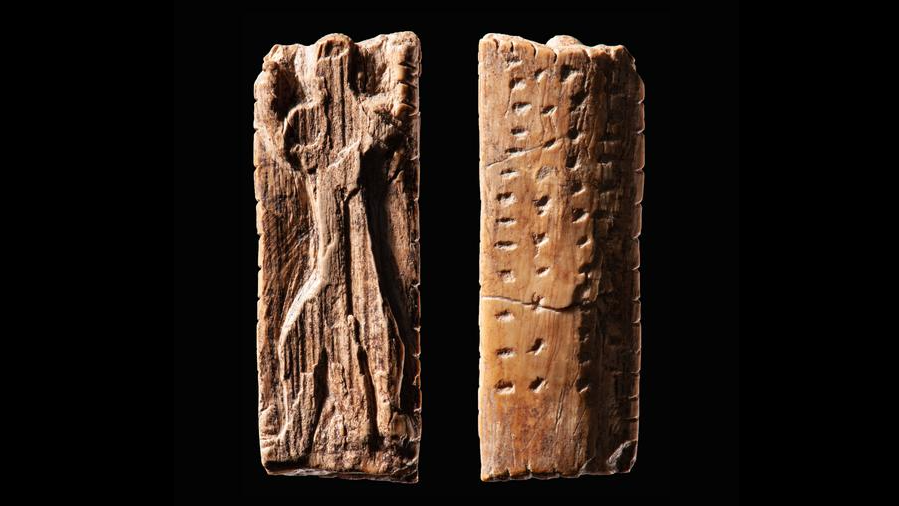
Both sides of the ivory carving. One side depicts a human figure, and the other side features a series of linear incisions.

The approximately 38,000-year-old Adlant statuette, excavated from the Geissenkursterle Cave, consists of a small ivory plate with an anthropomorphic figure and several cutouts and dots. (Image credit: Württemberg State Museum / Hendrik Cwietasz, CC BY 4.0)

“Humans’ ability to encode information in signs and symbols has developed over thousands of years,” Benz said. “Writing is just one particular form in a long series of symbol systems.”

you may like

Although the statistical analysis did not reveal what the carved signs meant, the researchers found that the figurines had a higher “information density” than the utensils.

This is not the first study to propose that human writing systems date back to the Paleolithic period. In a 2023 study, researchers examined dots and lines in 20,000-year-old cave drawings of animals and concluded that they formed an early calendar. And paleoanthropologist Genevieve von Petzinger claimed that 30 symbols found in caves around the world indicate that humans developed an early form of writing at least 40,000 years ago.

The new study includes “two good approaches to at least try to confirm that these marks have meaning beyond decorative doodles,” von Petzinger, who was not involved in the study, told Scientific American. “The more you learn about the choice of ‘writing’ surfaces and the selection of specific images and symbols, the more you will learn about this period.”

Researchers continue to search for intentionally marked objects to further our understanding of early human communication.

“Innumerable tools and carvings from the Paleolithic and Paleolithic periods are inscribed with an array of deliberate symbols,” Dutkiewicz said in a statement. “There are many symbolic sequences found in artifacts. We’ve only scratched the surface.”

Bentz, C., Dutkiewicz, E. (2026). Humans developed a traditional symbol system 40,000 years ago. Proceedings of the National Academy of Sciences, 123(9), e2520385123. https://doi.org/10.1073/pnas.2520385123

Stone Age Quiz: What do you know about the Paleolithic, Mesolithic and Neolithic periods?


Source link

#Biotechnology #ClimateScience #Health #Science #ScientificAdvances #ScientificResearch
Follow on Google News Follow on Flipboard
Share. Facebook Twitter Pinterest LinkedIn Tumblr Email Copy Link
Previous ArticleThis week’s science news: Spider webs on Mars, tigers returned to Kazakhstan, 2,000-year-old skull with permanently blackened teeth
Next Article ‘We’re starting to discover even more strange things’: These strange animals can control their body temperature
user
  • Website

Related Posts

History of Science: Discovery of Carbon-14 Opens Window on Past Civilizations — February 27, 1940

March 1, 2026

Scientists made AI agents rougher and improved performance on complex reasoning tasks

February 28, 2026

Giant columns of organic molecules on Mars may be one of the best signs of life ever

February 28, 2026
Add A Comment
Leave A Reply Cancel Reply

Latest Posts

New Chrome vulnerability allows malicious extension to escalate privileges via Gemini panel

Google develops Merkle tree certificate to enable quantum-proof HTTPS in Chrome

Hacktivists claim to have hacked the Department of Homeland Security and released ICE contract data

Apple embeds AI smarts in new $599 iPhone 17e

Trending Posts

Subscribe to News

Subscribe to our newsletter and never miss our latest news

Please enable JavaScript in your browser to complete this form.
Loading

Welcome to Fyself News, your go-to platform for the latest in tech, startups, inventions, sustainability, and fintech! We are a passionate team of enthusiasts committed to bringing you timely, insightful, and accurate information on the most pressing developments across these industries. Whether you’re an entrepreneur, investor, or just someone curious about the future of technology and innovation, Fyself News has something for you.

Castilla-La Mancha Ignites Innovation: fiveclmsummit Redefines Tech Future

Local Power, Health Innovation: Alcolea de Calatrava Boosts FiveCLM PoC with Community Engagement

The Future of Digital Twins in Healthcare: From Virtual Replicas to Personalized Medical Models

Human Digital Twins: The Next Tech Frontier Set to Transform Healthcare and Beyond

Facebook X (Twitter) Instagram Pinterest YouTube
  • Home
  • About Us
  • Advertise with Us
  • Contact Us
  • DMCA
  • Privacy Policy
  • Terms & Conditions
  • User-Submitted Posts
© 2026 news.fyself. Designed by by fyself.

Type above and press Enter to search. Press Esc to cancel.